 iOS App
  Android App
 Study tips
The Peg Word System: A 2,000-Year-Old Memory Trick for Modern Exams
Piply Team
Phone numbers break apart in your working memory the second you look away. But throw in a rhyme and suddenly you can remember a dozen unrelated items in order. That's the peg word system at work, and it's older than your university.
Where It Comes From
The Greeks get credit for most things in memory science, and this one is no different. Simonides of Ceos, a poet living around 500 BC, watched a building collapse at a banquet. Everyone died. He was the only survivor, and he spent the rest of his life piecing together who had been sitting where based on his memory of the room layout. That incident gave rise to the method of loci, the peg system's older cousin. But the peg word system as we know it today traces a different lineage, one that runs through medieval rhetoricians and into the psychology labs of the 20th century.
Bower and Winzenz (1969) tested this explicitly in a controlled study. They gave participants a list of 10 unrelated words and either taught them a peg word system or let them use their own rehearsal strategies. The peg group recalled significantly more, and the advantage held even a week later. Greene (1930) had documented the system in educational settings decades earlier. So this isn't a trick some influencer discovered last Tuesday. It's old. The old or new, the peg word system has your back.
How It Works
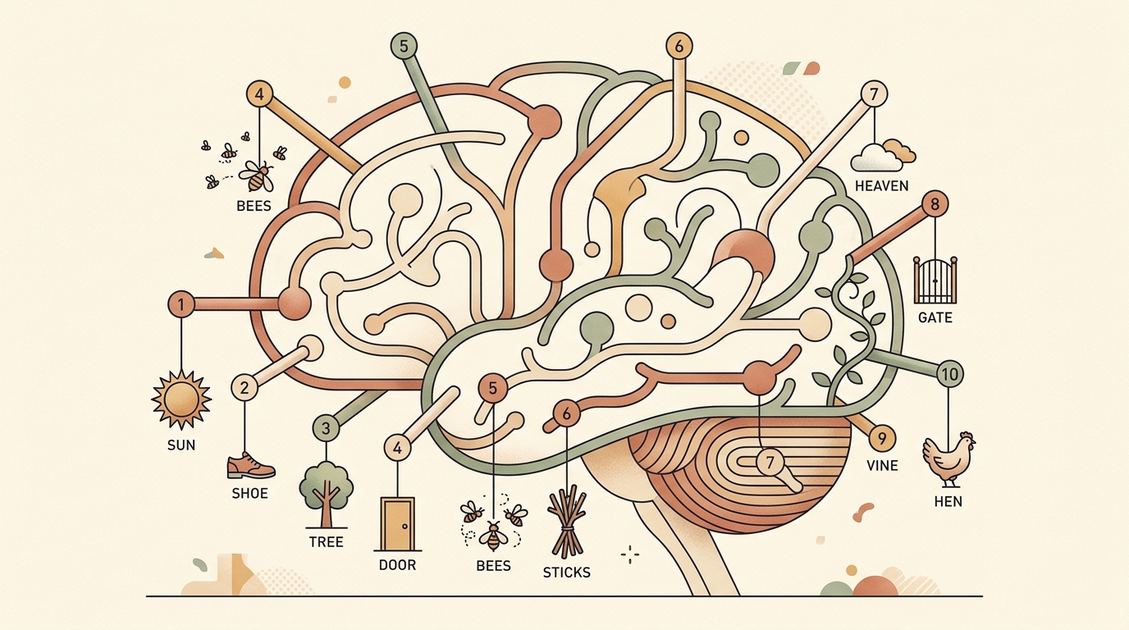
The standard English peg list uses rhyming pairs. You learn them once, and they become permanent mental hooks.
One is a bun. Two is a shoe. Three is a tree. Four is a door. Five is a hive. Six is sticks. Seven is heaven. Eight is a gate. Nine is line. Ten is a hen.
Once these are anchored, you attach anything you need to remember to one of the pegs using a vivid, strange mental image. You want to remember the three branches of government for a civics exam? Don't just read the words. Picture a giant tree with a legislative branch on the left, an executive branch on the right, and a judicial branch somehow growing out of the trunk. Make it absurd. A courtroom inside a tree, judges made of bark.
The system works because it fights the three things that make memory fail: it adds vivid imagery, it gives abstract information a concrete shape, and it provides an ordered structure so you don't just remember the items, you remember them in sequence.
Paivio (1971) called this dual coding, the idea that information stored both visually and verbally is far more durable than information stored through a single channel. The peg word system forces you to build that dual code every time you use it.
Why It Beats Rehearsal for Exams
Most students try to memorize through repetition. You read the same sentence five times. It feels familiar. You mistake that familiarity for knowing it. Roediger and Butler (2011) showed that recognition memory is a poor proxy for recall, and repetition-based study tends to inflate confidence without building the retrieval pathways you need under exam conditions.
The peg word system, by contrast, builds retrieval cues. Each peg is a doorway. Walk back through the hallway in your mind and each door opens to something specific.
It's also fast. Once you've internalized the peg list, you can encode a 10-item study list in under five minutes. You're not grinding through flashcards. You're constructing a story in your head, which is both more effective and, if you're being honest, more interesting than staring at the same page until your eyes glaze over.
How to Use It This Week
Pick up the peg list above. Read it twice. Say it out loud once. You already know most of it from nursery rhymes you forgot you knew.
Now take your next study session and find a list that needs memorizing. A sequence of events in history. The order of cellular processes in biology. The steps of a legal test. Whatever it is, map it onto the pegs.
A few things that help: the more absurd your mental image, the better. Your brain remembers weird. A tree made of congressional buildings is strange enough to stick. A normal tree with a government building next to it is forgettable. Don't be shy about the strangeness.
Also, walk through the sequence at increasing intervals. After 10 minutes, after a day, before your next class. Retrieval practice, as always, is what locks it in.
The Limit
This system shines for ordered lists. It does not help you understand constitutional law. You still have to actually think about the material. But for any exam where you need to reproduce a sequence in order, the peg word system is one of the fastest tools available, and you can learn it in the time it takes to finish this article.
So what do you need to memorize next?
Put the ideas into practice
Use Piply to organize materials and practise what you’re learning.
Try Piply