 iOS App
  Android App
 Study tips
Judgments of Learning: Predict, Test and Check What You Remember
Piply Team
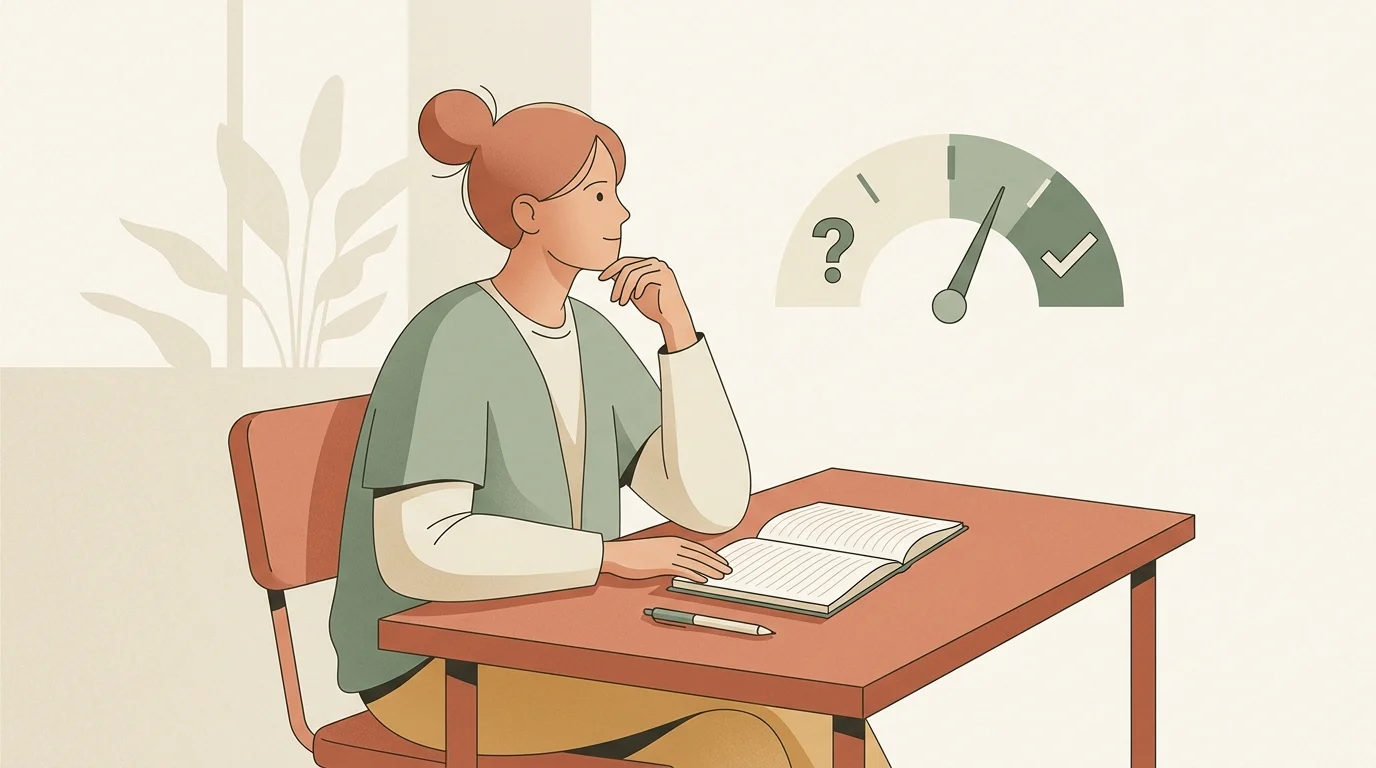
A judgment of learning is a prediction about what you will remember later. You might ask, “How likely am I to recall this term tomorrow without seeing the answer?” The prediction gives you something to compare with a later attempt.
This can be useful when studying for an exam, learning vocabulary or preparing for a professional certification. Confidence is one piece of information. An answer checked against the source gives you another.
What a judgment of learning measures
Decide what you are predicting before rating your confidence. Remembering a definition tomorrow, explaining an argument next week and applying a procedure at work are different tasks. A prediction about one does not establish readiness for the others.
Soderstrom and Bjork’s review (2015) distinguishes performance during practice from longer-term learning. An easy practice session can give an incomplete picture of later retention or transfer. This does not mean rereading cannot help; it means the feeling of ease is insufficient evidence of what you will remember later.
Why the timing and cue matter
Nelson and Dunlosky (1991) studied judgments made immediately or after a delay while people learned paired associates. Delayed judgments made from the cue alone predicted later recall more accurately under their experimental conditions.
Their main accuracy measure concerned which items a person was more likely to recall relative to other items. They also examined absolute prediction accuracy. The result does not establish a universal five-minute delay, guaranteed exam improvement or a single proven memory mechanism. The paper discusses several possible explanations.
A practical application is to put the answer out of view and make a prediction after some intervening activity. Treat the delay as part of a self-check, rather than a precise recipe validated for every learning task.
Try a prediction-and-check session
- Choose a small set of questions with answers you can verify. State the task and when you will attempt it.
- Record a confidence estimate for each question before looking at its answer. Keep the prompt visible if that matches the intended test.
- At the chosen time, answer without opening the source. Use the source or a clear marking rule to check your work.
- Compare predictions with results across several questions. Note omissions, incorrect reasoning and answers you got right despite low confidence.
- Choose what to revisit, then check again on a later occasion. Keep the question format and timing comparable when comparing sessions.
For example, imagine predicting an 80% chance of recalling several vocabulary items tomorrow. Missing one item does not make the prediction invalid: an 80% prediction allows some failures. Look at a group of similarly rated items over repeated checks before drawing a conclusion about your confidence.
Keep the result in proportion
A correct flashcard answer supports that answer under those conditions. It does not establish that you can solve an unfamiliar problem or explain the topic under time pressure. Include those tasks when they matter to your goal.
If you use generated questions in Piply, check their answers against your source. Record confidence separately if you want to compare it with later performance; this article does not establish that Piply automatically measures or improves judgment accuracy.
Choose one topic for your next self-check and write down the question, the planned delay and how you will mark the answer.
Put the ideas into practice
Use Piply to organize materials and practise what you’re learning.
Try Piply