Piply Logo
Piply
study-tips

The Hypercorrection Effect: Why Mistakes on Hard Questions Stick Better Than Easy Ones

The Hypercorrection Effect: Why Mistakes on Hard Questions Stick Better Than Easy Ones

You get a question wrong. Nothing unusual about that. But here's the part nobody tells you: you were sure. Genuinely certain. And that particular flavor of wrong, the confident kind, is the one your brain refuses to let go of.

Psychologists call it the hypercorrection effect. It's quietly one of the most useful findings in the study of learning, and almost no study advice mentions it.

Most people treat mistakes as a single category. Wrong is wrong. You get a question wrong, you look at the answer, you move on. Butterfield and Metcalfe blew that assumption up in 2001 in the Journal of Experimental Psychology: Learning, Memory, and Cognition. They gave people general-knowledge questions and had them rate how sure they were of each answer before showing the correct one. Then they tested everyone again later.

The result was strange. When people were confident and wrong, they almost always remembered the correction on the retest. When they were unsure and wrong, the correction barely stuck. The high-confidence errors got fixed. The low-confidence ones didn't.

That's the opposite of what you'd expect. An answer you were sure about feels stubborn, locked in place, hard to overwrite. But it's the reverse. Confidence plus error produces a memory that wants to update itself.

Why surprise does the heavy lifting

The mechanism is surprise. When reality violates a strong expectation, your brain snaps to attention. Butterfield and Mangels showed in 2003 that high-confidence errors trigger a bigger P3 response, an electrical signal in the brain tied to surprise and the orienting of attention. A wrong guess surprises no one. You suspected it was wrong. A wrong certainty is a genuine violation. And violation is what tells the brain to stop and encode.

Think of it like this. If I tell you the capital of France is Lyon, you'd catch the error instantly. Your reaction would be automatic, almost physical. That little jolt of "that's not right" is the hypercorrection effect firing. Now imagine I correct you on a fact about a city you've never heard of. Nothing fires. No surprise, no encoding. The difference is all in how much you expected to be right.

This is why confident mistakes are so valuable, and why nobody notices them. They happen fast. You mark an answer, see you're wrong, feel a quick flash of annoyance, and move on. But that flash is the learning. The annoyance is the signal. You've been treating it as noise.

The guess teaches you almost nothing

Here's the uncomfortable part. A low-confidence wrong answer, the classic wild guess, does almost nothing for you. You were already unsure, so being wrong just confirms what you suspected. No violation, no surprise, no memory boost.

This matters because students spend huge amounts of time in exactly that zone. Guessing. Shrugging. Checking the answer. Moving on. All of it gets filed under "reviewing," but it's barely learning. The high-value moment is the confident miss, and most people rush straight through it.

A concrete example. Say you're studying biology and you mix up mitosis and meiosis. You're confident it's mitosis that produces four cells. You answer, you check, you're wrong. That specific correction will stick for weeks. Now say you're studying the same chapter and you genuinely don't know what a chromosome is. You guess. You're wrong. You read the definition. Two days later it's gone. Same chapter, same evening, wildly different outcomes. The difference is confidence.

It's not confidence alone

Sitzman, Rhodes and Tauber complicated the picture in 2014 in Memory & Cognition. They found that what really predicts whether you'll fix an error isn't confidence on its own. It's prior knowledge. People who know a lot about a subject correct their high-confidence errors better than people who know little.

That makes sense once you think about it. Surprise works best when there's a structure to slot the correction into. A confident mistake in a subject you understand is a hole being filled. A confident mistake in a subject you don't understand is just noise with nowhere to go. The correction has no shelf to sit on.

So the effect compounds. The more you know, the more useful your confident errors become. Students who already built a base get the most out of it. It's a multiplier on top of knowledge, not a shortcut.

What this means for how you study

The hypercorrection effect isn't a trick for memorizing trivia. It's a signal about where your study time is worth the most. The errors you should care about are the ones that sting. The "I could have sworn" moments. Those are the gaps you can actually close.

Cyr and Anderson pushed on this in 2018 in Memory. They looked at when errors help versus when they just happen. Their conclusion: an error helps when you actually process the feedback, not when you glance at it. The confident error matters partly because it makes you slow down and read the correction. A guess doesn't create that pause. So the effect is about attention as much as surprise. Two halves of the same thing.

The practical lesson falls out of that. You can't benefit from the hypercorrection effect if you never commit to an answer before checking. And you can't spot your confident errors if you never write down how sure you were.

How to use this

Commit before you check. The effect dies the second you peek. You need to produce a real answer first, even a wrong one. On a flashcard or a practice problem, answer, then check. Peeking kills the surprise.

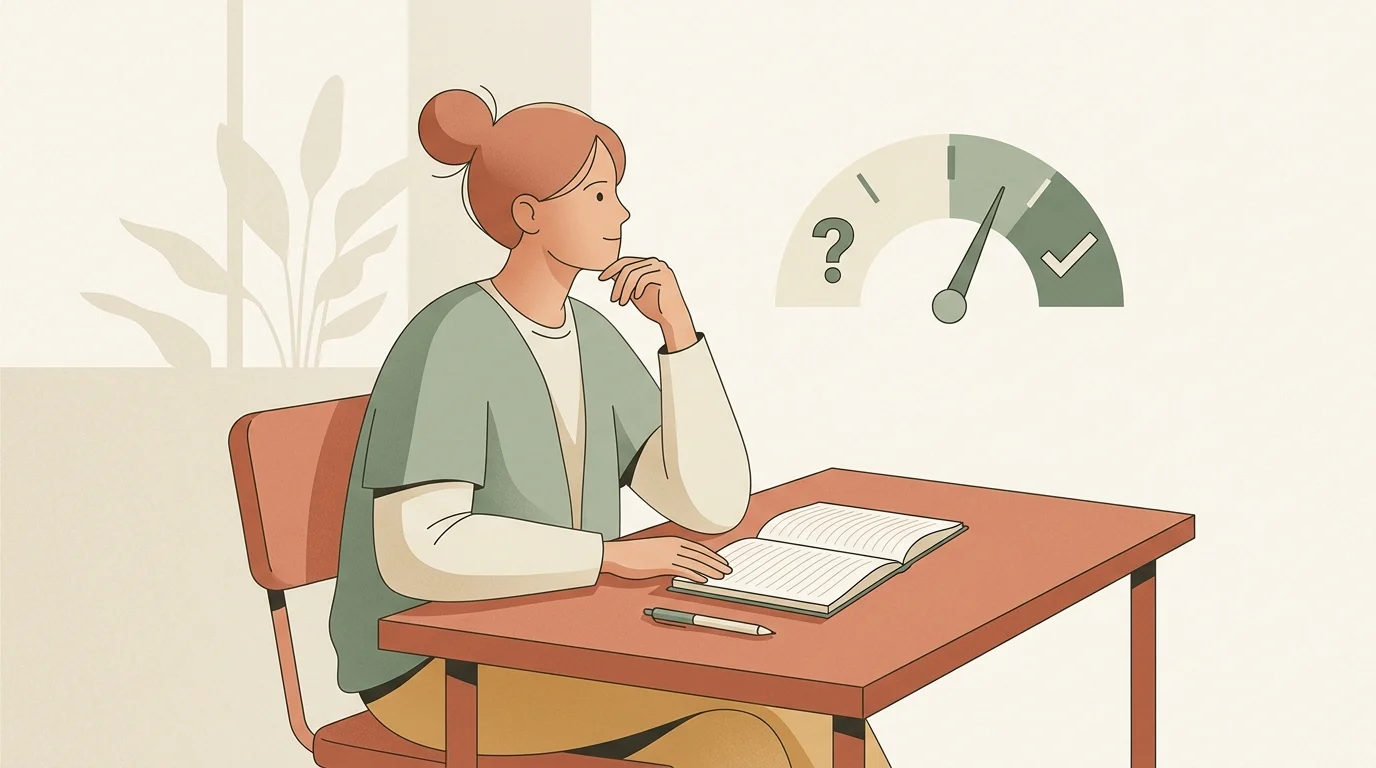
Rate your confidence. Before you check, give your answer a number from 1 to 5. Two seconds. It's the step everyone skips, and it's the only way to tell a confident miss from a guess later. Without the rating you can't find the errors worth keeping.

Linger on the "I was sure" moments. When you're confident and wrong, stop. Don't swipe past. Read the correction twice. Ask why you were wrong. That's the exact second your brain is primed to encode, and most people blow through it on the way to the next card.

Don't manufacture hard questions. This one runs against instinct. You can't fake the effect by jumping to the hardest material where you'll guess wrong all day. Guessing wrong is low-confidence by definition and teaches little. The effect needs real confidence built on real knowledge. Work at the edge of what you know, not miles past it.

The part that surprises people

The through-line is odd enough that it's worth saying straight. Confidence is the thing that makes an error useful. Not effort. Not how long you stare at a card. Confidence. We usually treat confidence as a liability, something that makes us wrong and stubborn. In learning it's the opposite. Confidence is what turns a mistake into a lesson.

And that flips how you should feel about getting things wrong. The answers that hurt, the ones where you slam the desk and say "I knew that," are your best study material. Not the ones you guessed on. The confident misses.

Think about the last exam you got back. Which questions stung the most? The ones you were sure about. Now, honestly, which answers do you still remember? If the effect holds, it's the exact ones that stung. So here's my question: what's one thing you were confidently wrong about recently, and did the correction stick?

Ready to try Piply?

Turn this article into your reality. Start studying faster today.

Try Piply for Free