 iOS App
  Android App
 Study tips
The Generation Effect: Produce an Answer, Then Check It
Piply Team
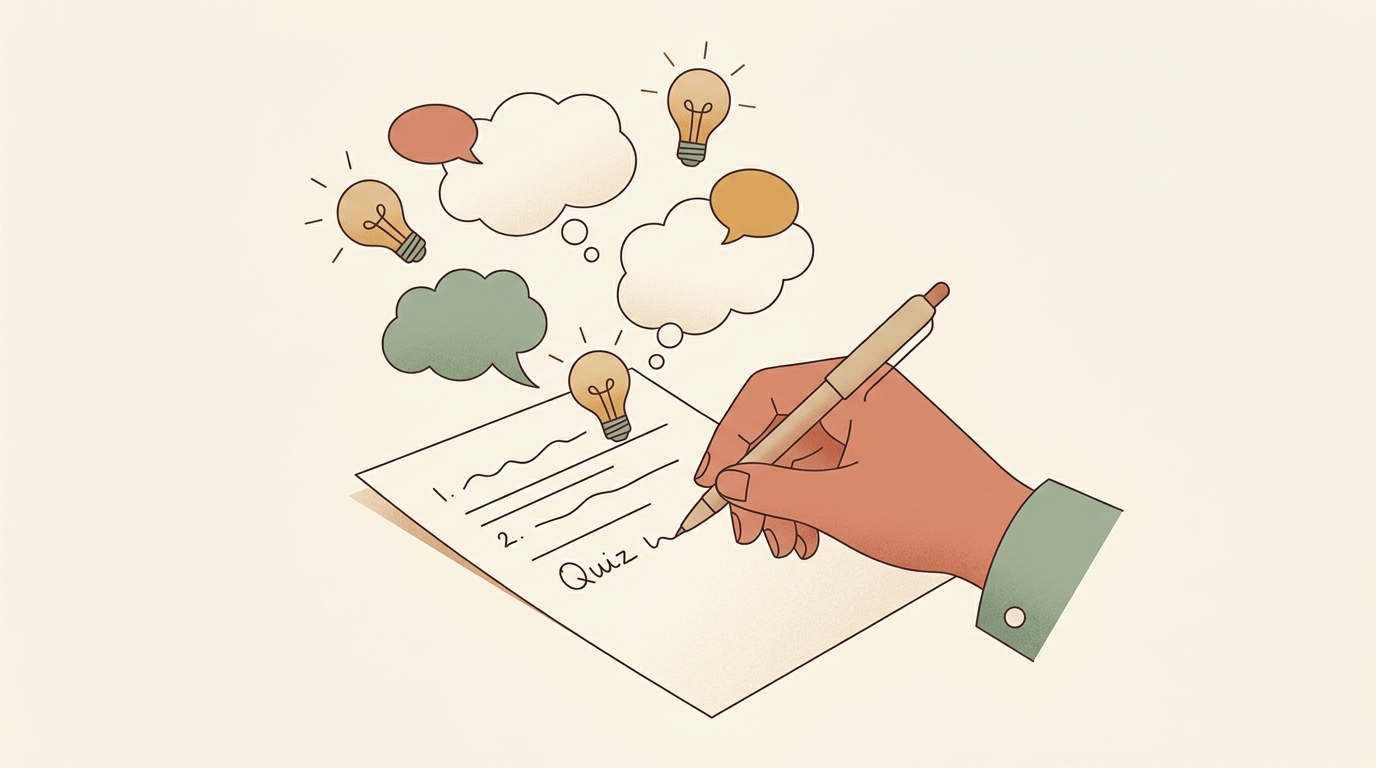
Generating an answer gives you something concrete to check: the word you supplied, the explanation you wrote, or the calculation you completed. You can compare it with a reliable source and decide what needs another attempt.
The generation effect concerns memory for information people produce themselves compared with information they read. It does not mean that every self-made question is better than a textbook question, or that reading is wasted time.
What generation-effect research studied
In his 1992 retrospective account, Norman Slamecka described the five word-memory experiments he published with Peter Graf in 1978. Participants generated a target word using a cue, its first letter and a relationship rule, or read the supplied word. For example, a cue could ask for an opposite. Generated words were better remembered across the experiments. This was constrained word production, not a comparison of whole study routines.
A 2007 meta-analysis by Bertsch and colleagues combined 445 effect sizes from 86 studies. It found an average memory advantage for generation over reading, with substantial variation across tasks and test conditions. Its standardized effect size of 0.40 is not a 40% improvement in grades.
What the finding does not establish
The meta-analysis examined memory tests such as recognition and recall. It excluded some populations and materials, including clinical samples and bilingual participants. Its results cannot guarantee that making your own summaries or quiz questions will outperform every alternative.
The authors also found that effort alone was an insufficient explanation. Making a task more frustrating is not a reliable way to improve it.
Generating a response during learning and retrieving something previously learned are different activities, though a study task can include both. Writing a question, answering it from memory and correcting it are separate decisions. Choose each one for the material you need to learn.
Try one response and check it
This is an optional study routine, not a protocol tested by the cited papers:
- Read a short section or inspect a worked example. Identify the idea or procedure you need to use. Keep an example available if you are still learning the basics.
- Produce one response. Explain a term in your own words, complete a missing step, or try a related problem. If you write a question, make the expected answer clear.
- Compare your response with the source or marking criteria. Correct missing conditions, wrong steps and unsupported details. Ask for help if the source does not resolve the uncertainty.
- Later, try a fresh question or example without viewing your previous response. Check it again to see what you can recall or apply.
For SQL, you might write a query for a stated condition, then compare the returned rows with the expected result. For biology, explain a process and check whether you included its essential stages. These are practice examples, not findings from the word-memory experiments.
Keep reading and feedback available
Use a supplied example when you need one. You do not have to invent every practice question. If generating questions takes most of your session, try an existing question and spend the time checking your answer instead.
You can keep your responses on paper, in a document or alongside your notes. The useful record is the task, your response, the correction and the next thing to check. A feeling of difficulty does not tell you whether the answer is accurate or whether you can use it later.
Put the ideas into practice
Use Piply to organize materials and practise what you’re learning.
Try Piply