 iOS App
  Android App
 Study tips
Distributed Practice for Math: Why Spreading Problem Sets Out Beats One Long Session
Andy Anderson
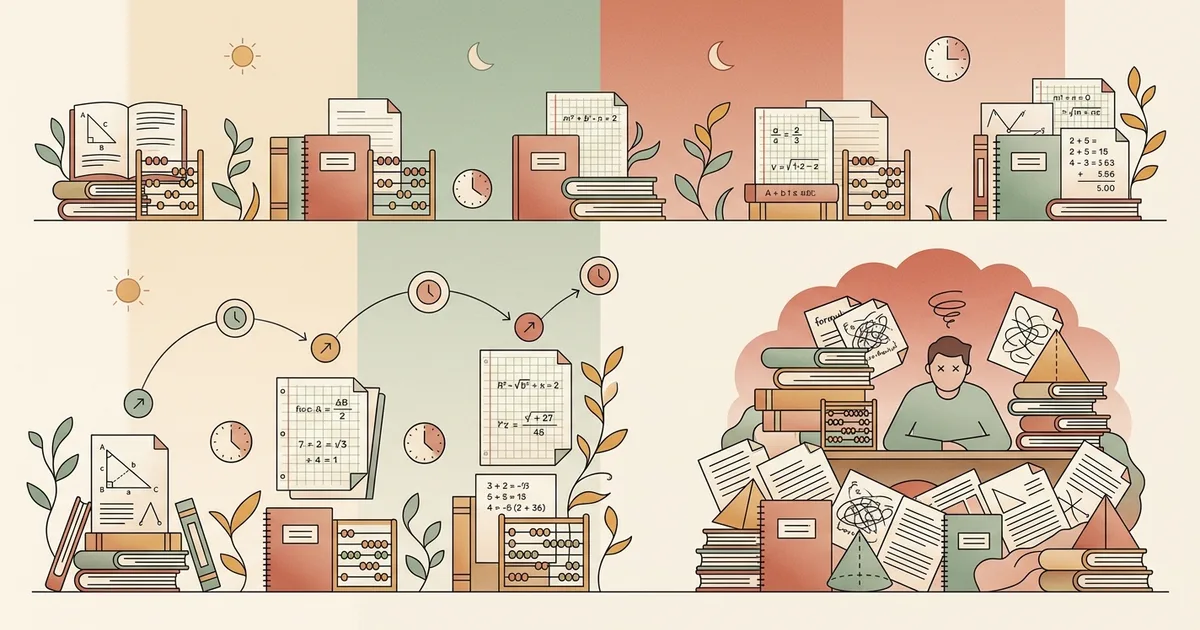
It's 11 PM. The math test is tomorrow. You've got forty problems left and a half-empty coffee mug. The logic feels airtight: more hours now equals a better score in the morning.
Your brain disagrees.
There's a learning principle that's been tested for over a century, and it keeps showing up in study after study. Spreading your practice across multiple sessions beats cramming. By a lot. The weird part is how much of a difference it makes, and how few students actually do it.
The difference comes from how memory behaves after time passes. Math practice works better when the brain has to reconstruct a method, not just repeat it while the answer path is still warm.
The Spacing Effect Isn't a Tip
In 2006, a study by Cepeda, Pashler, Vul, Wixted, and Rohrer put this to a direct test. They had adults learn math computations, then tested them at different intervals. The group that practiced across multiple sessions, even when the gap between sessions was weeks long, remembered more than the group that crammed. The crammed group did fine the next day. Then everything fell apart.
Rohrer and Pashler ran a follow-up in 2007 specifically looking at math. Same result. Spaced practice produced better long-term retention of arithmetic problems. The effects held even when total study time was matched across groups. This wasn't about working harder. It was about working in the wrong shape.
Dunlosky and colleagues reviewed decades of learning research in 2013 and ranked distributed practice as one of the highest-utility study strategies. Practice testing sat beside it. Combined, these two account for most of the real learning gains you'll see in school. Everything else is decoration.
And the original work goes back further than you might think. Bahrick and Hall tracked Spanish vocabulary learners in 1991 and found that people who distributed their study sessions over months retained far more after five years than people who crammed the same hours into weeks. Five years. We're not talking about next week's quiz.
Why Spaced Practice Works
Your brain treats forgotten information like a problem to solve. When you encounter a problem you've half-forgotten and reconstruct it, the memory gets stronger than if you'd just reviewed it while it was fresh. There's a window where retrieval feels hard. That struggle is the mechanism.
A few things are happening under the hood.
Encoding variability means each session stores the idea in a slightly different context. More retrieval cues. More ways back in.
Consolidation means the brain gets downtime between sessions to stabilize what you practiced. Sleep is doing real work here.
Effortful retrieval means a slow answer, a wrong first attempt, or a messy reconstruction can strengthen memory more than smooth review.
Forgetting, weirdly, is part of the design. If you come back while the problem is still obvious, you don't have to rebuild anything. If you come back after it has faded a little, your brain has to work.
This is why rereading a worked solution feels productive. It isn't. You're recognizing the path, not walking it.
Where Math Students Go Wrong
Most math practice happens in the wrong direction. Students open the textbook, do a problem, check the answer, and move on. When they get stuck, they look at the solution immediately. The answer is right there. The struggle never happens. The memory never forms.
Then they finish the problem set, feel tired, and call it studied.
Compare that to a student who does five problems, closes the book, comes back tomorrow, and has to reconstruct the method from scratch. The second student is doing more cognitive work per minute. That work is what builds retention.
The mistake is thinking that coverage equals learning. Twenty problems solved with the answer key open teaches you almost nothing that survives the week.
How to Use This
Here's a spacing setup that actually works for problem sets.
Step one. Break the set into halves or thirds. Don't try to do all 30 problems in one sitting. Pick 10 today.
Step two. Wait a day. Tomorrow, do a different 10. Don't review the first 10 yet. Do new ones.
Step three. On day three, return to day one's problems cold. No peeking. This is where retrieval happens. The struggle is the point.
Step four. On day four, work the remaining problems and revisit any that gave you trouble on day three.
Step five. The day before the test, do a mixed set. Pull from all three batches. This is your retrieval practice layer.
The total time across four days is similar to one long session. The retention is not similar at all.
Two adjustments matter.
If the material is procedural, like integration steps, shorter gaps work. A day between sessions is usually enough.
If the material is conceptual, like understanding why a proof works, spread it wider. A week between touches forces deeper reconstruction.
Cepeda's 2006 work suggests the optimal gap depends on how long you need to remember. If the test is in a week, space practice over a few days. If the test is in a month, space it over weeks. Match the gap to the goal.
So when you sit down to study tonight, the question isn't only how long. It's when you'll come back to it.
The Objection Everyone Has
But I have too much to learn and not enough time.
I hear this a lot. And the research is pretty direct here. Cramming produces short-term performance that looks like learning. It isn't. You score okay on the test, then two weeks later you can't do a single problem. The total amount of time you end up spending across the semester gets higher because you keep having to relearn.
Distributed practice is faster in the long run, even when it feels slower in the moment.
One more thing. Don't space everything evenly. That gets boring fast. Mix in a hard session after a few easy ones. Take a day off when your brain is fried. The schedule above is a starting point. Adjust it to your life. The principle holds even when the calendar doesn't.
What's the math topic you've avoided because cramming didn't work?
Put the ideas into practice
Use Piply to organize materials and practise what you’re learning.
Try Piply