 iOS App
  Android App
 Study tips
Breathwork Before an Exam: A 90-Second Technique Backed by Vagal Nerve Studies
Piply Team
Your heart is pounding. Your palms are slick. The exam paper sits face-down on the desk in front of you and your brain feels like it's been replaced with static. You studied. You know this stuff. But right now, your body is screaming danger signals so loud that nothing else gets through.
Here's what most students don't know: you can flip that switch in about 90 seconds. Not by "calming down." Not by positive affirmations. By breathing in a way that directly talks to your nervous system.
The Nerve Nobody Told You About
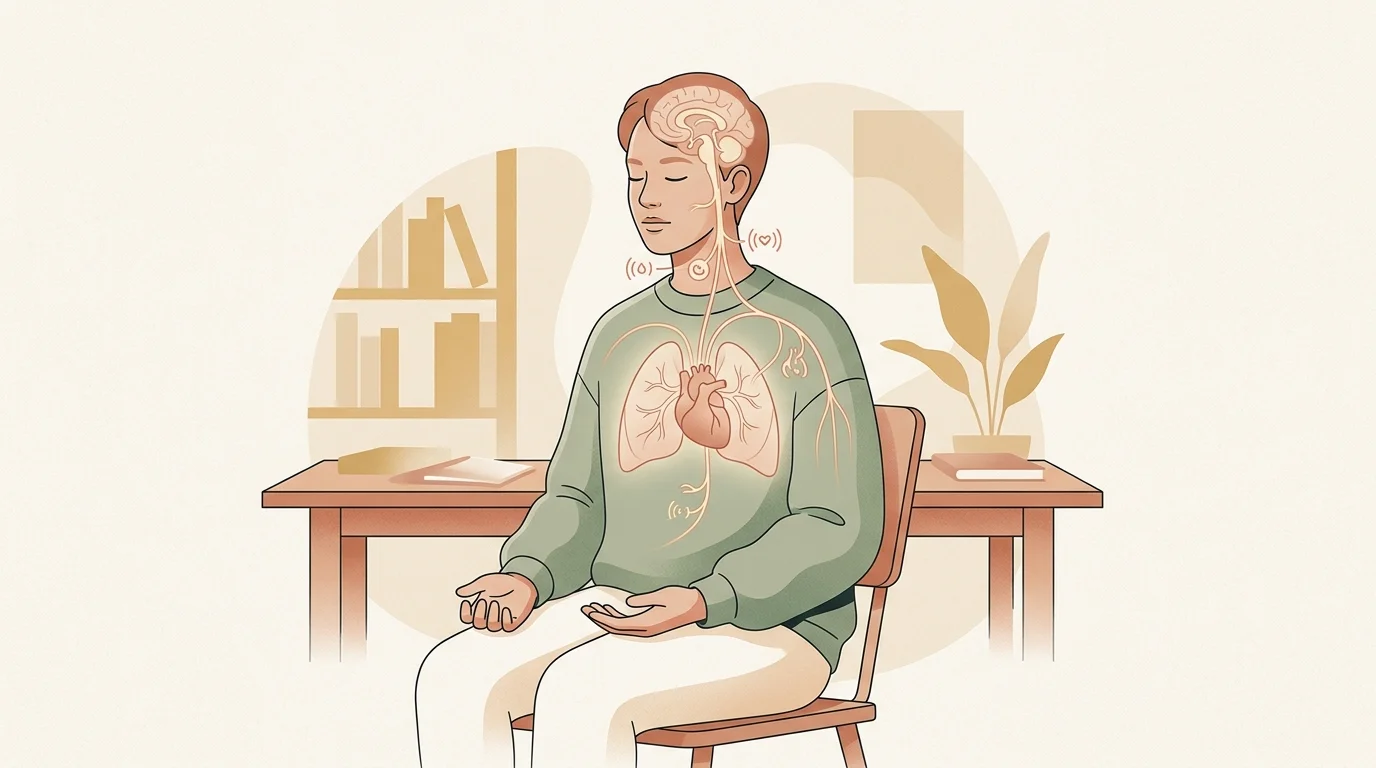
There's a nerve that runs from your brainstem down through your neck and chest, weaving into your heart, lungs, and digestive system. It's called the vagus nerve, and it's the main highway of your parasympathetic nervous system, the branch that puts the brakes on your stress response.
When you're sitting outside the exam hall with your heart racing, your sympathetic nervous system has hijacked the controls. Cortisol is up. Heart rate variability is down. Your prefrontal cortex, the part of your brain that handles reasoning and recall, is effectively getting drowned out by the amygdala screaming threat, threat, threat.
The vagus nerve can shut this down. But you have to stimulate it the right way.
Most people try to calm themselves by taking a deep breath. The problem is, a big gasp of air actually activates the sympathetic branch. It's the exhale that matters. Specifically, a slow, extended exhale.
Why Your Exhale Is a Remote Control
In 2018, Zaccaro and colleagues published a systematic review in Frontiers in Human Neuroscience examining what slow breathing does to the body. The finding that keeps showing up across studies: breathing at roughly 6 breaths per minute, with a longer exhale than inhale, reliably increases heart rate variability and shifts the autonomic nervous system toward parasympathetic dominance.
The mechanism is surprisingly straightforward. When you inhale, your diaphragm drops, your chest expands, and your heart rate ticks up slightly. This is called respiratory sinus arrhythmia, and it's completely normal. When you exhale slowly, your heart rate drops. That drop sends a signal back up the vagus nerve to your brainstem. The message is simple: we're safe. The threat system dials down in response.
Gerritsen and Band, also in Frontiers in Human Neuroscience in 2018, gave this a name: the "respiratory vagal stimulation model." The idea is that slow, deliberate exhales are the most direct way a person can voluntarily influence vagal tone. No meditation experience needed. No years of practice. Just breathing with attention to the exhale.
And this isn't abstract neuroscience. Steffen and colleagues ran a study in 2017 with medical students, a group that knows something about high-stakes exams. They had students practice HRV biofeedback, which relies on the same slow-breathing mechanism, before their tests. The students in the breathing group showed measurably lower anxiety and higher perceived control compared to controls. Same study time, same preparation. The only variable was what they did with their breath in the minutes before the exam.
A separate 2021 study by Balban and colleagues, published in Cell Reports Medicine, tested different breathing protocols head-to-head. Their finding: cyclic sighing, where you inhale twice through the nose and exhale slowly through the mouth, produced the largest improvement in mood and the largest reduction in respiratory rate compared to other techniques. Two inhales, one long exhale. That's the pattern that moved physiological markers the most.
The 90-Second Protocol
So what does this look like when you're actually sitting there, exam paper still face-down, trying not to spiral? Here's the sequence:
Inhale through your nose for 4 seconds. Exhale through your nose or mouth for 6 seconds.
That's one cycle. Ten seconds. Six breaths per minute, right in the sweet spot that Zaccaro's review identified. Do this for nine full cycles and you've put in 90 seconds of deliberate vagal stimulation.
If 4 and 6 feels too long at first, start with 3 and 5 and ease your way up. The ratio matters more than the exact count. Your exhale should be noticeably longer than your inhale. That's the part that activates the vagus nerve.
Don't force the breath. Don't gasp on the inhale or push hard on the exhale like you're blowing up a balloon. Quiet, steady, unremarkable. Breathe like you're trying not to wake someone sleeping in the next room.
You can mix it up depending on how you feel. The cyclic sighing approach Balban's team tested adds a second short inhale before the long exhale. So: inhale, then a quick top-up inhale, then a full 6-second exhale. Some people find this more satisfying when anxiety is running high. Try both and see which one your nervous system prefers.
Nobody Needs to Know
Here's the practical advantage: you can do this anywhere and nobody will notice. Sitting in the exam hall waiting for the signal to start. Standing in line outside the testing center. At your desk the night before when sleep isn't coming. You look like a person sitting quietly. Meanwhile, you're manually dialing down your stress response one exhale at a time.
You can even use it mid-exam. Hit a question that spikes your anxiety, feel the familiar chest tightening, and take 30 seconds to breathe before you come back to it. That's not lost time. That's reclaimed bandwidth. Panic eats far more time than breathing does.
Timing Is Everything (Mostly)
There's a nuance worth flagging. You can't wait until you're in a full-blown panic attack. Once the amygdala has completely hijacked the sympathetic system, getting back to baseline takes longer, and those first few cycles of slow breathing can feel genuinely uncomfortable. Your body wants to breathe fast because it thinks there's a threat.
Start before the spike. Five minutes before you walk into the room. Right after you sit down but before the paper lands on your desk. Even the night before, if pre-exam insomnia is your particular curse. The vagus nerve doesn't care what the clock says. It responds to the exhale every time.
What to Skip
Skip the 20-minute YouTube guided breathwork videos if you're prone to overthinking. Some of them are beautifully produced, and then you spend three minutes wondering if you're doing it right, another minute reading the comments, and suddenly the exam starts in four minutes and you've achieved nothing but phone anxiety.
Also skip the apps that want a monthly subscription for "premium breathing." Your lungs don't need a software license. The mechanism is already installed.
And don't hold your breath between cycles. Some breathing techniques involve extended breath holds, which can spike sympathetic activity in people who are already wired. If you're anxious, holding your breath just confirms to your nervous system that something is wrong. Long exhale, gentle inhale, no holds.
Why This Actually Works for Recall
Students who use breathwork before exams don't just report feeling calmer. They often say they can actually get to what they studied. The material feels closer, more available, less like it's behind a fog.
The neurobiology backs this up. The prefrontal cortex needs the limbic system to settle before it can do its job. Recall isn't just about whether the memory trace exists. It's about whether the retrieval pathways are accessible under pressure. High sympathetic activation narrows those pathways. It's not that the information disappeared. You can't get to it.
Slow breathing clears the road. You're not changing what you know. You're making it reachable.
For 90 seconds of investment, the return is hard to beat. Less panic. Better access to what you actually studied. A nervous system that's working with you instead of against you.
How do you handle the minutes right before an exam starts?
Put the ideas into practice
Use Piply to organize materials and practise what you’re learning.
Try Piply