Piply Logo
Piply
study-tips

Spaced Repetition vs Massed Practice: The Long-Term Memory Advantage Explained

Spaced Repetition vs Massed Practice: The Long-Term Memory Advantage Explained

You know that feeling. It's the night before the exam, and you've been staring at the same chapter for three hours. Your eyes hurt. Your coffee is cold. But you're going to get through this if it kills you. You read the same page twice. Then a third time. By hour four, you can almost recite it.

You pass the exam. You forget everything by next week.

This isn't a failure of effort. It's a failure of strategy. What feels like intense, productive studying is actually one of the least effective ways to build memory that actually lasts. And the research has been saying this for over a century.

The Problem With Marathon Sessions

In 1885, Hermann Ebbinghaus sat down and memorized nonsense syllables. Thousands of them. He tested himself obsessively over weeks, tracking exactly how quickly he forgot what he'd learned. What he produced was the forgetting curve, and it remains one of the most important findings in all of cognitive psychology. The curve showed that memory drops sharply within the first day, then levels off gradually. Without intervention, most of what you learn vanishes within a week.

Here's the part that matters: the shape of that curve depends entirely on how you review the material.

When you cram, you experience what's called a massed practice session. You compress a huge amount of exposure into a single, exhausting block. Your brain recognizes the information instantly because it was just there. This fluency feels like mastery. It isn't. You've essentially told your memory system, "I'll need this for tomorrow," and your brain has obliged by holding it just long enough.

Roediger and Butler (2011), writing in Trends in Cognitive Sciences, describe the testing effect, which shows that the act of retrieving information strengthens memory far more than passively reviewing it. Massed practice gives you almost no retrieval practice. It gives you the illusion of fluency and none of the substance.

What Spacing Actually Does

Now consider the opposite approach. Instead of studying the same chapter for three hours straight, you spend 30 minutes on it on Monday, 20 minutes on Wednesday, and 15 minutes on Friday. Same total time. Completely different outcome.

Cepeda and colleagues (2006) ran a meta-analysis covering 317 experiments to find out exactly why. Their paper, published in Psychological Bulletin, found that spacing out study sessions produced dramatically better long-term retention than the same number of sessions crammed together. The effect was consistent across age groups, subject matter, and task types.

Why does it work? The mechanism is called the spacing effect, and it comes down to a simple principle: when you review material just as you're starting to forget it, the act of remembering is harder. That difficulty is the point.

Bjork (1994), in Learning, Remembering, Believing, introduced the concept of desirable difficulties. The idea is that learning feels harder when you space your practice, space your review, or test yourself instead of rereading. These difficulties are desirable because they lead to stronger, more durable memory traces. Your brain has to work harder to retrieve the information, and that effort is what makes the memory stick.

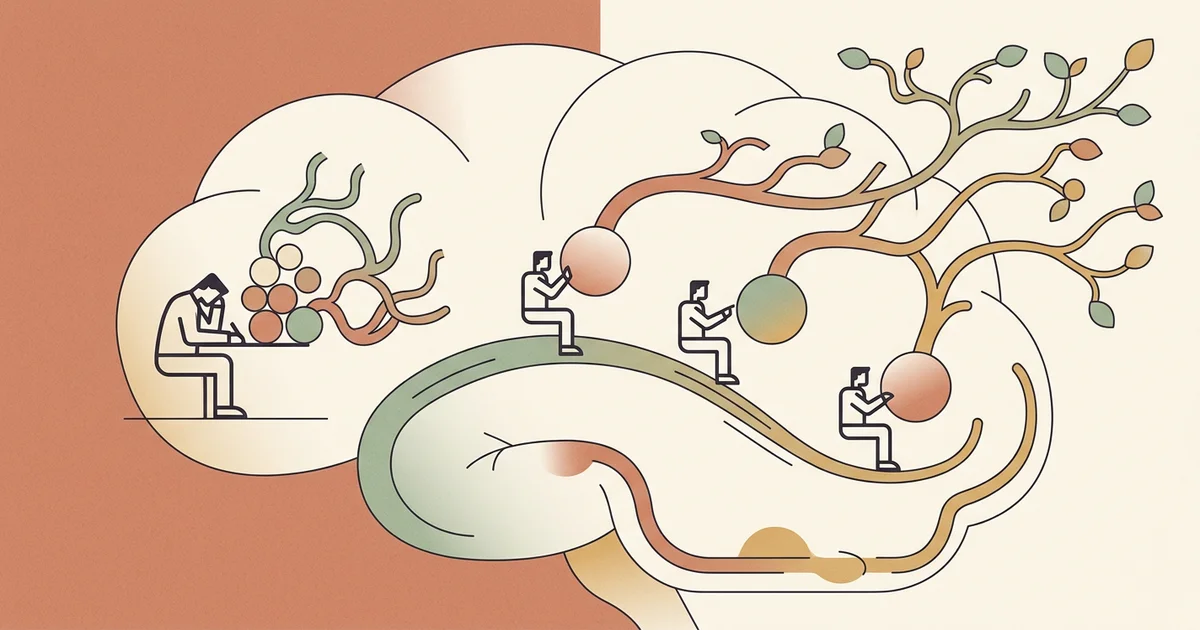
Think of it like this. Walking a well-paved path through a field once won't leave a trail. Walking the same path ten times over several weeks will. Memory works the same way. The groove gets deeper each time you retrieve something, but only if you wait long enough that the path has started to fade.

The Consolidation Argument

There's a biological layer here that makes the case even stronger. During sleep, your brain replays and strengthens the neural connections formed during the day. This process, called memory consolidation, is how short-term information gets transferred into long-term storage. When you space your study sessions, you're giving your brain multiple consolidation windows. The information gets reactivated, refined, and integrated each night.

Massed practice doesn't give you that. You study for four hours, sleep, and by morning the consolidation window has done what it can with a single pass of heavily repeated material. Spaced practice gives you several passes. Several nights. Several chances for the brain to say, "this matters enough to keep."

This is why students who space their study across weeks routinely outperform students who cram, even when the cramming student has logged more total hours. The cramming student has more exposure. The spacing student has more consolidation.

How to Use This

The theory is one thing. Actually changing how you study is another. Here's what you can do starting today.

1. Frontload your calendar, not your brain. Don't try to study everything the week before the exam. Instead, map out your syllabus at the start of the term. Identify when you'll encounter each major topic. Schedule at least three review sessions for each one: one within a day or two of first learning it, one about a week later, and one a couple of weeks after that. This is the minimum viable spacing schedule.

2. Use an active recall system. Don't just flip back through your notes. Close the book and write down everything you can remember. When you get stuck, look at the material, then close it again and try once more. This retrieval attempt is where the real learning happens. Spacing combined with retrieval practice is the one-two punch that Bjork's research consistently identifies as the most powerful combination.

3. Let forgetting happen. This is the counterintuitive part. When you come back to material and it feels difficult, that's the desirable difficulty kicking in. Don't panic. Don't reread immediately. Stay with the struggle. The effort of retrieving a half-forgotten answer is exactly what builds durable memory. If you can retrieve it immediately, you've waited too long and should push your next review further out.

4. Keep a spacing journal. Write down what you studied and when you reviewed it. Set a calendar reminder for your next pass. Apps like Anki automate this using a spaced repetition algorithm, but a simple spreadsheet or paper notebook works just fine if you prefer something low-tech.

5. Prioritize your hardest material for spacing. The spacing effect is strongest for information that is difficult or complex. Simple, already-familiar material doesn't benefit as much. Save your spaced sessions for the concepts that genuinely challenge you.

The Honest Truth About Effort

There's an uncomfortable part to all of this. Spaced practice feels worse than massed practice. It feels slower. Less productive. Less satisfying. Your brain sends very convincing signals that the cramming approach is working, because the fluency is real in the moment. This is called the fluency illusion, and it's one of the main reasons people keep cramming despite knowing it doesn't work.

Ebbinghaus knew it in 1885. The data has only gotten stronger since.

The students who build real expertise aren't necessarily the ones who study the longest. They're the ones who study in a way that respects how memory actually works. Spacing is the single most evidence-backed adjustment you can make to your learning habits, and it costs nothing except the comfort of familiar, ineffective routines.

What would your study schedule look like if you planned it at the start of the term instead of the night before?

Ready to try Piply?

Turn this article into your reality. Start studying faster today.

Try Piply for Free