 iOS App
  Android App
 Study tips
PQ4R: A Pre-Reading Method From 1976 That Outperforms Most Modern Study Guides
Piply Team
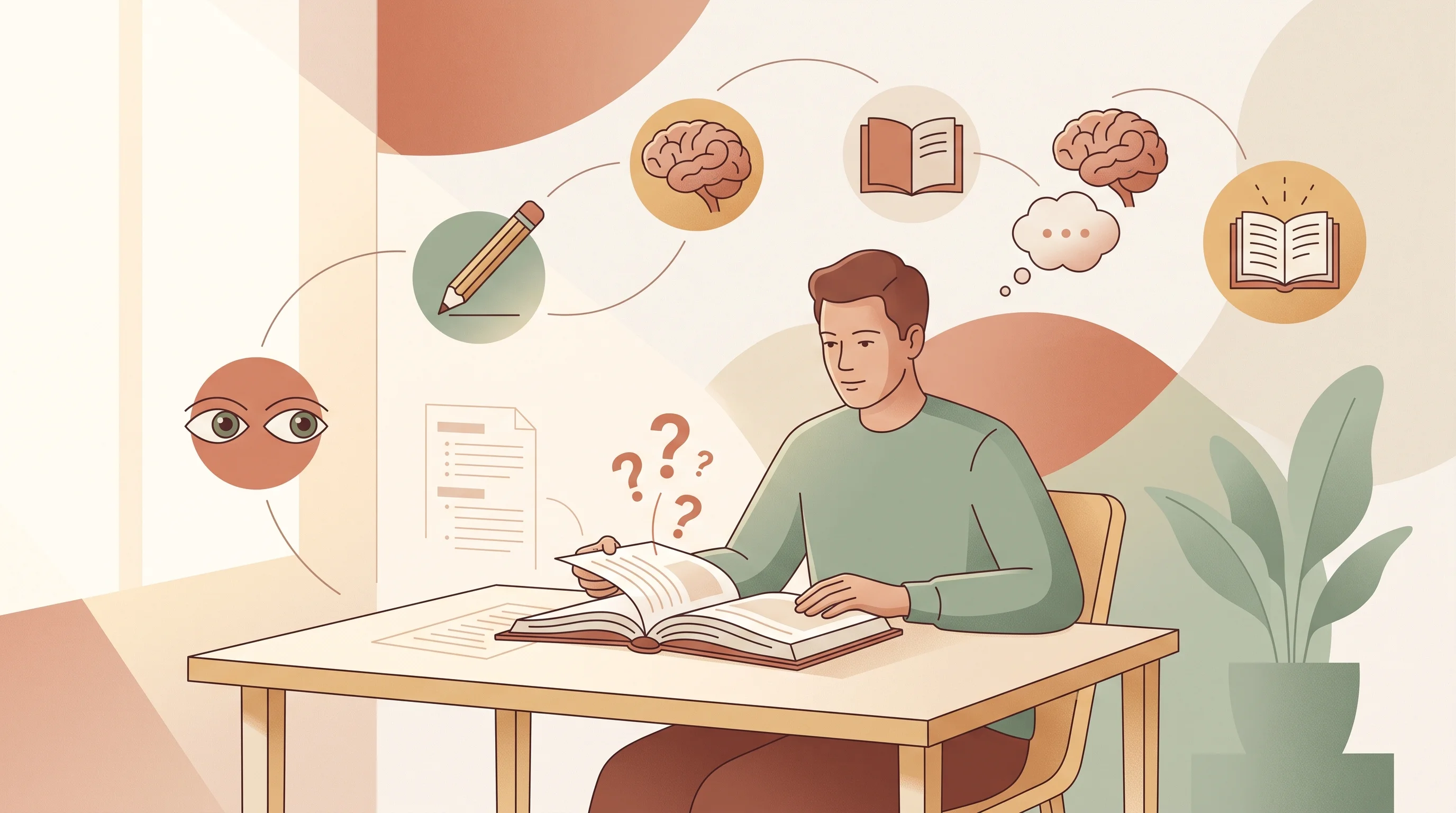
You open your textbook. You start reading from the top. You get to the bottom of the page. Nothing stuck. So you read it again.
That's not studying. That's just moving your eyes over words.
Thomas and Robinson introduced the PQ4R method in 1976 as a systematic answer to exactly this problem. Preview, Question, Read, Reflect, Recite, Review. Six steps. And research keeps showing it outperforms most things that came after it.
Why Previewing Feels Like Cheating
The first step is controversial because it feels wrong. You're supposed to skim the chapter before you actually read it. Look at the headings. Read the bold terms. Check the summary questions at the end. Maybe glance at the first sentence of each paragraph.
Your instinct is to skip this and get to the "real" work. But that's backwards.
When you preview, you give your brain a framework before you encounter new information. You're not trying to understand everything. You're building a mental scaffold. When you then read the chapter, your brain has somewhere to hang the new facts. Without that scaffold, new information tends to bounce around short-term memory and then vanish.
Francis and York (2010) found that students who previewed a text showed significantly better comprehension on subsequent tests compared to those who jumped straight in. The effect was strongest when the preview included the chapter's main questions.
The Question Step Changes How You Read
Before reading each section, you turn the heading into a question. Not a statement. A question.
If the heading says "The Calvin Cycle," you ask yourself: "What happens in the Calvin cycle?" If it says "Market Failure," you ask: "What exactly causes markets to fail?"
Now you've turned reading into a search mission. You're not passively receiving information. You're hunting for something specific. That changes the nature of attention in a way that's hard to replicate by just reading harder.
This sounds simple. It is simple. And that's the point.
Reading Becomes Active (If You Let It)
The third step is just reading. But here's the thing most students miss: you're supposed to look for the answer to your question. When you find it, you note it somehow. When something confuses you, you mark it and keep moving.
You don't stop on the confusing part. You keep going, get the overall picture first, then come back. This prevents the spiral where you spend twenty minutes on paragraph three and never finish the chapter.
Nist and Kirby (1986) documented that the question-generation step alone produced measurable gains in comprehension because it kept readers actively evaluating what they understood as they went. Passive reading is just words entering one ear and leaving the other.
Reflect is Where It Actually Gets Interesting
This is the step most students skip entirely, and it's the reason PQ4R outperforms systems that focus purely on review.
After reading a section, you close the book and think about it. What did this actually mean? How does it connect to what you already know? Why is the author making this point?
This sounds vague because it kind of is. That's fine. The vagueness is the point. Your brain does its best integration work when you're not following a strict script. You're looking for the "so what" of what you just read.
When you can connect new information to existing knowledge, it stops being arbitrary and starts being meaningful. Meaningful information is harder to forget.
Reciting Exposes Every Gap
Close the book. Actually close it. Now explain the main points out loud, as if you were teaching someone.
You will immediately notice the holes. There are always holes. You'll think you understood something until you try to say it without looking. That's the gap between recognition memory and recall memory. Recognizing words on a page is a completely different skill than retrieving them from memory. Tests use recall. So should you.
The nice thing about finding gaps while you're still in the chapter is that you can still fix them. You'll know exactly what to re-read.
Review Ties It Together
After you finish the whole chapter, you do a final pass. Close the book, try to recite everything you can, then re-read only the parts that were shaky.
Many students stop here. They think the work is done. It's not. A quick review the next day is what moves this from short-term to long-term memory. Without that follow-up, you're relying on the material staying accessible in your head long enough for the exam. You shouldn't rely on that.
Why This Still Works Better Than Most Modern Systems
Here's what PQ4R gets right that most study systems miss: it solves the comprehension problem at the source. Most modern tools like flashcards and spaced repetition are output mechanisms. They help you retrieve information you've already processed. But if you never processed it deeply in the first place, retrieval practice just helps you practice not knowing it faster.
PQ4R's first three steps. Preview, Question, Read. are all about the initial encounter with new material. Most study systems don't address this at all. They assume you've already read the chapter and understood it, and now you just need to remember it.
The evidence for this approach is consistent. Thomas and Robinson's original studies showed that students using PQ4R scored higher on comprehension tests than students using traditional outlining methods. McKeachie and others found that the questioning component specifically had one of the strongest effect sizes among comprehension interventions. The combination of preview + question + recall consistently beats any single-technique approach.
How to Actually Use This
Don't try to do all six steps perfectly every time. That's not the point. Here's a realistic version:
Before reading a chapter, spend 90 seconds on the preview. Look at the structure. Read the summary questions. Build the scaffold.
Before each major section, turn the heading into one question you want answered.
As you read, look for the answer and note it. Keep moving. Don't stop on confusing parts.
After each section, close the book and try to explain it out loud. This is the step that feels weird and valuable at the same time.
After the whole chapter, recite the main points from memory. Re-read only what you couldn't explain.
That's it. The whole thing adds maybe 15 to 20 minutes to a study session. That's not nothing. But it's less than the time most students spend reading the same pages two or three times without anything landing.
The 1976 method works because it forces you to approach a text the way your brain actually learns: with questions, with gaps to fill, with active retrieval. It doesn't matter when it was invented. What matters is whether it works on the brain you have right now.
Put the ideas into practice
Use Piply to organize materials and practise what you’re learning.
Try Piply