Mind Mapping for Verbal Learners: When It Works, When It Backfires
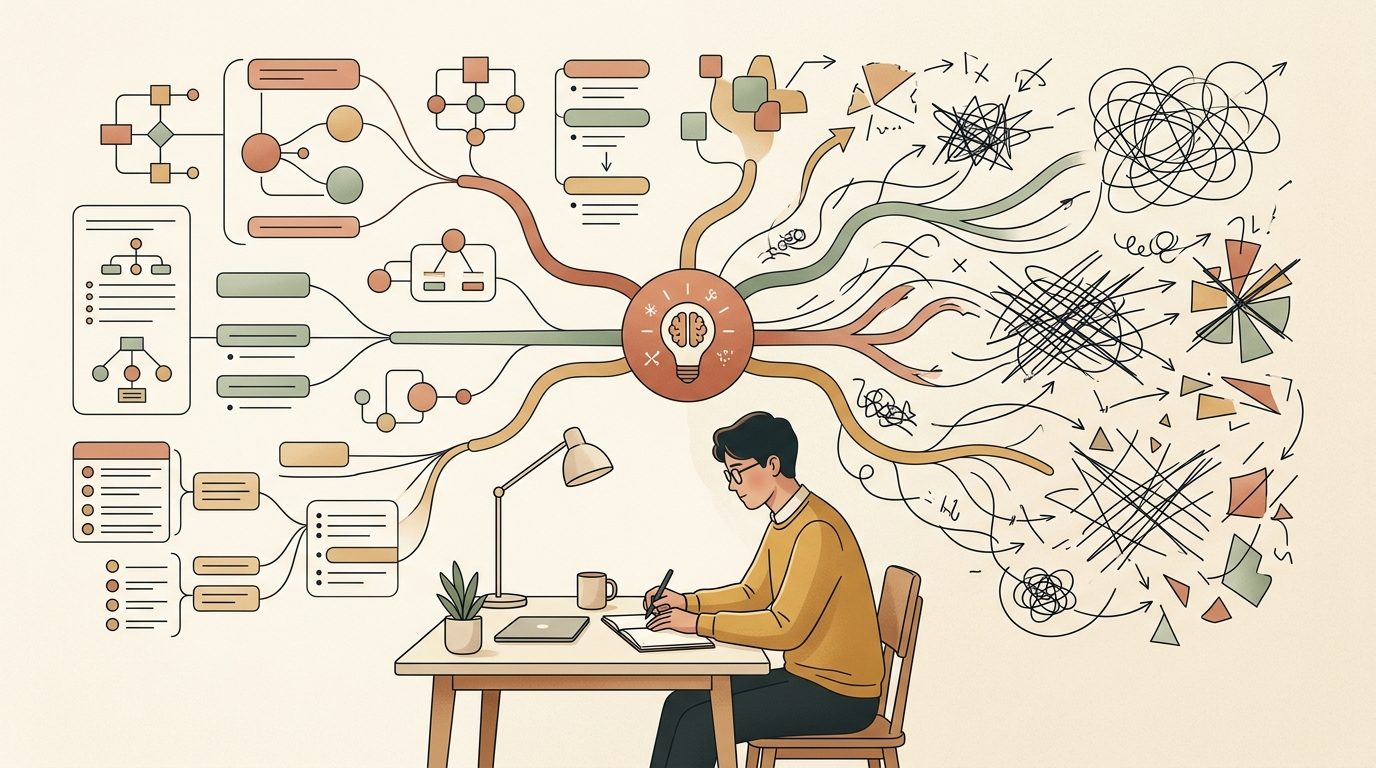
Mind maps look brilliant on Pinterest. Colorful branches radiating from a central idea, keywords floating in organic webs. For some students, they're magic. For others, they're a beautiful waste of time.
The weird thing is that the students they work for and the students they fail are basically a coin toss. Nobody tells you which side of the coin you're on before you spend three hours drawing one and colouring it in. And the advice you'll find online is useless at answering this, because it's all written by people who already love mind maps.
Here's what the research actually says, stripped of the evangelism.
The Split Nobody Talks About
Mind maps were popularised by Tony Buzan in the 1970s and never really went away. Walk through any university library in October and you'll spot at least five people sketching nodes and branches. The appeal is obvious. They look like thinking. They externalise structure in a way that linear notes don't. A well-made mind map gives you the satisfying feeling that you've captured the shape of a topic, not just its ingredients.
But the evidence for them is genuinely messy.
Farrand, Hussain, and Hennessy (2002, Medical Education) ran a study with medical students that's been cited in nearly every mind mapping debate since. They found that mind mapping produced no statistically significant improvement in factual recall compared to the students' own preferred study methods. Worse, the mind map group reported lower motivation. That study gets waved around as proof mind maps are woo-woo nonsense dressed up as cognitive science.
It's also misleading, because it tested the wrong thing.
Mind maps aren't great at encoding isolated facts into memory. That's not what the format is for. They're for organising understanding, connecting ideas, seeing how one concept feeds into another. If you're trying to memorise the steps of glycolysis, flashcards or a table will serve you better. If you're trying to understand why glycolysis matters in the broader picture of cellular metabolism, a mind map might actually earn its keep.
The problem is that most students use mind maps for the first purpose and never get to the second. They treat the map as a memorisation tool and then blame the tool when it fails at a job it was never designed for.
What the Meta-Analyses Actually Found
Nesbit and Adesope (2006, Review of Educational Research) analysed 55 studies on concept maps and knowledge maps. Their conclusion was measured, not glowing. Mind maps showed a small to moderate positive effect on knowledge retention and a moderate effect on knowledge transfer. But then they added a caveat that gets quietly dropped from every Instagram infographic about this. The effect was strongest when students created maps themselves rather than studying from maps someone else had made.
Translation: the learning happens in the making, not the having.
Merchie and Van Keer (2016, British Journal of Educational Psychology) piled on another caveat. They found that mind mapping only improved outcomes for students who already had a reasonable grasp of the material. For complete novices, it was basically noise. Sometimes it made performance worse. Students with low prior knowledge burned so much mental energy on spatial layout, colour coding, and branch hierarchy that they had nothing left for the content.
This is the expertise reversal effect showing up in graph paper and coloured pens. A strategy that helps someone consolidate knowledge can overwhelm someone who's still figuring out what the words mean. The tool assumes you've already done the hard part.
Why Verbal Learners Get the Short End
Here's where this gets specific, and where the one-size-fits-all advice collapses.
Most mind mapping literature treats visual and verbal learners as the same kind of person. They're not. And the research on how these two groups interact with spatial organisers is thin but consistent.
Verbal learners process information primarily through language. Words, sentences, logical sequences, arguments that build from premise to conclusion. They think in prose. Give a verbal learner a mind map and one of two things happens. Either they transform it into a glorified outline, numbering branches and reading them sequentially, effectively converting the map back into the linear format they prefer. Or they get frustrated by the lack of logical flow and abandon it halfway through, convinced they're missing something that everyone else can see.
A study by Plass, Chun, Mayer, and Leutner (1998, Journal of Educational Psychology) on multimedia learning provides the mechanism. Students with high verbal ability performed worse when information was presented in a predominantly visual-spatial format compared to a text-heavy format. Same content, same concepts, just a different organisational structure. The format itself changed the learning outcome.
This doesn't mean verbal learners should abandon mind maps. It means they need to use them for what the format is genuinely good at, rather than trying to force a visual tool to do a verbal job.
D'Antoni and colleagues (2018, BMC Medical Education) compared mind mapping to standard note-taking for complex medical material. The mind map group outperformed on conceptual understanding, the kind that requires integrating multiple ideas. They didn't outperform on factual recall. The authors were explicit about this distinction. Mind maps help you see how things relate. They don't help you remember what things are.
When Mind Maps Earn Their Keep
The practical boundary line, based on what we've covered, is this. If your exam tests recall of discrete facts, skip the mind map and use retrieval practice. If it tests your ability to synthesise ideas across topics, a mind map might be your best friend.
Most exams do both. That's why most students can't tell whether mind mapping helped or not. They're measuring the wrong thing against the wrong outcome.
There's a subtler angle too. Mind maps are genuinely good at something most study advice ignores: reducing the anxiety of not knowing where to start. When a topic feels like an undifferentiated blob of information, drawing a map gives you an entry point. It breaks the blob into pieces and puts them in spatial relationship to each other. Even if the map itself never gets reviewed, the act of making it has already done something useful. You've converted "I don't know anything about this" into "here are the five things I need to know about this, arranged by importance." That's not a memorisation gain. It's an emotional and organisational one. It still counts.
How to Use This (for Actual Studying, Not Pinterest)
Start ugly. The biggest mistake is trying to make a beautiful mind map. Aesthetic effort is cognitive effort you're stealing from the content. Use scrap paper, a pen that's running out of ink, whatever. Scribble. Cross things out. Draw arrows that go in completely the wrong direction and then draw them again. The goal is organising thought, not impressing yourself.
Write phrases, not keywords. This goes directly against Buzan's original rules. He insisted on single keywords per branch. But for a verbal learner, a keyword without context is just a floating word. "Mitochondria" on a branch tells you nothing when you review it a week later. "Mitochondria convert glucose to ATP" tells you what matters and why it matters. The extra eight words cost you half a second to write and save you five minutes of confusion during review. If single keywords work for you, great. If they don't, you're not breaking a law of nature. You're ignoring a style preference from a guy who trademarked the word "mind map" and sold a lot of books.
Do the map, then write an outline from the map. This two-step process is where the actual learning happens. The map helps you discover relationships you hadn't noticed. The outline locks those relationships into a structure your verbal brain can retrieve. Each step does something the other can't. Skip either one and you're leaving half the benefit on the table.
Don't use mind maps for first exposure. Remember the Merchie and Van Keer finding about prior knowledge. If you don't understand the material yet, mind mapping is premature and possibly counterproductive. Read the chapter first. Take messy linear notes. Then, once you have a mental model of the territory, spend 15 minutes turning it into a map. That's when the relational processing kicks in and actually does something useful.
Abandon it when it stops helping. Some topics are inherently linear and don't benefit from spatial mapping. Chronological history. Step-by-step lab procedures. Mathematical proofs. Trying to map these spatially is like writing a narrative description of a painting. The format fights the content instead of supporting it. Use the right tool for the right shape of knowledge.
Limit yourself to 20 minutes. One of the biggest time sinks in studying is a technique that feels productive but produces diminishing returns. Mind mapping is high on that list. Set a timer. When it goes off, stop. Whatever you've got is good enough. The marginal benefit of rearranging branches and picking nicer colours is approximately zero, and the opportunity cost of not doing retrieval practice in those extra minutes is real.
The Quiet Part Out Loud
Mind mapping became a brand long before it became evidence-based. Buzan trademarked the term, built a consulting empire, and sold millions of books promoting a technique that, when tested under controlled conditions, produces modest effects under specific circumstances and nothing under others.
That doesn't make it useless. Plenty of students swear by it and I believe them. But the students who swear by it are almost always the ones for whom the specific conditions happen to be true. They have enough background knowledge. They're studying material that benefits from relational organisation. They're doing the messy, generative work of making their own maps rather than colouring in someone else's.
If you're a verbal learner who tried mind maps once and felt stupid because they didn't click, that feeling wasn't a personal failure. It was a format mismatch between a visual-spatial tool and a language-processing brain. The tool wasn't built for how you think.
So here's the thing I'm actually curious about. What's a study technique you tried because it looked impressive or because someone told you it was the thing, but it never actually worked for you?
Ready to try Piply?
Turn this article into your reality. Start studying faster today.
Try Piply for Free