Habit Stacking for Students: How to Attach Studying to Habits You Already Have
Most study advice starts with willpower. Set a schedule. Force yourself. Grind through it.
That's exactly backwards.
The students who study consistently aren't the ones with iron discipline. They're the ones who never have to decide to study in the first place. The decision already happened, buried inside something they were going to do anyway.
Habit stacking is the difference. The term was formalized by BJ Fogg, a behavioral scientist at Stanford's Persuasive Tech Lab, whose 2009 paper in the Proceedings of the 4th International Conference on Persuasive Technology laid out the core mechanism: the easiest way to build a new habit is to anchor it to an existing one. You don't create motivation from scratch. You borrow momentum from a behavior that's already automatic. Your brain already runs the script for "make coffee" or "brush teeth" or "board the bus." A new habit just hitches a ride.
The formula Fogg gives is deceptively simple: "After I [existing habit], I will [new tiny behavior]."
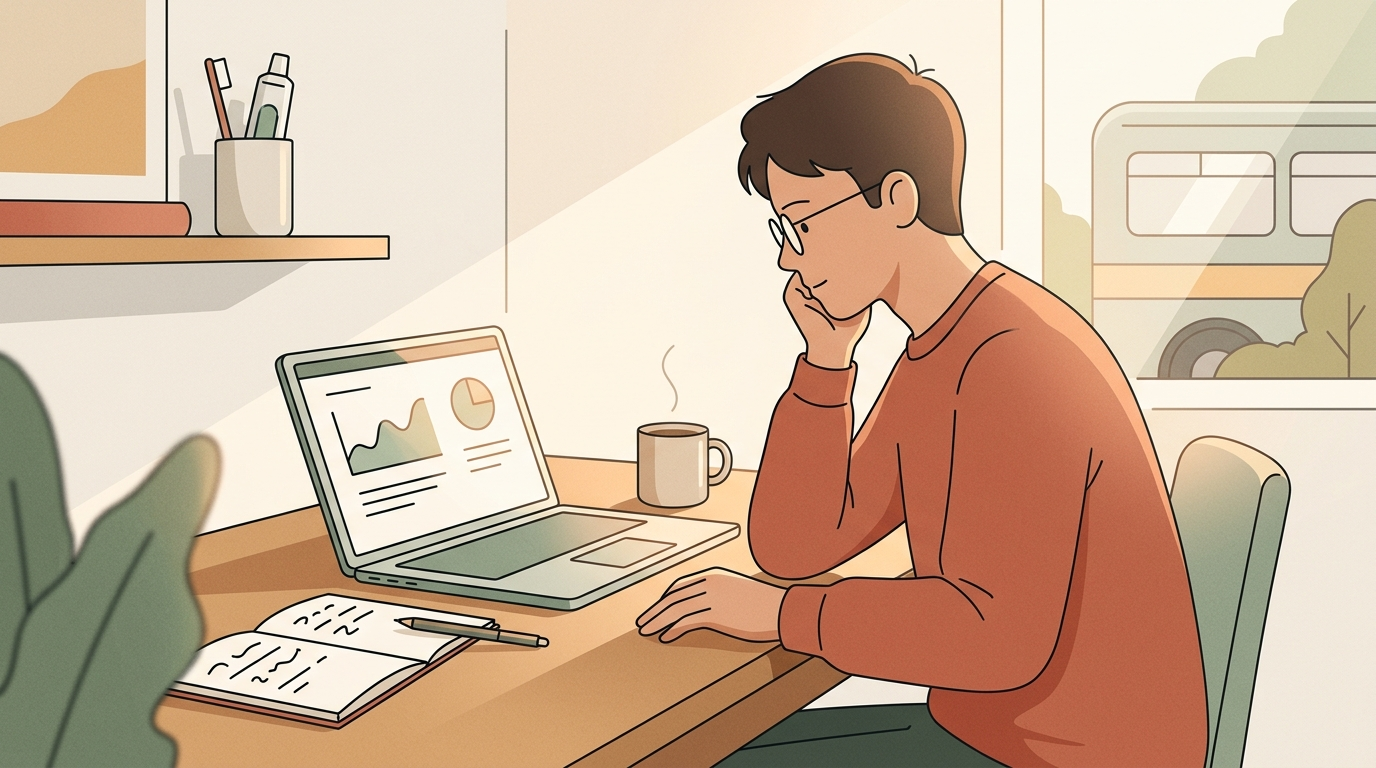
After I pour my morning coffee, I will open my textbook.
After I sit down on the bus, I will review five flashcards.
After I brush my teeth at night, I will write down tomorrow's study goal.
The mechanism works because of something called context-response chunking. Your brain doesn't store habits as standalone intentions. Wood and Neal (2007), writing in Current Directions in Psychological Science, argued that habits are context-response associations encoded as single units in procedural memory. The environment, the time, the preceding action, and the behavior get bundled together. When the context fires, the whole bundle fires, bypassing the deliberative prefrontal cortex entirely. This is why you can walk into the kitchen, open the fridge, and grab a snack without a single conscious thought. The room triggered the script.
Stacking exploits this architecture. If "make coffee" is already chunked with "kitchen, 7am, pour hot liquid," then bolting "open textbook" onto the end of that chunk means the textbook-opening inherits all the automaticity of the coffee-making. You don't need motivation. You just need proximity.
James Clear popularized this for a mainstream audience in Atomic Habits (2018). His formula adds a useful layer: "After [current habit], I will [new habit] in [specific location]." The location matters because it reinforces the context-response association. Same desk, same time, same trigger, same behavior. The brain links them faster.
But here's what the popular books undersell: the anchor habit you choose makes or breaks the stack.
Lally, van Jaarsveld, Potts, and Wardle (2010) published a study in the European Journal of Social Psychology that tracked 96 people trying to form a single new habit over 12 weeks. The behavior was simple: do a specific health-related action once per day after a chosen cue. The median time to automaticity was 66 days. But the range was massive: 18 to 254 days. The difference between 18 and 254 wasn't motivation or personality. It was the quality of the anchor and the consistency of the context.
This changes the strategy entirely. If you anchor studying to "after I finish lunch," you've built on quicksand. Lunch time drifts. Tuesday it's 11:30 with friends. Thursday it's 2pm alone at your desk. The anchor wobbles, so the study habit wobbles too. Within two weeks, the stack collapses, you blame your lack of discipline, and nothing changes.
The anchors that actually work share three properties. First, they're non-negotiable. You never skip brushing your teeth. You never skip waking up. You never skip getting dressed. These are the bedrock behaviors, not the aspirational ones. Second, they happen at the same time every day. Fluctuation is the enemy of chunking. Your basal ganglia love predictability. Third, they happen in the same physical location where you'll do the studying. If the anchor is "after I get into bed" but your desk is in another room, the spatial gap kills the automaticity. The new behavior has to be physically possible immediately after the anchor, without friction. No walking. No opening apps. No finding headphones. Zero steps between anchor and action.
Fogg calls this "designing for ability." The tinier the behavior and the closer it sits to the anchor, the more likely it is to fire. "After I pour coffee, I will open Piply and start a study session" takes about fifteen seconds. It's not ambitious. That's exactly why it works. Opening the app is the hardest part of studying for an hour. If the anchor reliably gets the app open, the rest tends to follow.
There's a subtler reason tiny behaviors outlast ambitious ones: they don't trigger your brain's threat response. Planning to study for three hours after lunch activates the same anterior cingulate cortex regions that light up when you anticipate pain. Your brain treats the prospect of a long study session the way it treats the prospect of a difficult physical task, and it generates proportional resistance. A thirty-second behavior slips under the radar. The ACC barely registers it. By the time you're actually studying, the initial friction was so low you didn't feel the transition. The resistance never had a target.
Stacks also break. They break when you travel, when you get sick, when exams scramble your routine. The standard advice is "never miss twice," and it's directionally correct but incomplete. When a stack breaks, don't try to restart the whole thing at once. Go back to the smallest version. If you were doing "after coffee, open textbook and study for 45 minutes" and that collapsed during finals week, strip it back to "after coffee, open textbook." Just the book opening. Do only that for a full week. The anchor repairs faster when the load is minimal.
Gardner, Lally, and Wardle (2012), reviewing habit formation interventions in the British Journal of General Practice, found that the single strongest predictor of habit formation wasn't motivation or even frequency. It was the simplicity of the target behavior paired with an unambiguous contextual cue. The more complex the new behavior, the more it relied on conscious executive function instead of automatic procedural memory. That's the same finding from a different angle: you can't hack your way into automaticity with a complex routine. Start with the smallest thing that meaningfully moves you forward.
The second mistake students make is stacking multiple behaviors onto one anchor. "After I brush my teeth, I will review flashcards, then outline tomorrow's lecture, then check my assignment deadlines." That's not a stack. That's a to-do list with a dental cue. The anchor fires once, but the new behavior chain is so long it requires sustained conscious effort. The automaticity never develops because the procedural memory system can't chunk a fifteen-minute sequence in one shot. One anchor, one tiny behavior. Protect it for three weeks. Let it go automatic before you layer anything else.
A practical stack that has held up in actual student use:
"After I sit at my desk with morning coffee, I will open my study dashboard."
That's the whole habit. Twenty seconds. After a month of this, the coffee triggers the desk triggers the dashboard. Nobody had to force anything.
The nighttime version: "After I brush my teeth, I will write one review question based on today's lecture." One question. Not ten. Not a full review session. One question proves you processed the lecture. It takes thirty seconds. But now you're doing retrieval practice every single night without ever opening a calendar.
Here's the part nobody talks about. Habit stacking makes studying feel like it just happens. When the behavior fires automatically, the internal debate never occurs. There's no "should I study now? maybe after one more episode." The stack runs, the dashboard opens, and by the time your conscious attention arrives you're already inside a session. You didn't decide to study. The environment decided for you. That's not a productivity trick. It's a psychological hack that routes around your prefrontal cortex entirely, straight into the basal ganglia where motor routines live. Your conscious mind doesn't get a vote because the sequence never reaches consciousness in the first place.
The students who study every day without visible effort aren't more disciplined than you. They just built better anchors.
What's one thing you do every single day, same time, same place, without fail? Name it. Now: what's the smallest study habit you could bolt onto it?
Ready to try Piply?
Turn this article into your reality. Start studying faster today.
Try Piply for Free