 iOS App
  Android App
 Desirable Difficulty: Why Harder Study Sessions Lead to Better Retention
Piply Team
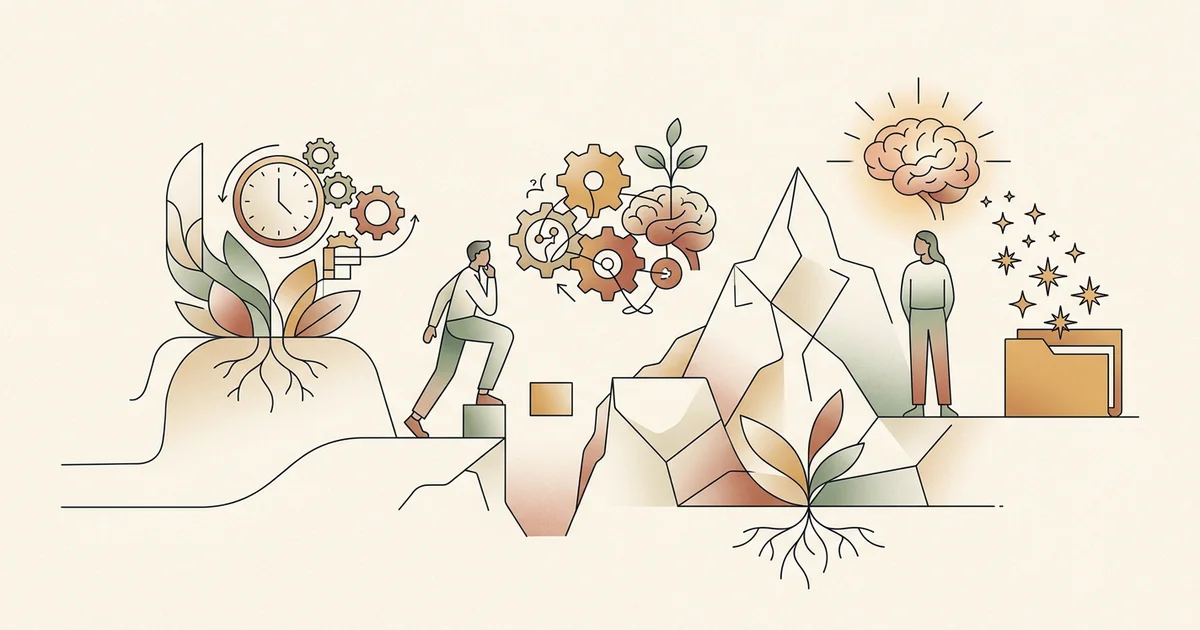
The instinct is wrong. When you're struggling to remember something, when the material feels heavy and resistant, when you keep forgetting what you just read. Your brain is telling you to slow down, reread, maybe just copy the notes over again. That feeling is a liar.
What feels like learning often isn't. And what feels hard? That's where the actual retention happens.
Robert Bjork coined the term "desirable difficulties" in 1994 to describe this phenomenon. The idea is simple: conditions that make learning feel harder often lead to better long-term memory, even though they feel worse in the moment. We've been optimizing for the wrong thing. We've been chasing the feeling of fluency instead of the reality of retention.
Think about how most people study. They reread highlighted passages. They review notes they've already written. They watch videos where someone explains concepts. All of this feels productive. The material becomes familiar. Comfortable. But familiarity is not the same as knowledge.
Here's the problem. When you see something you've already seen, your brain takes shortcuts. It recognizes the words. It accesses a vague sense of having been here before. And it stops working as hard. The actual cognitive process that builds durable memory, the struggle, the retrieval, the reconstruction, that part shuts down. You feel like you're learning. You're coasting.
The research is uncomfortable. In a landmark study, Karpicke and Roediger (2008) had students study word pairs either by repeated study or by repeated testing. The students predicted they would do better with repeated study. They were wrong. Dramatically wrong. The students who practiced retrieving the words remembered them significantly longer, even though studying felt harder and less productive. The act of retrieval, even when it produced errors, strengthened memory far more than passive re-exposure.
So the science says: stop making it feel easy. Make it hard. Make yourself work for it.
But how? Here are some specific approaches.
How to Use This
Test yourself constantly. Don't wait until you've "learned" something to quiz yourself. Quiz yourself while you're still learning. Use flashcards. Close the book and write down everything you remember. Yes, you'll get things wrong. That's the point. Errors, followed by correction, create stronger memory traces than correct answers given too easily. Spacing out retrieval attempts matters too. Bjork and Bjork (2011) showed that increasing storage strength and retrieval strength are different processes. When you struggle to retrieve something, you're weakening the current memory but strengthening the ability to retrieve it again later.
Interleave your practice. Don't study one topic in isolation until you've mastered it before moving on. Instead, mix topics together. Study math problems from different problem types in the same session. Mix vocabulary from different chapters. Research by Rohrer and Taylor (2007) showed students who interleaved geometry problems performed better on tests than those who blocked practice by problem type, even though blocked practice felt more productive during study. The mixing creates confusion in the short term. That confusion is the difficulty. It's desirable.
Space your sessions. Cramming feels efficient because it produces a quick spike in short-term familiarity. But that familiarity fades fast. The spacing effect, one of the oldest findings in memory research, shows that distributing study across multiple sessions leads to much better long-term retention. Use a planner. Spread out your review. A week of shorter, distributed study sessions will outperform a marathon night before the exam, and the difference becomes more dramatic the longer the retention interval.
Embrace the struggle. When you're reading something and it doesn't immediately make sense, when you have to reread a paragraph three times, when you feel like you're not getting it. Don't switch to an easier source or wait until you're in a better mood. That struggle is the learning. You've just been trained to interpret it as failure. It's not. It's the moment your brain is actually building something durable.
There's a practical implication here. You might need to stop trusting how you feel during study. The correlation between feeling like you're learning and actually learning is weak. Sometimes you'll finish a study session feeling frustrated and accomplished. You mastered it. You got it. Other times you'll finish a study session feeling uncertain and vaguely dissatisfied. The second session might have been far more productive for long-term retention, even though it felt worse.
This is hard to accept. We want learning to feel good. We want the confidence that comes with fluency. But confidence is not accuracy, and fluency is not retention.
You can still reread your notes if you want. You can still watch explanations. These activities have a place. But if that's all you do, you're leaving most of your potential memory gains on the table. The effortful, difficult, sometimes embarrassing process of trying to remember, getting it wrong, and trying again. That is where learning actually happens.
So the next time you open your textbook and everything feels easy, ask yourself: am I actually learning anything right now? Or am I just taking the scenic route to forgetting?
What study habit have you been avoiding because it feels too hard?
Put the ideas into practice
Use Piply to organize materials and practise what you’re learning.
Try Piply