 iOS App
  Android App
 Study tips
Spaced Repetition for Thesis Writers: How to Retain 100+ Papers Without Rereading Everything
Andy Anderson
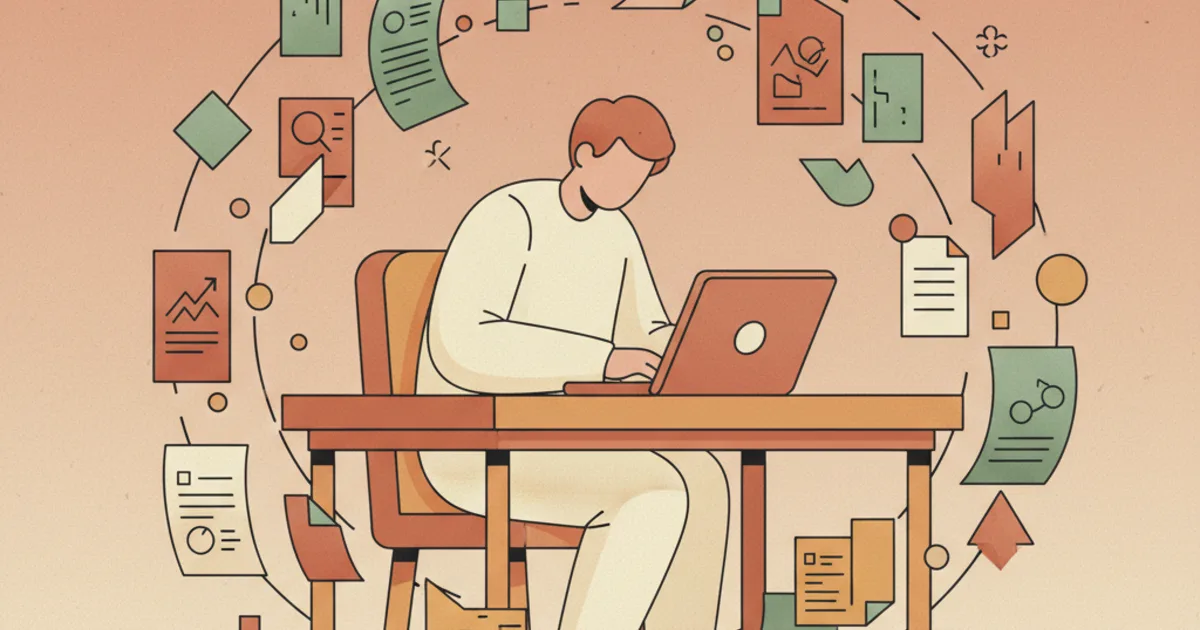
A PhD student posted this recently:
"I've been reading papers but I can't retain anything anymore. I use Zotero to organize everything. If I need to recall anything, I've to go back, reopen the papers, and re-read them. If I spend more than 30 minutes reading, everything slides through my brain. Nothing sticks."
This isn't a rare problem. It's the defining cognitive challenge of thesis work.
You read a paper today. Two months later, when you're writing the introduction and need to cite it, you remember it existed but not what it argued. You open it again. You skim for five minutes and vaguely recognize the points. You aren't rereading. You're rediscovering.
The problem isn't your note-taking system. It's that your brain treats each paper as a one-time event rather than something it needs to hold onto across months.
Spaced repetition is the fix. But applying it to thesis writing requires a different approach than the standard "make flashcards of key terms" advice.
Why thesis-level material breaks normal spaced repetition
Standard spaced repetition advice assumes your study material fits into clean question-answer pairs.
- What is the forgetting curve? Answer: Ebbinghaus's finding that memory decays exponentially without review.
- What are the three types of muscle fibers? Answer: Type I, Type IIa, Type IIx.
Thesis material doesn't work that way.
A journal article isn't a discrete fact. It's an argument with methodology, findings, limitations, and implications.
A literature review is about the relationships between thirty different arguments.
When graduate students try to apply Anki to their thesis reading, the system breaks for three reasons:
Volume. A thesis might reference 100 to 300 sources. Creating individual flashcards for every finding, method, and citation across all of them is full-time work itself. The overhead defeats the purpose.
Granularity mismatch. The unit of recall isn't "what is the p-value in study 4" but "which paper used a moderation analysis for a similar mediator to what I'm proposing." You need to remember the argument, the method, and the connection to your own work. That's more than a flashcard can hold.
Context dependence. A paper you read for the literature review needs to be recallable alongside other papers you read months apart. Standard spaced repetition treats each card independently. Your thesis needs to connect them.
The literature review retention problem
Let us be specific about the failure mode.
You're writing the introduction. You know Paper A made an argument about mechanism X and Paper B challenged it with evidence Y. You need to cite them in the same sentence.
But you read Paper A in March and Paper B in May. You can't remember which paper made which claim.
So you spend thirty minutes hunting through Zotero, reopening PDFs, scanning abstracts, finding the exact passages. The sentence takes you ninety seconds to write and thirty minutes to prepare for.
Scale that across two hundred citations and you just lost a week of your life to rediscovery work.
The solution isn't better organization.
Zotero, Mendeley, and Endnote already handle taxonomy well. Tag a paper, file it in the right folder, search by keyword.
These tools treat the retrieval problem as a search problem.
It isn't a search problem. It's a memory problem.
You aren't trying to find the paper. You know it exists. You're trying to remember what it said.
How to use spaced repetition for thesis work
The standard flashcard approach fails for thesis writing because it optimizes for the wrong outcome. You don't need to recall isolated facts. You need to recall arguments, methods, and connections.
Here's what works instead.
Extract claims, not definitions
When you read a paper for your thesis, ask one question before you close it: "What is the single most important claim this paper makes that I will need to reference?"
Write it in your own words. One to three sentences. Not a direct quotation. A synthesis.
That claim becomes your review item. Not "what did Smith et al. find" but "Smith et al. demonstrated that retrieval practice improves transfer of learning even when the practice test format differs from the final assessment format."
The goal is to retrieve the argument, not the label.
Review by connection, not by card
Standard spaced repetition schedules are based on time since last review. Thesis writers need a second axis: connection to other material.
When you review Paper A, do more than ask "what did it say." Ask "how does this connect to the three papers I read last month." The retrieval strengthens the relationships between concepts, more than the individual memory.
This is closer to how your brain will need to access the information during writing. You don't write a thesis by listing findings. You write it by weaving findings together. Train that weaving during review instead of hoping it appears at the keyboard.
Batch review by theme, not by recency
Instead of reviewing ten random papers each week, review them in groups that correspond to your thesis chapters. The methodology chapter draws on a specific set of papers. Reviewing them together builds the mental network you need when writing that section.
This violates the strict spacing principle slightly. The tradeoff is worth it because the connections between the papers reinforce each other in a way that isolated review can't replicate.
Use the writing itself as retrieval practice
Here is a technique that works well: after you read a batch of papers on a theme, don't open a notes app. Open a blank document and write one paragraph that synthesizes everything you remember from the batch. No looking at the sources.
This is retrieval practice at the right level of complexity.
You aren't recalling a single fact. You're reconstructing an argument from multiple sources.
That's exactly the skill you need during thesis writing.
After you write, check your sources for accuracy. You'll find gaps. Those gaps tell you exactly what needs more review.
The one-touch citation strategy
A simple policy that eliminates most of the retrieval problem: every paper you read gets exactly one touch during the reading phase and one touch during the writing phase.
The one touch during reading is your claim extraction: the one-to-three sentence summary of the paper's key contribution to your thesis. The one touch during writing is the actual citation.
Between those two touches, spaced repetition maintains the memory.
When you see the paper title in your citation manager, the claim should be recallable in seconds. If it isn't, you either summarized too vaguely or let too much time pass.
Both are fixable.
Where Piply fits
Piply was designed around the problem this article describes: the gap between reading a paper and needing to recall it months later.
When you upload a PDF to Piply, it generates retrieval prompts from the content automatically. But for thesis-specific work, the key feature is how it handles synthesis. Piply does more than turn your papers into flashcards. It creates review items at the argument level: claims, methods, findings, and the relationships between them across different sources.
The spaced repetition schedule adjusts for the reality of thesis writing. Papers for Chapter 2 are scheduled together. Papers for Chapter 3 get a separate review schedule. When you finish reading new material, the system doesn't start fresh. It adds the new connections to the existing review rotation.
The bookkeeping that kills most thesis-level spaced repetition attempts disappears entirely. You don't need to decide which paper is due for review today, or which batch of readings needs consolidation. Piply surfaces the right items at the right time based on how your brain is actually forgetting them.
What to keep
The PhD student who posted about losing retention was right to feel frustrated. Reading piles of papers and remembering none of them isn't a sign of poor effort. It's a structural problem with how we treat the information before we write.
Every paper you read for your thesis has a shelf life. Without review, that shelf life is measured in days, not months. By the time you're drafting the discussion and need to compare your findings to two papers you read in the first semester, those memories have decayed into vague impressions.
Spaced repetition reverses that decay. But it only works if the method fits the material. Flashcards made for undergraduate terminology quizzes don't scale to thesis-level reading. You need a system that tracks arguments, not definitions. Connections, not isolated facts. Synthesis, not recall.
Build that system and your writing time becomes what it should be: composing, not rediscovering.
Further Reading
- Cepeda, N. J., Pashler, H., Vul, E., Wixted, J. T., & Rohrer, D. (2006). Distributed practice in verbal recall tasks: A review and quantitative synthesis. Psychological Bulletin, 132(3), 354-380.
- Dunlosky, J., Rawson, K. A., Marsh, E. J., Nathan, M. J., & Willingham, D. T. (2013). Improving students' learning with effective learning techniques: Promising directions from cognitive and educational psychology. Psychological Science in the Public Interest, 14(1), 4-58.
- Roediger, H. L., & Karpicke, J. D. (2006). Test-enhanced learning: Taking memory tests improves long-term retention. Psychological Science, 17(3), 249-255.
Put the ideas into practice
Use Piply to organize materials and practise what you’re learning.
Try Piply