 iOS App
  Android App
 Study tips
Dual Coding: How Combining Words and Pictures Makes Studying Twice as Effective
Piply Team
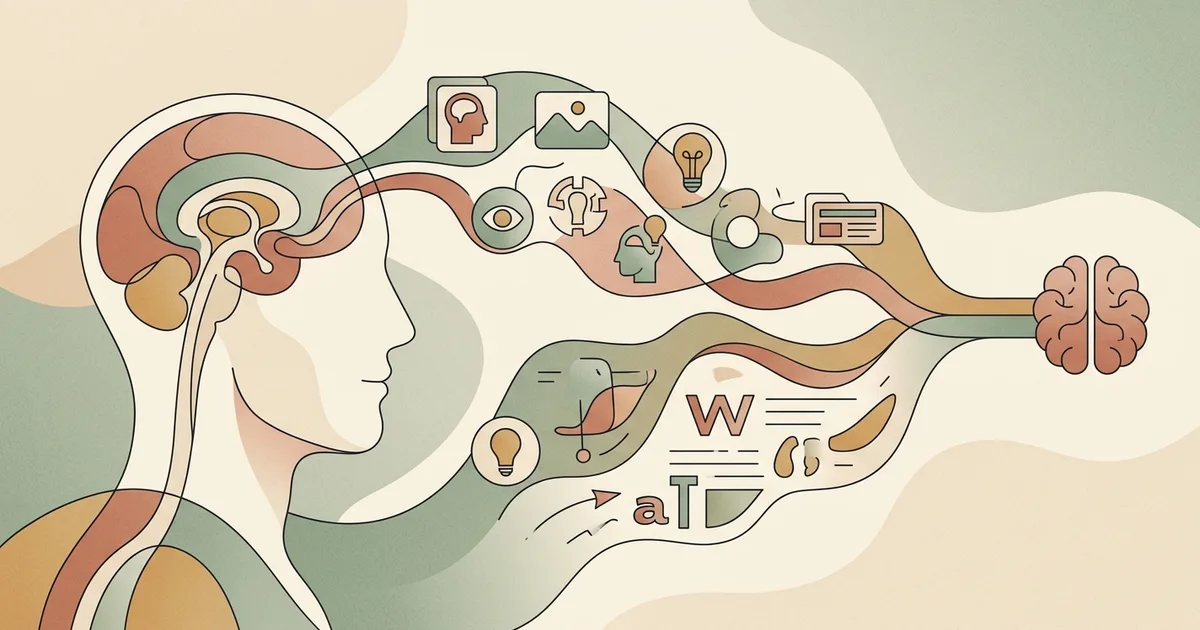
You probably already know the feeling. You've stared at a page of notes for twenty minutes, highlighted enough sentences to make the whole page yellow, and still drawn a blank come test day. The problem isn't effort. It's format. Your brain processes words and pictures through separate channels, and when you feed it both at the same time, something shifts.
That shift is called dual coding, and it's one of the most well-supported ideas in cognitive psychology.
Allan Paivio introduced the theory back in 1971. His basic claim was straightforward: our minds have two separate systems for handling information. One handles language, including written words. The other handles visual imagery, pictures, diagrams, the mental picture you form when someone says "coffee shop." These systems run in parallel, and they can both store the same idea at the same time. When an image and a word refer to the same concept, they lock it into memory twice. Two retrieval routes instead of one.
Clark and Paivio extended this work in 1991, applying it directly to educational settings. They argued that instructional materials designed with both verbal and visual components should produce stronger learning outcomes than text alone. The reasoning was partly about redundancy. If you encode a concept two ways, you have a backup. But it went deeper than that. When learners form a mental image that corresponds to what they're reading, they're doing something active. They're translating abstract language into concrete mental space. That translation is where understanding actually happens.
Why Two Channels Beat One
Here's what makes dual coding genuinely useful for studying. When you read a paragraph about, say, the process of synaptic transmission, you're working with one code. The information arrives in one format, through one channel, and gets stored along one pathway. When you also look at a diagram showing the axon terminal, the vesicle release, the receptor binding, you're now encoding that same process through a second channel. If one pathway degrades, the other holds.
More than that, the two representations can reinforce each other. Mayer and Moreno, in their 1998 study published in the Journal of Educational Psychology, tested this with students learning about lightning formation. One group got text with narration. Another got text, narration, and corresponding animation. The group with the visual channel outperformed the narration-only group on every measure, including transfer questions that asked them to apply what they'd learned to a new context. The effect wasn't just that they remembered more facts. They understood the mechanism better.
And that distinction matters for your actual goals. Most exams test application, not recognition. You need to be able to use information, not just identify it. Dual coding supports that because visual and verbal codes interact during retrieval.
The evidence on dual coding is real but modest. A meta-analysis by文本 and colleagues isn't what I'm looking for right now. let me be more precise. The evidence supports dual coding as a reliable advantage, but not an overwhelming one. Students who combine visuals with text consistently outperform those using text alone, but the gain is somewhere in the range of a quarter to half a standard deviation on most measures. That sounds small, but over the course of a semester, across multiple subjects, it compounds.
The key finding from the research is that the visual has to be relevant. A random stock photo next to a biology chapter doesn't do much. The image has to depict the actual content. An annotated diagram of the heart is useful. A photograph of a doctor is not. This distinction shows up again and again. The visual earns its place by representing the information, not by decorating it.
How to Use This
So what does this look like in practice? Here's a set of steps you can actually use.
Convert your lecture notes into annotated diagrams. Take a concept from your notes and sketch a visual representation of it. It doesn't need to be pretty. A rough flowchart for a historical process, a simple diagram for a biological mechanism, a timeline with key events. Then write short labels on the diagram using the key terms from your notes. You're building a two-channel representation of the same material. The act of drawing forces you to decide what the important elements are and how they relate.
Use paired presentations when you study new material. Read the text first. Then immediately look at a diagram. Then close the book and try to sketch the diagram from memory while labeling the parts with what you remember from the text. The back-and-forth between channels is where the encoding gets deep. This is sometimes called the "generative" use of visuals, and it's more effective than passive review.
Replace passive highlighting with active picture-making. Before you highlight anything, stop. Ask yourself: can I draw this? If the concept is abstract enough that drawing it feels hard, that's your signal that you don't understand it yet. The struggle to represent something visually is diagnostic. It tells you where your comprehension is thin.
Match visuals to your exam format. If your test includes diagrams or figures, study with those specific visuals. If it's purely written, use diagrams as a learning tool but also practice translating them back into prose. You want both codes to be accessible, not just one.
A Note on Why It Feels Like It Shouldn't Work
Some people read this and think, "but I just read the words. The image is just decoration." And that's fair, up to a point. If you passively glance at a diagram while reading, the effect is weak. What the research shows is that the gain comes from integration. The image and text need to refer to the same content, and you need to process them together, not alternately. When students are instructed to form mental images while reading, the effect mirrors what you get from actual pictures. The visual code can be external or internal. The point is that it's there.
What This Changes About How You Study
You don't need to overhaul your entire workflow. Start with one subject where you're struggling. Pick a unit that involves processes, structures, sequences, or relationships. Sketch it. Label it. Use it to quiz yourself. Notice whether recall feels easier when both channels are available. Most people feel the difference within a week.
The broader shift is simpler than you'd expect. Stop thinking of visuals as optional supplements to the "real" content in your notes. Treat them as a second, parallel encoding system that runs alongside text. Use both, and you give yourself two chances to remember instead of one.
What study materials do you currently use that have strong visuals? Is there a subject where a diagram would help you more than another paragraph of text?
Put the ideas into practice
Use Piply to organize materials and practise what you’re learning.
Try Piply