 iOS App
  Android App
 Study tips
Sleep and Memory: Why Your Brain Consolidates Learning While You Sleep
Piply Team
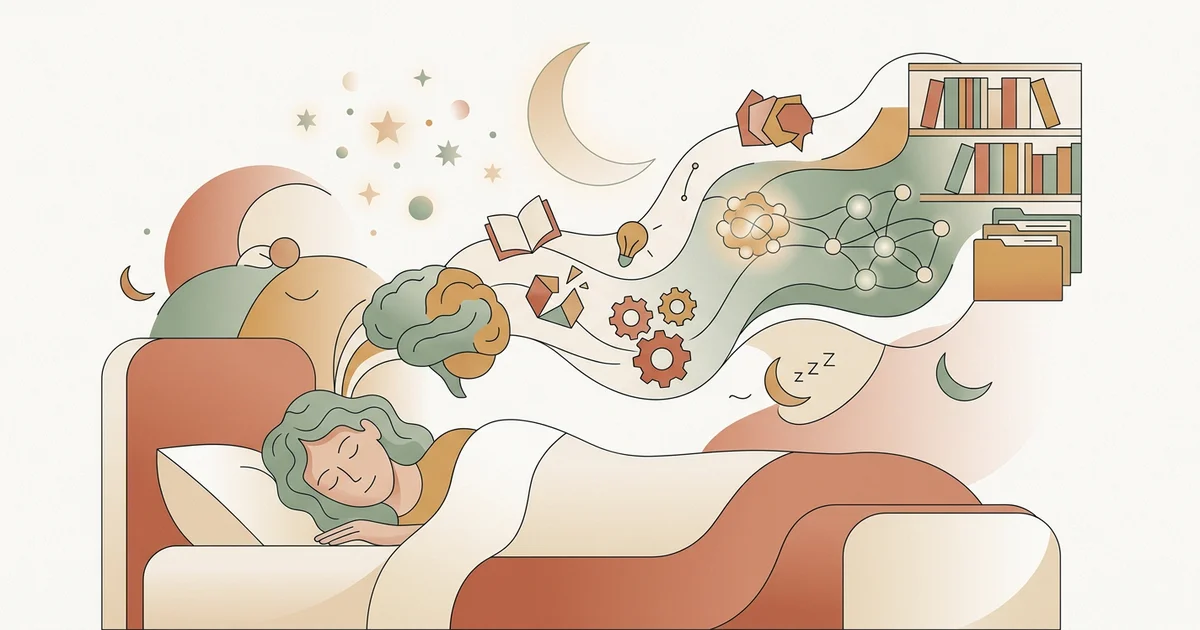
You spent three hours memorizing anatomy terms. You went to bed late but you went to bed. Then you woke up and half of it was gone. The frustration is real, but you're not stupid. You're just missing one thing.
Sleep.
Not as a reward for finishing your work. Not as something that happens while you're not studying. Sleep is the actual place where learning becomes memory. Your brain doesn't wait until you're awake and refreshed to do this work. It starts the moment you close your eyes.
What actually happens in your brain while you sleep
Your hippocampus, that seahorse-shaped region in your temporal lobe, fires up while you rest. It replays the neural patterns from your study session. This is your brain's way of practicing what it just learned, strengthening the connections between neurons.
Rasch and Born (2013), publishing in Physiological Reviews, described this process in detail. During slow-wave sleep and REM sleep, the hippocampus communicates with your cortex. Memories move from temporary storage to long-term storage. The information gets integrated with what you already know.
Here's what surprised researchers. Mednick et al. (2011), in a study published in Nature Neuroscience, found that people with more sleep spindles, those bursts of neural activity during non-REM sleep, showed 20 percent better performance on motor learning tasks the next day. Sleep spindles are like a signature on your memory. More spindles, better retention.
Stickgold (2005), writing in Nature, suggested that sleep doesn't just preserve memories. It edits them. Sleep may extract the essential rules and structures from what you learned, making your knowledge more abstract and useful.
That three-hour anatomy session you did last night? Your brain took that raw material and started sculpting it while you dreamed. But if you didn't sleep, that sculpture never happened. You woke up with rough clay and no time to shape it.
The all-nighter problem
You already know this feels terrible. The science explains why.
Diekelmann and Born (2010), in Nature Reviews Neuroscience, ran a study where participants learned word pairs. Those who slept after learning retained almost everything. Those who stayed awake forgot about 40 percent.
This happens because your hippocampus has limited capacity. It can hold information temporarily, but it needs sleep to transfer that data to your cortex. Without sleep, your hippocampus fills up. When it fills up, earlier memories get pushed out.
All-nighters are especially damaging because you stay awake through the consolidation window, then wake up and study new material with a depleted hippocampus. You're trying to pour water into a glass that never got emptied.
But there's a subtler problem too. Chronic mild sleep restriction, the kind where you lose 30 or 60 minutes a night for a week, impairs learning without making you feel noticeably tired. You think you're fine. You're not.
Sleep treats all your memories equally
Here's something that doesn't get talked about enough. Sleep doesn't care what you're learning. It will consolidate your guitar practice with the same dedication it gives your organic chemistry.
Diekelmann and Born (2010) showed this with a word-pair experiment. Students who learned pairs in the evening and then slept retained far more than students who learned the same pairs in the morning and stayed awake all day. The sleep itself was the deciding factor. Not the time of day, not the difficulty level, not how hard you stared at the flashcards.
This means you can't selectively protect your important memories. Sleep is all-or-nothing. You get the consolidation or you don't.
So when you stay up cramming for one exam while ignoring your other subjects, you're not prioritizing. You're betting that only one type of learning matters. Your brain doesn't make that distinction.
How to use this
You can't control sleep directly, but you can arrange your days to let it work for you.
Study before bed. Not right before, but in the evening. Give yourself an hour to wind down after studying, then sleep. Your hippocampus replays what it recently processed, so studying close to sleep gives it fresh material to work with. Diekelmann and Born (2010) found that evening study followed by sleep outperformed morning study followed by a full day of wakefulness.
Keep a consistent sleep schedule. This matters more than hitting exactly eight hours every single night. Your brain consolidates most efficiently when it expects sleep at a regular time. Inconsistent schedules, even if you average the same total hours, disrupt spindle production and memory consolidation. This isn't about willpower. It's about rhythm.
Don't sacrifice sleep for last-minute review. You might feel like you're being productive. You might even feel like you're learning more because you're awake and reading. But you're not. You're just keeping your hippocampus too busy to do its actual job.
Sleep is when your brain decides what to keep. Stay awake, and that decision gets made without you.
Put the ideas into practice
Use Piply to organize materials and practise what you’re learning.
Try Piply