 iOS App
  Android App
 Study tips
Why We Built Study Sessions Instead of Another Solo Study Tool
Elizabeth Nune
Most study products are built around content.
How do we summarise faster? Generate better flashcards? Turn notes into quizzes?
All of that matters. We work on those things too.
But we kept seeing another problem that had nothing to do with content quality.
Students had the notes. They had the slides. Some even had solid study plans. They still weren't starting.
Or they started, drifted after fifteen minutes, and spent the rest of the session half-studying and half-looking for a reason to quit.
That's the problem Study Sessions were built to solve.
The issue wasn't always "I don't know what to do"
Often it was:
- I don't want to start alone
- I keep losing momentum
- I say I will study at 7 and then 7 becomes 9:40
- I need a bit of accountability without a whole group project
That kind of friction is easy to underestimate because it sounds small. In practice, it shapes whole semesters.
Why other people help, even when they're quiet
There's a reason students often work better in libraries, labs, or around classmates. The presence of other people can change behaviour. Sometimes it increases effort.
Sometimes it makes starting easier. Sometimes it simply reduces the feeling that you're doing all the hard parts alone.
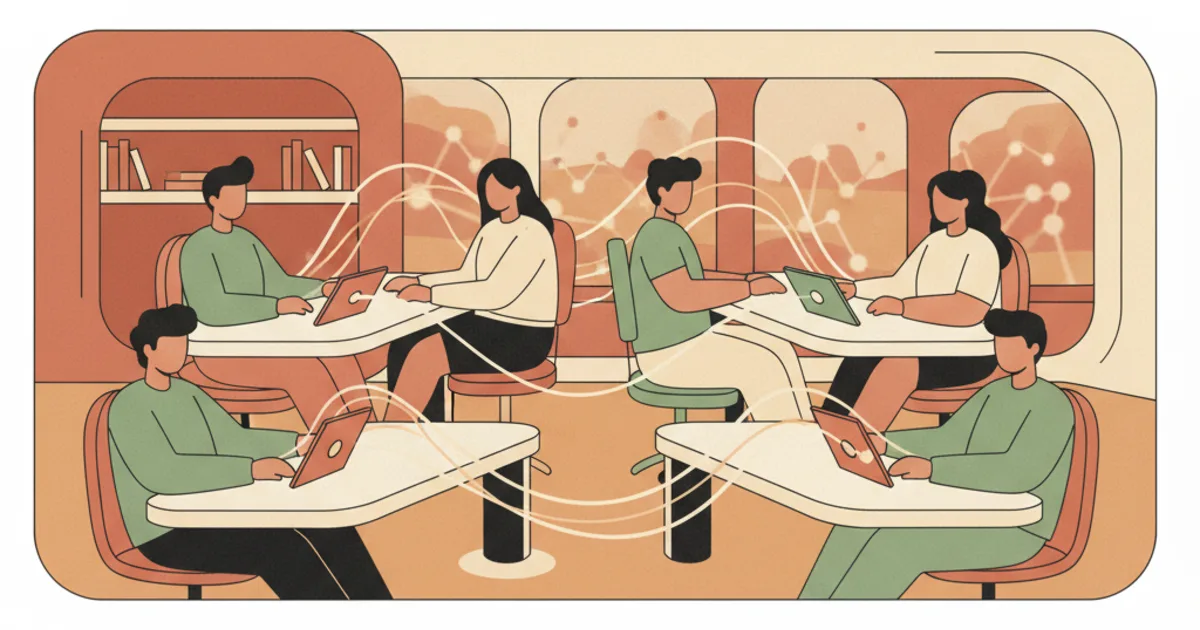
Education research on peer learning and accountability shows that students often benefit when studying becomes a visible shared activity instead of a private promise they can quietly break. Not every session needs to be discussion-heavy. Sometimes silent co-working does enough.
That's one of the ideas behind Study Sessions.
What we didn't want to build
We didn't want another chaotic chat room.
We didn't want a fake productivity space where everyone says they're locked in and nobody is actually working.
We didn't want a study feature that only works if you already have the motivation of an Olympic athlete.
The goal was simpler: create a lightweight structure that helps students start, stay, and come back.
What Study Sessions are meant to do
At their best, study sessions give students four things:
1. A visible start time
This matters more than it sounds. A scheduled session turns "I should study later" into something closer to a commitment.
2. Gentle accountability
Not surveillance. Not pressure. Just enough social presence that it becomes harder to disappear from your own plan.
3. A shared work context
When everyone in the room is there to focus, the session feels like work faster. You spend less time negotiating with yourself.
4. A lower barrier to connection
For a lot of students, it's easier to join a study session than to initiate a social event. Shared work can become a safer entry point to community.
Why this matters for learning, more than motivation
Studying with others can improve the quality of the learning itself when it leads to explanation, questioning, and retrieval. Even when the session is quiet, students are often more likely to follow through on the hard parts: practice questions, teaching a concept aloud, or admitting what they don't understand.
That's better than another hour of passive rereading done alone.
The version we think is actually useful
The best study session isn't necessarily the loudest or most social. Usually it's:
- small enough to feel manageable
- clear about what the session is for
- quiet enough that people can focus
- structured enough that it actually begins on time
That's the version we wanted to support.
What to keep
We didn't build Study Sessions because students needed one more feature. We built them because a lot of students already knew what to study and still needed help getting themselves into the work.
If starting alone is the hardest part, a shared session isn't a gimmick. It's infrastructure.
If that sounds like the missing piece in your routine, Piply Study Sessions were built for that exact problem.
Put the ideas into practice
Use Piply to organize materials and practise what you’re learning.
Try Piply