 iOS App
  Android App
 Study tips
Self-Explanation Effect: Why Teaching Yourself Out Loud Doubles What You Learn
Piply Team
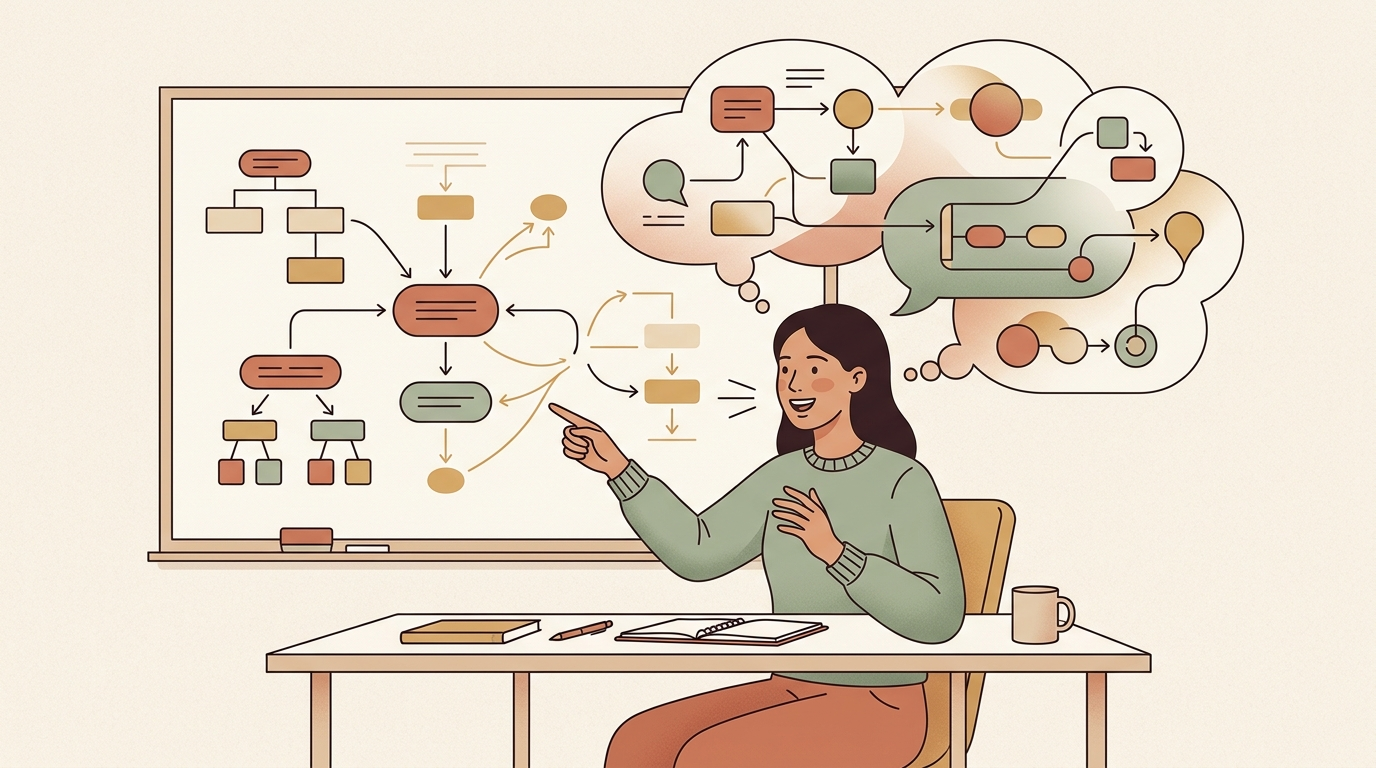
Most students think they understand a concept until they try to explain it. That moment when you open your mouth and nothing comes out? That's not failure. That's where learning actually starts.
And yet almost nobody does it.
Students re-read notes. They highlight. They watch the same video twice. All passive, all comfortable, all nearly useless compared to what takes about thirty seconds: saying out loud what you just learned and why it makes sense. Chi, Bassok, Lewis, Reimann, and Glaser (1989, Cognitive Science) called this the self-explanation effect, and the numbers from their original study are stubbornly hard to ignore. Students who talked through textbook examples as they read scored nearly twice as high on problem-solving tests as those who read the same material silently. Same textbook, same time on task, wildly different outcomes.
Why Just Saying It Changes Everything
Self-explanation isn't parroting. Parroting is repeating the definition of torque word for word. Self-explanation is saying "okay, torque is basically how hard you twist something, and it depends on two things: how much force you use and how far from the pivot you apply it. So if I push near the hinge of a door, nothing happens. Push at the edge, and it swings. That's why door handles are on the far side."
One sentence turns into a chain of reasoning. The mechanism clicks into place.
The cognitive explanation is straightforward but worth knowing. VanLehn, Jones, and Chi (1992, Journal of the Learning Sciences) argued that self-explanation works because it forces what they called the "knowledge integration" process. When you read passively, new information sits in a mental box labeled "stuff I read." It doesn't connect to anything you already know. When you self-explain, you're forced to find those connections. You have to answer "why is this true?" and "how does this relate to that other thing?" Those questions build bridges. Without the bridges, you're memorizing isolated facts. With them, you're building a mental model.
And mental models don't crumble under exam pressure the way memorized facts do.
The Part Nobody Talks About
There's a catch. Self-explanation feels bad. It's uncomfortable in a way that re-reading isn't. You start explaining something to yourself and hit a wall almost immediately. You realize you don't actually understand what you thought you understood. Your brain, which would rather feel smart than be smart, sends up a strong signal: stop doing this.
That discomfort is the mechanism working. Renkl (1997, Learning and Instruction) found that the students who benefited most from self-explanation weren't the ones who explained smoothly and confidently. They were the ones who stumbled, backtracked, and corrected themselves mid-sentence. The self-correction, not the explanation itself, did the heavy lifting.
This flips a common intuition on its head. We tend to think learning feels like clarity, like things clicking into place. But the research on self-explanation suggests the opposite: learning feels like confusion followed by a small resolution, over and over. If you wait until you "feel ready" to explain something, you'll never start. The explanation doesn't demonstrate understanding. It creates it.
How to Actually Use This
The technique is simple. The discipline to do it is not.
While studying, pause every few paragraphs. After a paragraph or a section, look away from the material and say out loud what you just learned. Don't paraphrase the text. Explain the concept to an imaginary person. Why does it work this way? What would happen if conditions changed? What's the counterexample?
Roy and Chi (2005, Journal of the Learning Sciences) found something fascinating: the quality of self-explanations matters far more than the quantity. Students who generated "principle-based" explanations (ones that referenced underlying rules and mechanisms) outperformed students who generated more explanations but only at the surface level. So don't just explain what happened. Explain why it had to happen that way.
Write it, then say it. Some people find writing easier as a warm-up. Write a one-sentence explanation. Then deliver it aloud without reading it. The spoken version will almost always be different from the written one, and those differences reveal gaps.
Use the Feynman Technique as a self-check. Try to explain the concept in language simple enough for a twelve-year-old. If you can't, you've found a gap. Go back, re-study the specific part you stumbled on, and try again. This isn't about dumbing things down. It's about stripping away jargon until only understanding remains.
Talk to your phone. If talking to yourself feels weird (it will), record voice memos. Pretend you're explaining the concept to a friend who missed class. Listen back. You'll hear the gaps you didn't notice in the moment.
Self-explain mistakes. When you get a practice problem wrong, don't just note the correct answer. Explain what you did wrong, why the error happened, and what the correct reasoning should have been. This is where self-explanation really earns its keep. Post-hoc explanations of errors produce some of the strongest learning gains in the literature.
A quick note on timing: self-explanation works best during initial learning, not during review. When you're encountering new material for the first time, pausing to explain forces integration early. If you wait until you're reviewing for an exam, the unconnected facts have already settled into separate mental boxes, and prying them apart is harder.
When It Doesn't Work
Not every study strategy works for every subject, and self-explanation is no exception. It's strongest for conceptual, principle-driven material: physics, chemistry, math, computer science, economics. Domains where understanding why matters more than remembering that.
For pure memorization tasks (capitals of countries, vocabulary lists, anatomy terms), you're better off with retrieval practice or spaced repetition. Self-explanation doesn't help much when there's nothing to explain, just something to remember.
There's also a skill floor. Absolute beginners in a subject sometimes lack enough background knowledge to generate useful self-explanations. If you don't know what "force" means, you can't explain why torque depends on distance from the pivot. In those cases, you need a small foundation of knowledge first. But that foundation is smaller than most students assume. You don't need mastery to start self-explaining. You just need enough to ask "why?" and have a fighting chance at the answer.
One question that comes up when people try this for the first time: what's the difference between self-explaining and just thinking really hard? The difference is specificity. Thinking hard is vague. Self-explaining is concrete: you produce actual sentences that someone else could, in principle, understand. If you can't produce a coherent sentence about a concept, you haven't thought about it hard enough. You've just re-read it and nodded along.
The next time you finish a chapter or a lecture, try this: close the book, hit pause, and explain what you just learned to an empty room. If nothing comes out, good. That's the gap. Now you know exactly where to go back.
Put the ideas into practice
Use Piply to organize materials and practise what you’re learning.
Try Piply