 iOS App
  Android App
 Study tips
Method of Loci: Why Walking Through Your House Beats Re-Reading the Same Notes
Piply Team
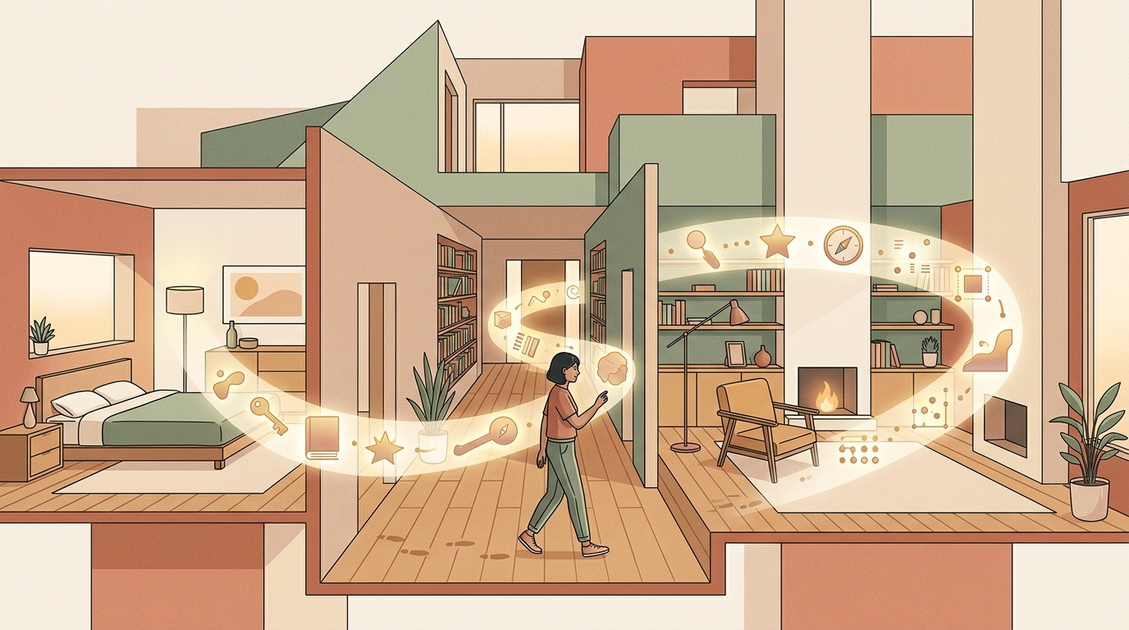
There is a particular kind of memory task that feels almost unfair. You close your eyes and walk through the house you grew up in. You can see the hallway, the kitchen with its cluttered counter, the way the light falls through the sitting room curtains. You can navigate all of it without thinking. That automatic spatial recall is one of the most powerful things the human brain does. The method of loci uses exactly that.
The technique is old. The Greek poet Simonides of Ceos is credited with inventing it around 500 BC, after a banquet hall collapsed and he was the only survivor. He walked through the ruins and identified the dead by remembering where each person had been sitting. That experience taught him something profound: our brains encode place and memory together, and one can unlock the other.
Why this works better than re-reading
Re-reading the same notes is the study equivalent of staring at a wall. The information enters your working memory and leaves. It never gets a permanent address.
The method of loci works differently. It exploits the brain's spatial memory system, which runs through the hippocampus, the same region that helps you remember where you left your keys. The hippocampus is particularly good at forming and retrieving memories that involve location and sequence. When you link new information to a familiar route, you are essentially giving that information a physical address your brain already knows how to find.
Research supports this strongly. Bellezza, Green, and Sulkes (1989) showed that the method of loci outperformed simple rehearsal across multiple memory tasks. Participants who visualized items along a familiar path recalled significantly more than those who repeated items mentally without spatial anchoring. Yates (1966) documented the technique's effectiveness across decades of use, noting that trained memory athletes consistently outperform control groups not because they have better brains, but because they use spatial encoding strategies that most people never learn.
The mechanism at play is called distinctiveness. Each stop along your memory route becomes a unique retrieval cue. If you place the causes of the French Revolution along the rooms of your apartment, the weirdness of that pairing is exactly what makes it stick. Your brain remembers the strangeness, not just the content.
What makes a good loci route
You do not need a palace. Your apartment works fine. Your commute works better. The key is that the route needs to be well-learned, with distinct stops and a clear sequence.
A good route has between ten and twenty stops. Fewer than that and you run out of room. More than twenty and the route becomes hard to navigate without missing items or reordering them. The stops should be memorable on their own: a doormat, a kitchen island, a specific chair. Avoid stops that blend together visually.
The items you want to remember should be vivid and, ideally, a little strange when paired with each location. You are not just placing information. You are staging it. A concept like supply and demand becomes more memorable if you visualize it doing something at your hallway doormat. The weirder the staging, the stronger the retrieval.
One thing people get wrong about this technique is treating it as a memorization shortcut. It is not fast. It requires upfront effort to build the route and link each item. That effort is the feature. The act of creating those vivid, location-bound associations is what pushes the material into long-term memory in the first place.
How to build your first memory palace
Pick a place you know intimately. Walk through it in your mind and identify ten stops along the way. Number them in order.
For a study context, pick ten concepts you need to recall. Visualize each one at each stop. Make the pairing specific. If you are studying the causes of World War One, do not just picture "militarism" at your front door. Picture something vivid and strange that will remind you of the specific meaning.
Then, review. Walk the route mentally before you sleep, and again the next morning. The retrieval practice that happens during the walk is as important as the encoding. You are not just storing information. You are practicing the act of finding it.
The method is genuinely flexible. Medical students use it for anatomy. Law students use it for case facts. Historians use it for chronologies. It works for any material that has structure, because structure is exactly what you are mapping.
How to use this right now
If you have an exam coming up with material that follows a sequence, try this tonight.
First, map your route. Choose a path with at least ten stops. Your morning commute works perfectly. Write down the stops in order so you have them fixed.
Second, assign one concept per stop. Spend thirty seconds at each assignment creating a vivid, strange image that connects the concept to the location.
Third, walk the route in your head. Do not look at your notes. When you reach a stop and nothing comes up, that is a gap. Note it and return to it.
Fourth, repeat. Walk the route before you sleep. Walk it again when you wake. The retrieval practice is where most of the learning actually happens.
This is not about becoming a memory athlete. It is about working with your brain's natural strengths instead of fighting them.
Does it feel ridiculous to picture the causes of inflation hanging from your kitchen light fixture? Yes. Does it work better than reading the same paragraph for the fifth time? The evidence says yes.
Put the ideas into practice
Use Piply to organize materials and practise what you’re learning.
Try Piply