 iOS App
  Android App
 Study tips
The Forgetting Curve: Why You Lose Knowledge (and How Spaced Review Fights It)
Piply Team
The Forgetting Curve: Why You Lose Knowledge (and How Spaced Review Fights It)
You studied it. You were sure you knew it. And then, two weeks later, the exam hits and it's gone.
This isn't a character flaw. It's not proof you're bad at learning. It's just how memory works. And once you understand why knowledge fades, you can stop fighting your brain and start working with it.
The Shape of Forgetting
In the 1880s, a German psychologist named Hermann Ebbinghaus tested his own memory over and over, tracking what stuck and what dissolved. He memorized nonsense syllables, waited, then measured how much he remembered. The pattern was brutal and consistent.
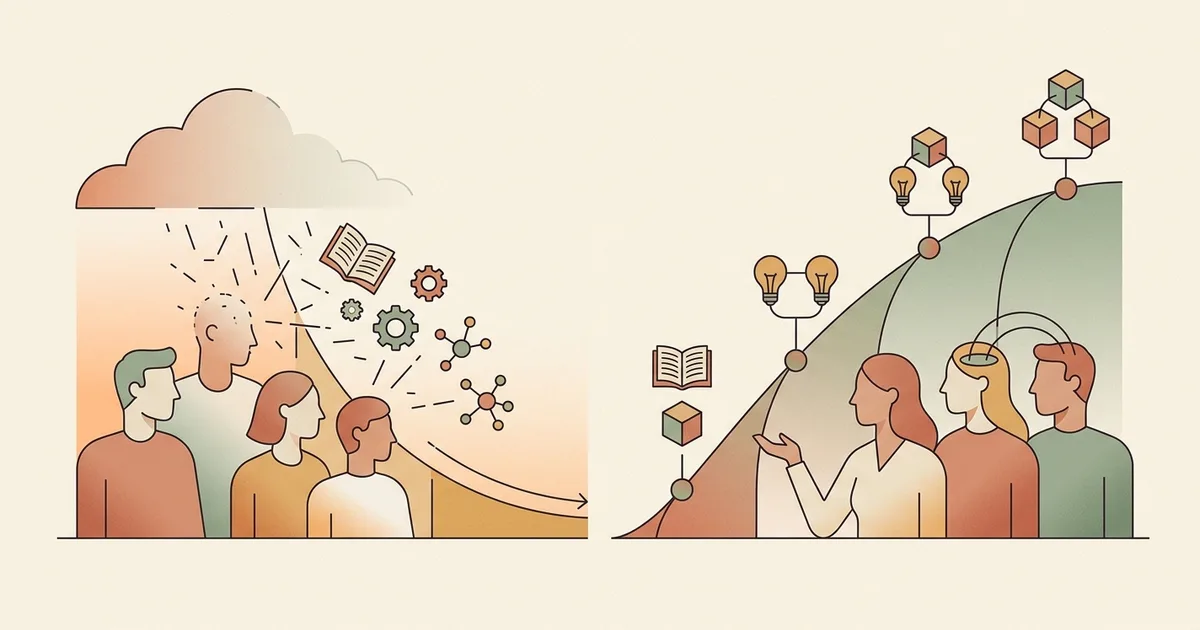
Within 24 hours, you forget about half of what you learned. Within a week, you're down to roughly 25%. Within a month, it's sparse.
This isn't a metaphor. Ebbinghaus quantified it. The forgetting curve is steep, and it doesn't flatten on its own.
What changes this trajectory? Review. But not just any review.
Why Cramming Fails
Here's what most people do. They read the material, maybe highlight some passages, feel confident, then move on. This is called maintenance rehearsal, and it barely registers in long-term memory. You recognized the words. You didn't encode them.
Cepeda and colleagues (2006) reviewed decades of spacing research and found something consistent: learning distributed over time beats massed practice every time. Cramming feels productive. It isn't.
Karpicke and Roediger (2008) ran a study where students learned word pairs, then either reviewed them repeatedly or practiced retrieving them with delays. The students who practiced retrieval remembered significantly more after a week, even though they reported feeling less confident during the process.
Confidence and competence aren't the same thing. You feel like you know something when it's in front of you. You actually know it when it's not.
What Spacing Actually Does
The mechanism matters here, so stick with me for a second.
Every time you review something, you're not just refreshing a static file. You're reconstructing the memory, pulling it from deeper storage, and re-saving it with new context. Each retrieval makes the memory stronger and more accessible. That's the testing effect in action, and it's one of the most robust findings in cognitive psychology.
But spacing matters for a different reason too. When you encounter material at increasing intervals, your brain has to work slightly harder each time. There's a brief struggle. That struggle is the point. Desirable difficulty, as Bjork (1991) called it, creates deeper encoding.
You want your brain to strain a little. Easy review doesn't stick.
How to Use This
You don't need an app. You don't need a complex system. You need three things: a way to track what you've learned, a sense of when to review it, and the discipline to actually do it.
1. Note the gaps, not the content. Most people track what they've covered. Track what you've forgotten instead. After a study session, write down questions you can't answer yet. Those gaps are where your review time goes.
2. Use expanding intervals. Your first review happens the next day. Your second review happens two days later. Your third, four days. Then maybe a week. The interval grows. This isn't arbitrary. Cepeda et al. (2006) found that longer intervals between reviews lead to better long-term retention, even if shorter intervals feel more productive in the moment.
3. Test yourself before you re-read. Don't open the book first. Try to recall what you learned yesterday. Write it out. Struggle with it. Only then look at the material to fill in what you missed. This retrieval practice is the engine of spacing.
4. Keep a simple log. Three columns: what you studied, the date, the next review date. Review the log weekly and adjust intervals based on how easily you recall each topic. Some things need shorter intervals. That's fine. Personalize it.
That's it. Track gaps, expand intervals, test before re-reading, keep a log.
Why This Gets Abandoned
Spaced review requires patience. You don't feel the benefit immediately. Cramming gives you a quick hit of familiarity. Spacing is slower and quieter.
The problem is that your brain doesn't value long-term retention when short-term relief is available. You're wired to prioritize immediate comfort. So you open the book again instead of testing yourself, because testing yourself feels harder and your brain interprets hard as bad.
This is where most people drop the strategy. They equate feeling good with learning well. They stop spacing because spacing requires sitting with discomfort.
Push through it. The knowledge you actually retain is worth the awkwardness of not feeling like an expert in the moment.
If you're currently using a single study session to learn something important, ask yourself: what's the actual goal here, fluency or lasting understanding? Because those two things rarely come from the same approach.
Put the ideas into practice
Use Piply to organize materials and practise what you’re learning.
Try Piply