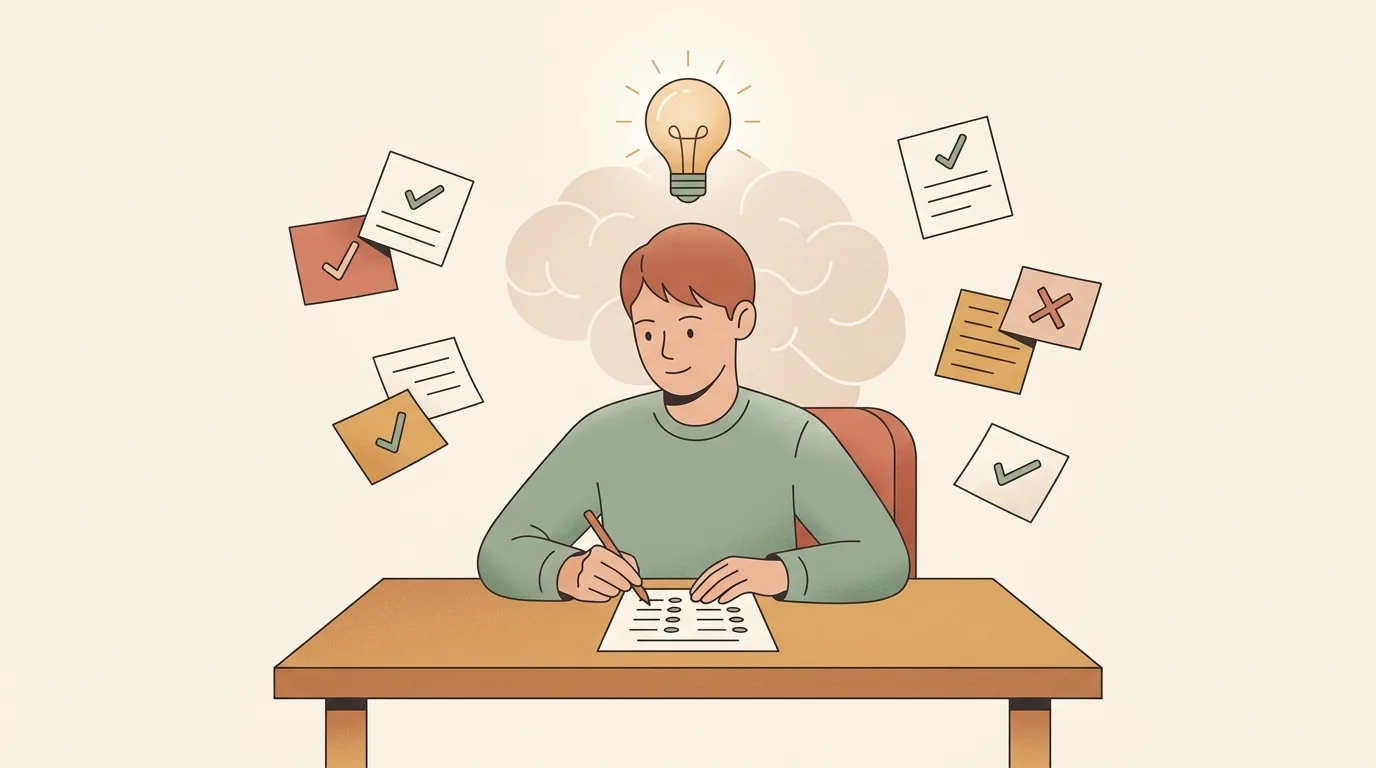
The Feynman Technique: Why Explaining a Concept Like You're Five Catches Every Gap
You've read the chapter twice. Highlighted half the paragraphs. Feels solid. Then someone asks you to explain it.
And you freeze.
That gap between "I get it" and "I can explain it" is where most studying fails. The Feynman Technique, named after the physicist who turned quantum electrodynamics into something undergrads could actually follow, exploits this exact gap. It doesn't add study time. It just makes the time you already spend count for something.
Here's the version most people have heard: pick a concept, explain it in simple terms as if to a child, notice where you falter, go back and learn that part, simplify further. Solid advice. But most people miss why it works, and without the "why" they skip the parts that matter.
The Cognitive Machinery Underneath
When you explain something out loud, your brain can't coast. Reading is passive in ways that feel active. Your eyes move across the page. You nod along. The words look familiar. But recognition is not recall, and recall is not understanding. Those are three separate things.
Explaining forces you to retrieve information from memory and reorganize it into a coherent thread. That's genuinely hard work. Your brain needs to fill in the connective tissue between facts, and that's precisely where gaps surface. The moment you stumble, the moment you reach for a word that isn't there, you've learned something about what you actually know.
Researchers have been poking at this for a while, though not always under the Feynman label. The self-explanation effect shows that students who explain material to themselves during study outperform those who just reread. Bisra and colleagues (2018) published a meta-analysis confirming that self-explanation prompts improve learning across STEM subjects. The effect holds whether you're studying biology, physics, or programming. It's not subtle.
The mechanism is more interesting than the result. When you explain, you generate connections between pieces of information that passive reading never forces you to make. Hoogerheide and colleagues (2019) found that students who explained material orally to a fictitious audience learned more than those who wrote explanations. Speaking adds a layer of processing. You hear yourself stumble. You catch the fuzzy parts in real time.
Expecting to teach changes how you encode information from the start. Guerrero and Wiley (2021) showed that students who were told they'd later teach a passage remembered more than those who expected a test, even before any teaching happened. Your brain prepares differently when it anticipates having to produce, not just recognize. That shift in processing happens at encoding, not at retrieval. It's invisible. And it matters.
Why "Like You're Five" Matters More Than You Think
The five-year-old framing gets mocked sometimes. You're not actually explaining semiconductor physics to a toddler. The constraint serves a different purpose entirely.
Jargon is armor. It protects you from having to actually know things. You can say "mitochondria are the powerhouse of the cell" and feel like you've explained something. But what does that mean? What's a powerhouse? Why does the cell need one? What happens when it breaks? Can you answer any of those without reaching for more borrowed phrases?
The Feynman technique strips that armor away. If you can't explain a concept without the technical vocabulary of your field, you don't understand it. You've just memorized the sounds. Feynman himself reportedly kept a notebook titled "Things I Don't Know," which is either apocryphal or the most on-brand thing imaginable.
Lachner and colleagues (2022) found that the quality of peer tutoring depends overwhelmingly on the tutor's content knowledge, not their social skills. Tutors with deep understanding gave better explanations, asked sharper questions, and adapted more fluidly to confusion. Surface-level tutors relied on scripts. They couldn't improvise. And their tutees absorbed less. The difference was not charisma. It was whether the tutor could reconstruct the idea from scratch.
Simplification is not dumbing down. It's translation. And translation requires you to understand the structure of what you're translating. A good Feynman explanation is harder to produce than a jargon-dense one. That's the point.
How to Actually Use It
Grab one concept from whatever you're studying. A theorem. A process. A mechanism.
Step one. Write the name of the concept at the top of a blank page. No textbook open. No notes.
Step two. Explain it out loud or in writing. Start with the simplest version you can manage. If you're explaining the citric acid cycle, begin with "cells need energy" and build forward from there. Use analogies. Draw if it helps. Talk to your wall. Talk to your dog. Record a voice memo. Whatever gets words out of your mouth.
Step three. Mark every stumble. When you reach for a term that isn't there. When a connection feels fuzzy. When you hear yourself say "and then something happens, I forget what." Do not gloss over these moments. They are the valuable part. Each one is a hole in your understanding you didn't know existed.
Step four. Go back to your source material only for those specific gaps. Not the whole chapter. Target what you couldn't explain. This is the difference between efficient review and starting over.
Step five. Explain again. This time it should flow. If it doesn't, you missed something. Repeat until the explanation stands on its own without crutches.
The whole loop takes maybe 15 minutes per concept. Compare that to an hour of rereading that leaves you with the same foggy understanding you started with. The math is not complicated.
What Most People Get Wrong
Some failure modes show up consistently.
Mistaking simplification for dumbing down. You're not removing complexity. You're translating it. A proper Feynman explanation preserves the structure of the idea while changing the language it's expressed in. That's harder than it sounds.
Skipping the second pass. You identify a gap, you glance at the textbook, and you think "oh right, I knew that." You didn't. Recognition after the fact masquerades as understanding. Our memories are far better at recognition than recall, and they're designed to trick us into thinking otherwise. You have to close the loop. Explain again. Without the source open.
Doing it in your head. Verbalizing engages different cognitive processes than silent reflection. Write it or say it out loud. The extra step of translating thought into language is where the gaps become visible. Internal monologue is too forgiving.
Only applying it to obviously hard concepts. The technique works best on things you think you already understand. The ones where you'd say "yeah, I got this, no problem." Those are almost always the ones you don't. The gap between recognition and explanation is widest right where confidence is highest.
Does the Feynman technique replace spaced repetition or active recall? No. It sits alongside them. But it fills a specific gap those methods don't touch: it diagnoses understanding, not just memory. It's a mirror, not a drill.
What's the last concept you were completely sure you understood, right up until someone asked you to explain it?
Ready to try Piply?
Turn this article into your reality. Start studying faster today.
Try Piply for Free