 iOS App
  Android App
 Study tips
Yerkes-Dodson Law: Why Moderate Stress Makes You Smarter and Panic Makes You Stupider
Piply Team
You've heard it a thousand times. "Reduce your stress." "Stay calm before the exam." "Meditate and you'll perform better."
The people who say this mean well. They're also wrong about half of it.
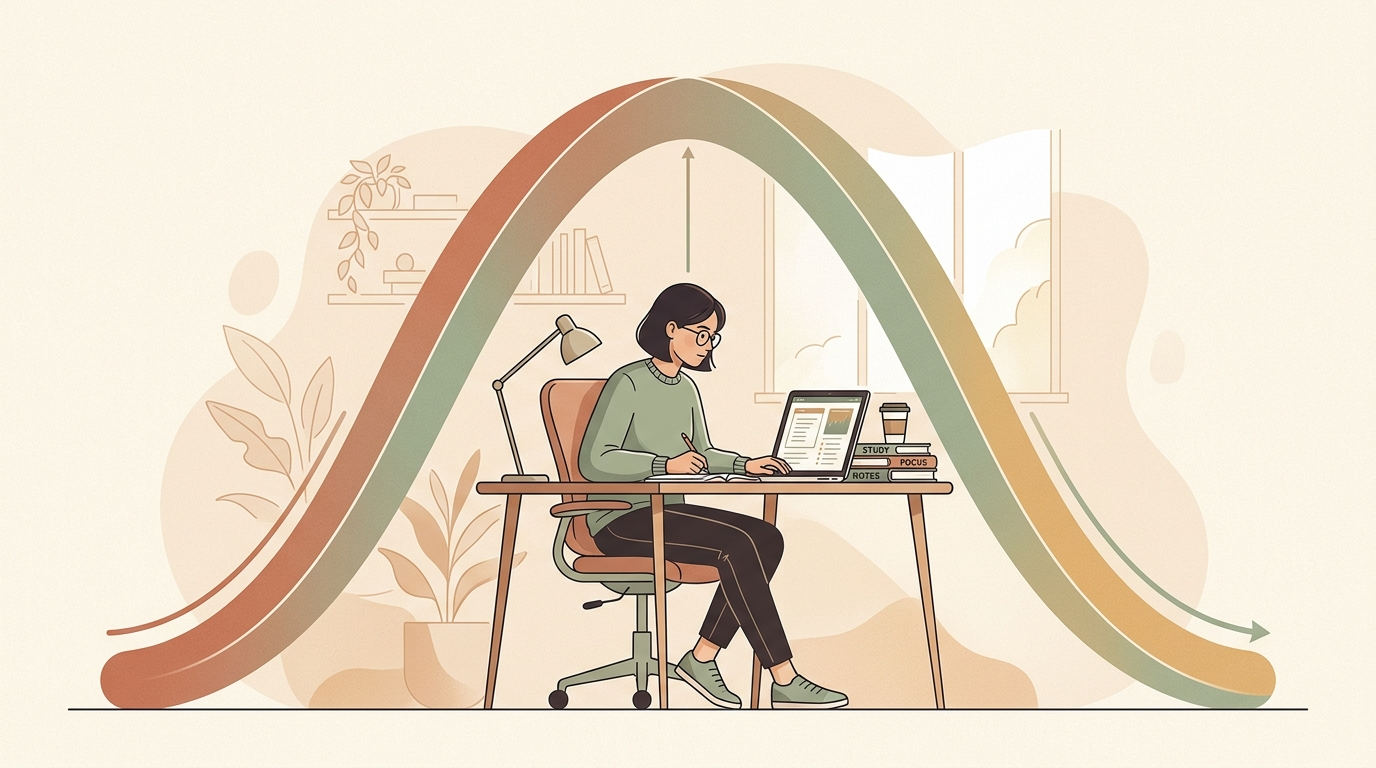
The Yerkes-Dodson law, first described by psychologists Robert Yerkes and John Dodson in 1908, doesn't tell you to eliminate stress. It tells you to find the right amount. Not too little. Not too much. The relationship between arousal and performance traces an inverted U: from bored, to focused, to panicked. The curve goes up, peaks somewhere in the middle, and then crashes hard.
Most study advice only talks about the right side of the curve. The crash. But the left side is just as real, and if anything, it's more common among students who've been told their whole lives they're "smart enough."
Think of it like caffeine. One cup sharpens you. The world comes into focus. Three cups and your hands shake. Six and you can't remember your own name. Stress works on cognition the same way, and the evidence for this has been accumulating for over a century.
What's remarkable is how durable the original finding is. Yerkes and Dodson discovered it by watching mice learn to discriminate between a white box and a black box. Mice that got mild electric shocks for wrong choices learned faster than mice that got no shocks at all. But turn the shock intensity too high, and learning collapsed. The mice didn't just perform worse. They stopped trying entirely.
And before you dismiss this as "just animal research," the same inverted-U pattern has shown up in humans across dozens of studies since. Public speaking. Math tests. Athletic performance. The nervous system you inherited from those mice hasn't had a meaningful design update.
The Mechanism, in Plain Biology
Here's what actually happens when you're moderately stressed about an upcoming exam.
Your adrenal glands release cortisol and norepinephrine. These hormones cross the blood-brain barrier and bind to receptors in your prefrontal cortex and hippocampus, the two brain regions most involved in learning and memory. At moderate concentrations, they enhance something called long-term potentiation. That's the cellular process by which neurons strengthen their connections. It is, as far as anyone can tell, the physical basis of memory itself.
Roozendaal, McEwen, and Chattarji (2009) reviewed the evidence in Nature Reviews Neuroscience. Their conclusion was unambiguous: moderate glucocorticoid levels enhance memory consolidation. This isn't a metaphor. It's not a motivational speaker's talking point. It's a direct neurochemical effect, measured repeatedly in both human and animal brains.
The problem is the window. It's narrow. Push past it and the exact same hormones start doing the exact opposite thing.
The hippocampus has two types of corticosteroid receptors. Mineralocorticoid receptors, MRs, have high affinity. They're activated even at low hormone levels and they support memory formation. Glucocorticoid receptors, GRs, have lower affinity. They only kick in when stress gets serious. And when they do, they actively impair memory retrieval (de Kloet, Oitzl, & Joëls, 1999, Trends in Neurosciences).
So your brain built a system that both helps and hurts memory. Same chemicals. Different concentrations. It's not a design flaw. It's a trade-off. The mechanism that helps you encode important threats also makes it hard to think clearly when the threat is overwhelming. Evolution doesn't optimize for exam performance.
The Mistake Most Study Advice Makes
The conventional wisdom treats stress as poison and calm as the cure. This completely ignores the left half of the Yerkes-Dodson curve. Low arousal is a genuine cognitive problem, and it's more common than people admit.
If you've ever sat down to study feeling completely indifferent about an upcoming test, you already know this. Nothing goes in. You read a paragraph and realize you've been thinking about lunch. Your brain treats the material as irrelevant because, biologically, that's exactly what it is. The hippocampus doesn't bother encoding things that don't matter.
Sapolsky (2015), writing in The Journal of Neuroscience, emphasized something most pop-science summaries skip over: the relationship between stress and cognition is not symmetric. The drop-off on the right side, the over-arousal side, is steeper and more catastrophic than anything on the left. Panic tanks performance faster than boredom does. But ignoring the under-arousal problem is still a mistake.
Lupien et al. (2007) added another wrinkle in Brain and Cognition: the cognitive effects of stress show up at cortisol levels that don't feel subjectively stressful. You can be impaired without knowing it. Your conscious experience of "feeling stressed" and your biological stress load don't always track each other. This is its own kind of trap. At least when you're panicking, you know something's wrong.
Students drift toward both ends naturally, often driven by personality. The overconfident student who's aced every practice test? Under-aroused. The anxious perfectionist who's been refreshing the grade portal since midnight? Way past the peak. The sweet spot is somewhere in between, and it isn't the same spot for every task.
This is where the 1908 finding gets genuinely useful. Harder tasks peak at lower arousal. Easy, well-practiced tasks can tolerate more stress. So if you're cramming vocabulary flashcards, a little anxiety probably helps. If you're solving a novel calculus problem, you need to be calmer than you feel like you should be.
How to Use This
The practical shift is simple to describe and hard to do. Stop trying to eliminate stress. Start trying to calibrate it.
Figure out where you sit on the curve first. Most people know in their gut. If you keep putting off studying because the material seems obvious and the exam feels far away, you're under-aroused. If you can't even open your notes because thinking about the test makes your chest tight, you're over it.
For the under-aroused, introduce mild accountability. Tell someone you'll text them a summary of what you studied by 6pm. Study somewhere public where other people can see your screen. Set a timer that forces you to produce something by a deadline. These are social-evaluative stressors, small ones, and they're often enough to bump you up toward the peak of the curve without tipping you over.
For the over-aroused, skip the affirmations. Your nervous system doesn't respond to words. Do box breathing instead: four seconds inhale, four hold, four exhale, four hold. It's mechanical. It works because it stimulates the vagus nerve, which directly downregulates your sympathetic nervous system. Your amygdala cares about CO2 levels in your blood, not your mindset.
Match the arousal to the task. This is the insight from the original 1908 paper that almost nobody talks about. Easy material can handle more stress. Hard material requires less. Study your hardest subject when you're calmest. Study the easy review material when you're a little wound up. Same amount of total stress energy, radically different outcomes depending on how you allocate it.
Pay attention to your own pattern. When did you last sit down to study and feel like everything clicked? What was your stress level? What kind of task? These are data points. Collect them. The Yerkes-Dodson curve is real for everyone, but where your personal peak sits isn't something a blog post can tell you.
The most useful thing about this century-old law is that it gives you permission to stop treating stress as a toxin. A certain amount of pressure isn't just tolerable. It's part of how learning works. Zero stress means zero encoding. The goal was never to eliminate it. The goal is the right amount, at the right time, for the right task.
Do you notice a difference in how well you study when there's a little pressure on the line versus when you don't care at all?
Put the ideas into practice
Use Piply to organize materials and practise what you’re learning.
Try Piply