Piply Logo
Piply
study-tips

Worked Examples vs. Problem Solving: When You Should Watch Before You Try

Worked Examples vs. Problem Solving: When You Should Watch Before You Try

Worked Examples vs. Problem Solving: When You Should Watch Before You Try

You know that feeling. You read a chapter, nod along, then open the problem set. And nothing. The page might as well be in another language. So you flip back, reread, try again. Still stuck. Three hours later you've "studied" and have four half-solved problems to show for it.

Most students solve this by solving more problems. Grind through the confusion. That's what studying is, right?

The evidence says otherwise. And the reason has less to do with effort and more to do with how working memory handles new information.

What Worked Examples Actually Do

John Sweller spent decades studying something that sounds obvious once you hear it: your brain has a tiny mental workbench. When you're learning something new, all the pieces fight for space on that bench. New vocabulary. Unfamiliar operations. The structure of the problem itself. If you throw all of that at working memory simultaneously, nothing sticks. The bench collapses.

Sweller's cognitive load theory, refined most recently in 2011, distinguishes between intrinsic load (how complex the material actually is) and extraneous load (how the material is presented). When you solve a problem from scratch, you're carrying both loads at once. You're trying to learn the structure of a problem while also inventing the solution path. For a novice, that's like trying to learn French grammar while writing a poem in French. One of those tasks needs to get out of the way.

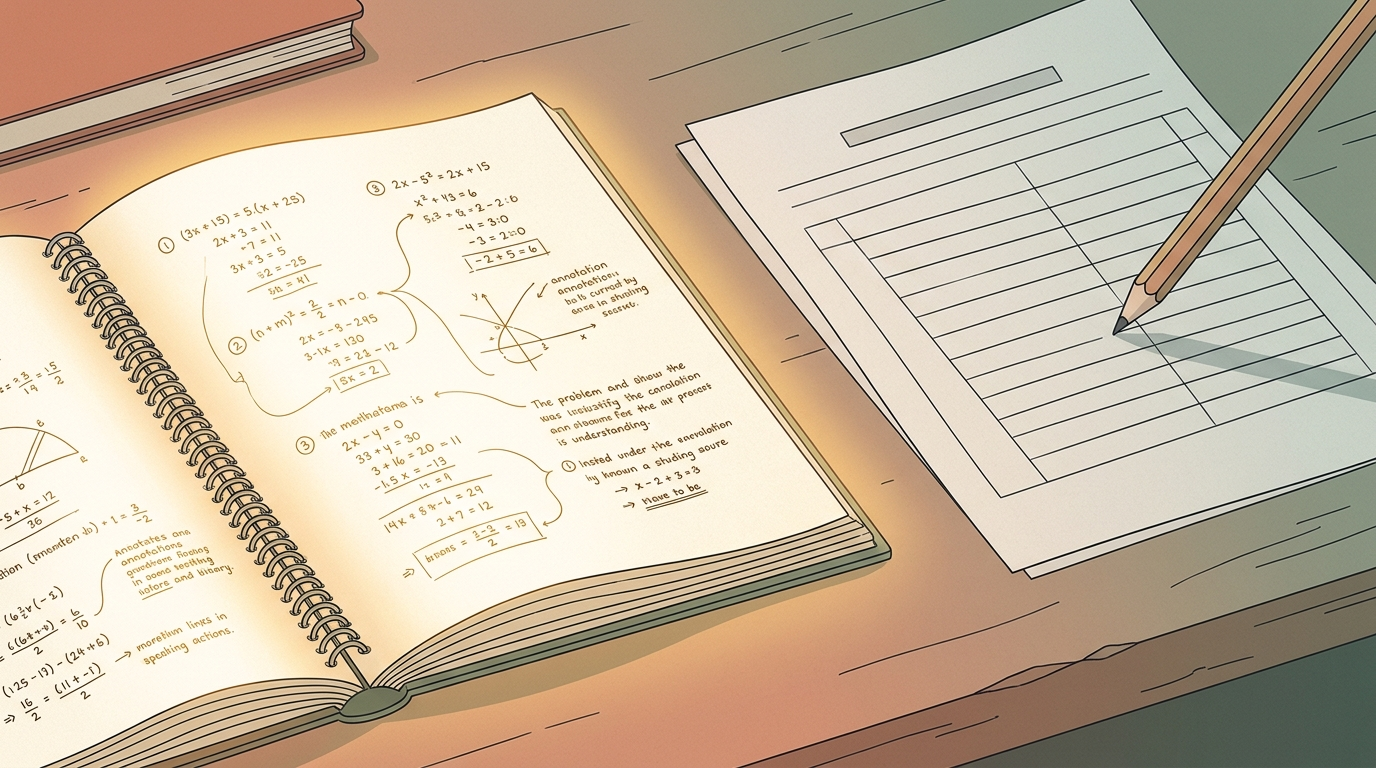
A worked example is a fully solved problem with every step shown. It removes the search. Instead of hunting for the right operation while juggling new concepts, you see the solution path laid out. Your working memory doesn't have to generate anything. It just has to understand.

The cognitive mechanism here is specific. Sweller's 2011 framework describes how worked examples slash extraneous load. They let you pour all your mental resources into building what he calls a schema, a mental framework for that type of problem. Think of a schema as a compressed file. Once you have one, ten steps collapse into one chunk. Your working memory suddenly has room to breathe.

This is why experts can solve problems that would overwhelm a novice. They're not smarter. They have better schemas. A calculus professor doesn't recalculate every derivative from first principles. They recognize the pattern and the solution path emerges automatically. Worked examples are the fastest route to that state for someone who's never seen the pattern before.

When Watching Beats Doing

A 2015 study by Van Gog and colleagues tracked how students learn troubleshooting procedures in electronics. Some groups got worked examples first, then transitioned to problems. Others started with problem solving immediately. The worked-example-first groups consistently outperformed the problem-first groups on transfer tasks, not just on similar problems, but on novel ones that required applying the principle in a new context.

Here's the part that surprises people. The worked example group also finished faster. Not because they skimmed. Because they weren't wasting time on dead ends. Every minute was spent building the right mental structure instead of reinforcing the wrong approach through trial and error. When you solve a problem without a schema, you often solve it badly. And then you remember the bad solution.

But the format matters. A worked example isn't just an answer key. The best worked examples show the reasoning between steps. They explain why the solver chose this operation rather than that one. Van Gog's research emphasizes that examples should integrate visual and textual information. If the explanation sits separately from the diagram, the learner splits attention between them and loses the benefit. The diagram and the text need to live together on the page.

The Expertise Reversal

There's a catch, naturally. Worked examples work brilliantly for novices and do almost nothing for people who already know the basics.

Kalyuga, Chandler, Tuovinen, and Sweller documented this in 2001. They called it the expertise reversal effect. When learners already had partial schemas for a topic, worked examples became redundant. The step-by-step format that had been scaffolding suddenly turned into noise. For intermediate learners, problem solving produced better learning outcomes.

The transition point is fuzzy. You don't wake up one day and switch modes. Knowledge builds in gradients. But the principle holds: as your understanding deepens, the instructional format that helped you needs to get out of your way.

This explains why some students swear by worked examples while others find them patronizingly slow. Neither side is wrong. They're just at different points on the expertise curve. The student who says "just let me do the problems" might be right, for where they are. The student who needs to see every step might also be right.

The skill is knowing which one you are, right now, for this specific topic.

How to Actually Use This

Start with worked examples, not problems. When you're brand new to a topic, do not open the problem set. Find fully worked solutions. Textbooks, solution manuals, step-by-step videos. Study the reasoning behind each step. Don't memorize the sequence. Understand why step three follows step two.

Self-explain. Renkl (2014) showed that the benefit of worked examples multiplies when you talk yourself through them. After studying a worked example, close the book and explain it to yourself. If you can't articulate why a step happens, you don't understand it yet. Go back. Self-explanation forces you to notice the gaps that passive reading hides.

Fade out gradually. Van Gog's research points toward a fading strategy. Start with fully worked examples. Then move to completion problems where the last step is missing and you fill it in. Then problems where two steps are missing. Then full problem solving. You're not jumping from watching to doing. You're sliding across a bridge, plank by plank.

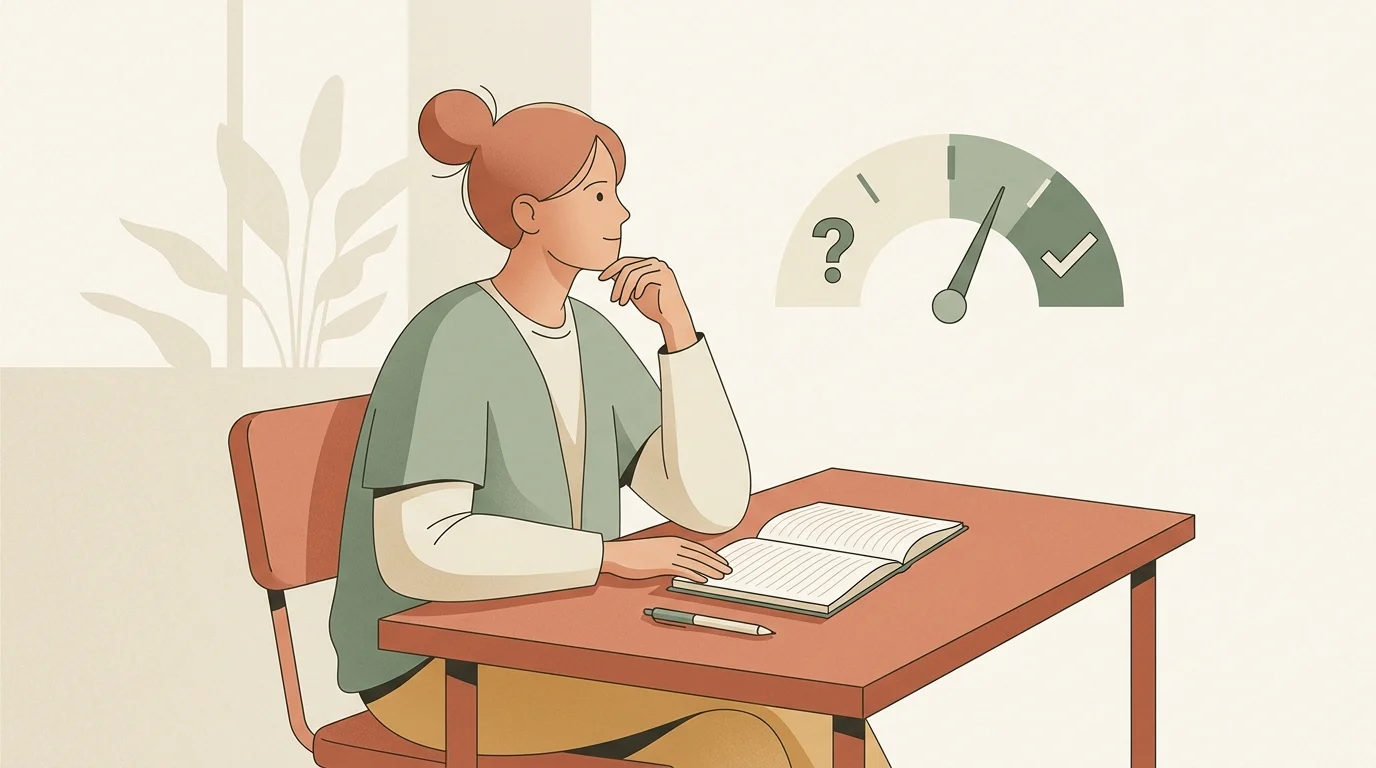
Test for the expertise reversal honestly. If you can solve the first few practice problems without peeking, you're probably past the worked-example phase. Switch to problem solving. If you're staring at a blank page for two minutes, you need more examples. Be honest with yourself here. Most students push into problem solving too early because it feels more productive. Staring at a blank page feels like work. It usually isn't.

Pair examples with retrieval practice later. Once you've internalized the schema through worked examples, spaced retrieval practice locks it in. A few days after studying worked examples, close your notes and solve problems from scratch. This combination (examples first, retrieval later) produces the strongest long-term retention in the literature. The worked examples build the structure. Retrieval practice cements it.

A common objection: "But I learn better by doing." You probably do, for things you already partially understand. That's not the same as a new topic. Walking into calculus with that mindset is like learning to drive by merging onto the highway first. You need to watch someone shift gears a few times before the pattern makes sense. After that, by all means, get behind the wheel.

What Most Study Advice Gets Wrong

The active learning movement has been so successful that it's created a kind of dogma. Passive is bad, active is good. Reading is passive, problem solving is active. Therefore, problem solving always wins.

This oversimplification misses what worked examples actually are. Studying a well-constructed worked example with full cognitive engagement isn't passive. It's structured observation. You're actively building the mental model you'll need later. The real distinction isn't passive versus active. It's productive versus unproductive.

Banging your head against problems you have no framework for is active. It's also unproductive. Watching a worked example while half-asleep is passive. Also unproductive. A worked example studied with genuine concentration, with self-explanation, with the book closed afterward to test your understanding, is the most productive use of your time as a beginner. The literature backs this up consistently, and it backs it up across decades and disciplines.

So next time you're learning something genuinely new, resist the urge to jump into problems. Watch first. Understand the shape of the solution. Then, when the schema starts forming in your head, switch modes. The transition point, not either extreme, is where the real skill lives.


What's the last topic where you jumped straight into problems and regretted it?

Ready to try Piply?

Turn this article into your reality. Start studying faster today.

Try Piply for Free