 iOS App
  Android App
 Study tips
How to Study While Working Full Time: The Working Grad Student's Survival Guide
Ben Roe
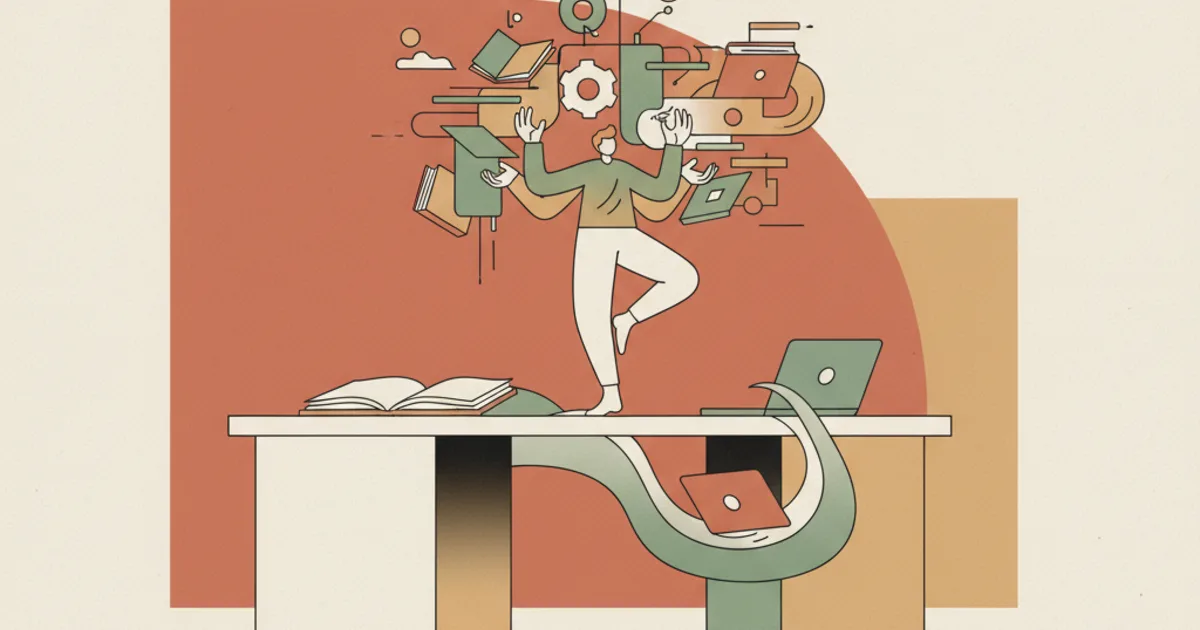
"Some days my brain is just fried when I get home."
A graduate student on r/GradSchool wrote that. She works full time, has three kids, and is writing a thesis.
She doesn't have a motivation problem. She has a capacity problem. After a full workday of meetings and decisions, her brain has nothing left to give.
She isn't alone. Across r/GradSchool, the same pattern repeats. "I wish I could afford to just work part-time, but I want my master's so that's not an option."
One student cut exercise from six days a week to three and gave up social plans entirely, still feeling like it wasn't enough.
If this sounds familiar, here is the uncomfortable truth: most advice about studying while working is written by people who have never done it. The standard tips (make a schedule, use a planner, stay organized) assume you've the same cognitive energy at 8 PM as you did at 8 AM. You don't. Pretending otherwise is how you end up staring at a textbook for 45 minutes while absorbing nothing.
This guide starts from a different premise: your brain is already partially depleted when you sit down to study. That changes everything.
The Real Problem Is Not Hours. It Is Cognitive Bandwidth.
Time management is the surface issue. Cognitive bandwidth is the deeper one.
After a full workday, your prefrontal cortex has been managing emotional regulation, making decisions, and filtering distractions for eight hours. Research on ego depletion, pioneered by Roy Baumeister, suggests self-control draws from a limited resource pool. Regardless of the replication debates, the practical experience is undeniable: making decisions all day leaves less mental fuel for deep study.
If you have two hours after work, you don't have two fresh hours. You have two hours of diminished cognitive capacity. The better question is how to make each hour deliver more when your brain is at 60 percent.
Build a Two-Mode Study System
Most students use a single study mode: deep focus.
Read the chapter. Solve the problems.
Take the notes. But when you're working full time, that mode isn't always available to you. Some days, deep focus is simply not in the cards.
The solution is to build a two-mode system.
Mode 1: Deep Work. This is for your highest-cognitive-demand tasks. New material. Difficult problems. Writing. You schedule this for your peak windows, whatever those are. For some working students, it's Saturday mornings. For others, it's 5:00 AM to 7:00 AM on weekdays before the work brain turns on. The key is protecting this window ruthlessly. No email. No phone. No multitasking.
Mode 2: Retrieval Practice. This is for your depleted hours. When your brain is fried after work, don't try to learn new material. Instead, practice retrieving what you already know. Flashcards. Practice quizzes. Explaining a concept out loud without notes. Retrieval demands less cognitive effort than learning new material from scratch, yet research consistently ranks it among the highest-effect-size study techniques. You get substantial learning from an activity your tired brain can handle.
The mistake is trying to do Mode 1 tasks during Mode 2 energy windows. That isn't laziness when it fails. That's physics.
Automate the Prep. Spend Your Time on Practice.
The average student spends 30 to 45 minutes per chapter creating study materials. Handwriting flashcards.
Typing summaries. Making outlines. Multiply that across four courses, and you've hours of prep before the actual studying begins.
A working student can't afford that. Every minute spent creating a flashcard is a minute not spent retrieving information. The prep-to-practice ratio needs to be as close to zero as possible.
This is where automation changes the equation. If you can upload a course PDF and get a complete deck of flashcards, a practice quiz, and a structured study guide in 30 seconds, you've just turned hours of prep into seconds. Your limited study window goes entirely toward practice, not preparation.
Piply does exactly this. Upload your material and it generates flashcards, multiple-choice quizzes, and organized study guides automatically. During Mode 2 evening sessions after work, you open the app and immediately start retrieval practice instead of figuring out what to do. The prep cost drops to zero, and every minute goes toward the thing that actually improves retention.
The Micro-Session Strategy
Most working students think of studying in blocks: two hours on Saturday, an hour on Wednesday evening. That mindset is correct for Mode 1 deep work. But it misses a massive opportunity for Mode 2.
Throughout your workday, you've pockets of dead time. Ten minutes waiting for a meeting to start. Fifteen minutes on your lunch break.
Twenty minutes of commute time on public transit. These pockets add up to an hour or more per day, and most students waste them scrolling.
A micro-session is a study burst of 10 to 20 minutes with one specific goal. Run through 20 flashcards. Answer five practice quiz questions. Recall key points from yesterday's reading. The goal is maintenance: keeping material active so your longer sessions build forward instead of rebuilding.
If you do three 15-minute retrieval sessions per workday, you accumulate over three hours of additional practice per week. That's time you didn't need to find. It was already there.
The key is having your study materials instantly accessible. If you need to pull out a textbook and figure out where you left off, the 10-minute window closes before you start. Your materials need to be one tap away.
Manage the Guilt Gap
There's a psychological pattern specific to working students that almost no study advice addresses. Call it the Guilt Gap.
When you're at work, you feel guilty about not studying. When you're studying, you feel guilty about not working. When you're resting, you feel guilty about both. This constant low-level guilt is cognitively expensive. It adds to your mental load without contributing anything.
Make explicit what is implicit: decide in advance what you're doing and what you aren't doing, and close the door on the rest.
When you block Saturday morning for deep study, the work emails don't exist for those three hours.
When you're at work, the chapter doesn't exist. This is simple in theory and hard in practice, but the alternative is splitting your attention across multiple domains and never being fully present.
That's the fastest route to burnout.
The Working Student's Weekly Template
Here is a concrete structure you can adapt. It assumes a standard Monday to Friday work schedule, but the principles apply to any pattern.
Weekdays: Micro-sessions during downtime at work (lunch, commute, gaps between meetings). After work: one 30-minute Mode 2 retrieval session using pre-made flashcards and quizzes. No new material. Just practice and review.
Saturday morning: one Mode 1 deep work block. Two to three hours. New material, difficult problems, writing assignments. This is your highest-use window. Protect it.
Saturday afternoon and Sunday morning: flexible Mode 2 sessions. Catch up on reading, run through practice quizzes, review weak areas identified during the week.
Sunday evening: a 20-minute weekly review. What did you cover?
What is still weak? What is coming up? Set priorities for the week ahead.
Total committed study time: roughly 8 to 10 hours per week, not counting micro-sessions. The difference is that every hour matches the right mode to the right energy level, with zero time lost to prep.
What Nobody Tells You About This Life
Balancing full-time work and graduate study is hard in a way that people who have not done it can't fully understand. The students on r/GradSchool who say "I cut exercise, I cut friends, and it's still not enough" aren't failing. They're running a system that was designed for a different reality.
The system needs to change, not the person.
Study when your brain can study. Automate the prep so your minutes go to practice.
Use micro-sessions to maintain what you've learned. Close the door on one domain while present in another.
You don't need more hours. You need a system that works with the hours you actually have, at the energy level you actually show up with.
Piply turns your course materials into flashcards, quizzes, and study guides in about 30 seconds. No prep. Just practice.
Try it for free at piply. ai.
Put the ideas into practice
Use Piply to organize materials and practise what you’re learning.
Try Piply