 iOS App
  Android App
 Study tips
The Testing Effect: Why Practice Tests Work Better Than Rereading Every Time
Piply Team
The Testing Effect: Why Practice Exams Are Your Most Powerful Study Tool
Here's something most students don't realize: every time you reread your notes, you're wasting time. I know that sounds harsh. But the research is unambiguous, and once you understand why practice testing works so much better than passive review, you'll never underline a textbook the same way again.
The Science Behind It
In 1932, a psychologist named Henry Roediger was running memory experiments, trying to figure out why some study methods stick and others fade. What he found, alongside Karpicke, would reshape how we think about learning entirely.
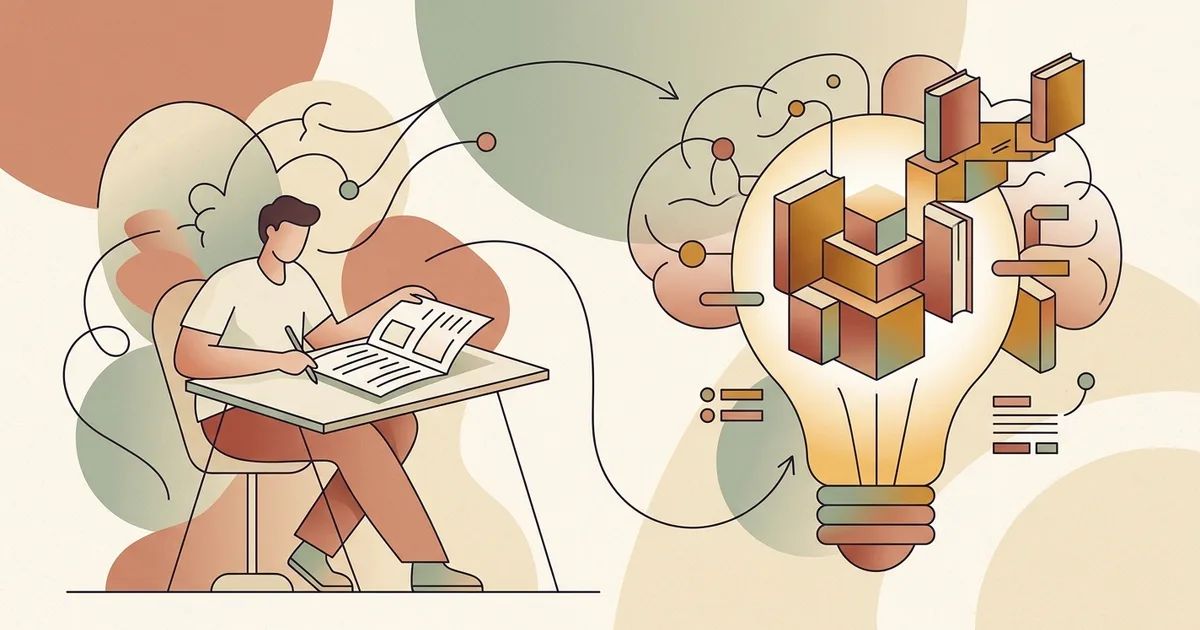
The testing effect. sometimes called the retrieval practice effect. describes a surprisingly simple phenomenon: the act of retrieving information from memory makes that information easier to recall later. Not just a little easier. Dramatically easier. Roediger and Karpicke (2012), writing in Psychological Science in the Public Interest, reviewed decades of research and concluded that practicing retrieval produces learning that is far superior to passive restudying. Students who read a text once then practiced recalling it remembered nearly twice as much a week later compared to those who read the same text three times.
Why does this happen? When you pull information out of your brain, you strengthen the neural pathways connected to that knowledge. Each successful retrieval slightly modifies those pathways, making the next retrieval faster and more reliable. (Don't think of it like a muscle, though. That's a metaphor that breaks down almost immediately. Think instead of a path through a forest. every time you walk it, the trail gets clearer.)
Meanwhile, rereading creates an illusion of fluency. The text looks familiar. You feel like you know it. But familiarity is not the same as memory, and the difference becomes brutally obvious the moment you sit down for the actual exam.
There's also the matter of what cognitive psychologists call desirable difficulty. Retrieval is hard. It requires effort. That difficulty is not a sign you're studying wrong. it's the mechanism through which learning actually happens. Bjork (1994), writing in the journal Memory, argued that conditions which make performance feel worse in the moment often produce superior long-term retention. You feel like you're struggling during practice testing because you genuinely are struggling. That struggle is the point.
The effects aren't small or marginal either. Aderet (2022) and colleagues, studying Israeli college students, found that students who completed practice exams scored significantly higher on final exams than students who used the same time for additional lecture review. The practice exam group didn't just do better. They did better by a margin that would change letter grades.
How to Use This
So what does this look like in practice? It means deliberately shifting from passive to active study behaviors, especially as exams approach.
Start with your course materials. Identify the key concepts, definitions, and problem types that will appear on the exam. Don't open your notes yet.
Close everything. Literally close your laptop, shut the textbook, put your phone in another room. Try to write down or verbally recite everything you remember about a specific topic. This is uncomfortable. You will feel like you're doing it wrong. You're not.
Check, then close again. Open your notes. See what you got right. See what you got wrong or incomplete. Now close the notes one more time and try the same retrieval. The second attempt is where a lot of the learning happens.
Use practice exams as diagnostic tools, not confidence boosters. If you take a practice exam and score well, that's useful information. But the real value comes from the questions you got wrong. Those gaps tell you exactly where to direct your retrieval practice next. Make a list of the topics that tripped you up and practice those specifically, rather than re-reading chapters you already know.
Space your practice over days, not hours. One hour of retrieval practice spread across three days outperforms three hours crammed into a single evening. This connects to what Bjork and colleagues call desirable difficulty again. the spacing effect compounds the testing effect. Two layers of difficulty working together.
Convert other study tasks into retrieval tasks. Instead of reading your notes, cover them and try to explain a concept out loud as if you were teaching someone. Instead of reviewing flashcards passively, flip through them and force yourself to recall before looking at the answer. This turns any study material into a practice exam.
The Honest Picture
I want to be direct here. Practice testing is harder than rereading. It requires more mental effort, it feels less productive in the moment, and you will probably feel worse about your performance early on. That's not a bug. That's the mechanism.
Students consistently overestimate how well passive review works. They underestimate how well retrieval works. Part of this is because retrieval practice feels harder, and we conflate feeling bad with doing badly. But the data is clear. the students who struggle through practice exams perform better on the real thing.
There's also a practical consideration worth naming. Some subjects lend themselves to retrieval practice more naturally. If you're studying history, try explaining causes and consequences without notes. If you're in a STEM course, work through problems with the textbook closed before checking your work. If you're learning a language, force yourself to recall vocabulary before looking at a word list. Every subject has a retrieval version.
The timing question is worth considering too. You don't need to wait until exam week. Incorporating practice testing throughout the semester means you're building retrieval pathways incrementally rather than trying to build them all at once right before the exam.
One more thing. don't confuse practice testing with simply completing old exams. If you take a practice exam while glancing at your notes between questions, you're not practicing retrieval. You're practicing looking things up. The difficulty is what matters. Keep the notes closed.
The Bigger Implication
This reframes what studying actually is. Studying is not consuming information. Studying is practicing the act of remembering. Every time you test yourself, you're doing the real work of learning, even if it feels like you're doing less.
Most of the study advice students receive. read carefully, highlight important passages, rewrite your notes. focuses on input. The testing effect tells us the output matters more. Pulling information out is harder than putting it in. That difficulty is why it works.
So the next time you sit down to study, ask yourself one question before you open anything: am I trying to put information in, or am I trying to pull information out? Because one of those is actual studying.
What's the study method you currently rely on most, and have you ever tried turning it into a retrieval exercise instead?
Put the ideas into practice
Use Piply to organize materials and practise what you’re learning.
Try Piply