 iOS App
  Android App
 Study tips
Exercise and Memory: Why 20 Minutes of Walking Before an Exam Changes Your Score
Piply Team
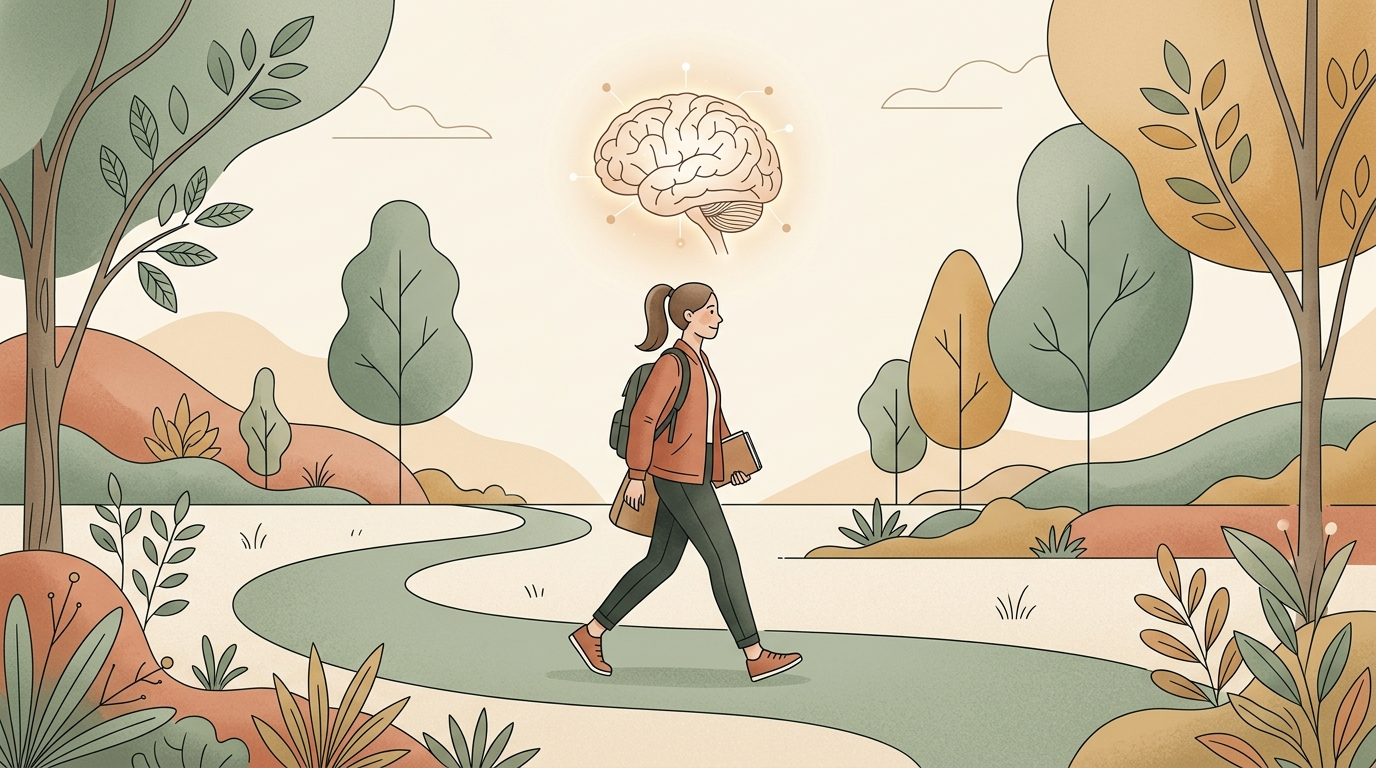
Most students treat exam day like a lockdown. Wake up, cram, chug caffeine, cram some more. Moving your body before the test feels indulgent. Like you're stealing time from the stuff that actually matters.
That instinct is wrong in a very specific, very measurable way.
A 20-minute walk before your exam isn't a luxury break. It's a direct neurological intervention. And the mechanism has nothing to do with "clearing your head."
What Actually Happens When You Move
Your brain runs on a protein called BDNF, brain-derived neurotrophic factor. Think of it less as fuel and more as the construction crew that maintains the roads. BDNF builds and strengthens synapses, the junctions where neurons talk to each other. Without enough of it, new memories form slower and decay faster.
Exercise triggers a sharp BDNF spike. Within minutes of moderate aerobic activity, the hippocampus gets flooded with it. And the hippocampus is where your brain encodes declarative memories. The names, dates, formulas, and definitions you need for the exam.
Suwabe and colleagues demonstrated this cleanly in 2018. They had young adults do 10 minutes of light cycling, then tested hippocampal function immediately after. The result wasn't subtle. Pattern separation, the brain's ability to tell similar but distinct memories apart, improved significantly. That's the exact skill you need when two economics theories blur together on a multiple-choice question, or when you're trying to remember which enzyme does what in which step of glycolysis.
What's striking is the dose. Ten minutes. Light effort. Not a workout. Not training. Just moving.
Timing Is Everything (Almost)
Here's where most people get the science sideways. They hear "exercise is good for your brain" and assume that means running a 5K three times a week will help them on finals. It will, over the long term. But acute exercise, the kind you do right now, today, works through a different window.
Loprinzi and colleagues reviewed the evidence in 2019 and found a consistent pattern: exercise before encoding improves recall. Exercise after encoding helps consolidation. And exercise right before retrieval boosts test performance. The effects peak at moderate intensity and last roughly one to two hours.
This means you have three opportunities on exam day.
You can walk before your final review session, when you're still encoding material. You can walk after studying, to help the consolidation process lock it in during sleep. And you can walk right before the exam, to raise your retrieval baseline when it matters most.
The middle one is underrated. Most students finish their last review at 10pm and collapse into bed. A 15-minute walk between closing the textbook and brushing your teeth gives your hippocampus a BDNF bath right as consolidation begins. That's a window worth exploiting.
Why Walking Specifically
Running works too. But walking has a few advantages nobody talks about.
First, it's self-paced. You can't accidentally gas yourself 45 minutes before an Organic Chemistry final. Moderate intensity means you can still hold a conversation, which for most people is a brisk walk, not a jog.
Second, it has basically zero coordination cost. Your brain isn't spending resources tracking pace, watching for traffic at high speed, or managing the biomechanics of a stride. It's cruising. And that leaves cognitive bandwidth for the kind of diffuse thinking that actually helps with insight and integration.
Third, you can do it anywhere. Around the building. Down the hallway. Parking lot laps. You don't need a gym, a shower, or a change of clothes. That matters when you're already anxious about being late.
Stillman and colleagues, writing in Trends in Neurosciences in 2016, mapped the mechanisms across age groups. The pattern holds: even in young, healthy brains, exercise acts as a cognitive primer. It doesn't teach you the material. It lowers the resistance to accessing it.
The Hippocampus Is Hungry
There's a deeper story here about hippocampal metabolism. The dentate gyrus, a subregion of the hippocampus, is unusually sensitive to metabolic shifts. It's one of the few brain regions that continues generating new neurons into adulthood. Those newborn neurons need BDNF to survive and integrate.
When you sit still for six hours straight, hippocampal glucose metabolism drops. Not dangerously. Just enough to slow the machinery of recall. A brisk walk reverses that drop in under 10 minutes.
This isn't about fitness. It's about signaling.
Your body evolved to move, then think. Not the other way around. The machinery for encoding and retrieving memories is coupled to the machinery for locomotion because for most of evolutionary history, moving through space meant encountering new information worth remembering. Where the food was. Which path had the predator. That coupling never went away. It's still there, waiting for you to stand up and use it.
How to Use This
The simplest protocol: walk for 15 to 20 minutes at a pace where you could talk but wouldn't want to sing. Do it 30 to 60 minutes before your exam. Don't listen to a review podcast. Don't quiz yourself with flashcards while walking. Just walk.
If your exam is in the afternoon, walk in the morning too. Not for memory, exactly. For attention regulation. Moderate morning exercise improves sustained attention for hours afterward. You'll study better, which means you'll encode more of what you review.
For multi-exam weeks: walk after each exam, not just before the next one. The BDNF spike helps clear the cognitive residue of the test you just finished. You'll start the next review session with less interference from the material you've already been tested on.
A few things that don't work: high-intensity intervals right before a test. The cortisol response can impair retrieval. Same goes for any exercise that leaves you physically drained. And don't try to learn new material during the walk itself. Divided attention during encoding produces weaker memories. Let the walk be a walk.
Kandola and colleagues, in a 2016 review in Neuroscience & Biobehavioral Reviews, traced the antidepressant effects of exercise through the same BDNF pathway. But they also noted something relevant here: the cognitive benefits are independent of mood improvements. You don't need to feel better after the walk for it to work on your memory. It works anyway.
So the kid who's nervous, pacing, doesn't feel "refreshed" after their pre-exam walk. They still got the BDNF. They still got the hippocampal boost. The machinery does its thing whether you subjectively notice it or not.
The Thing Most Students Don't Know
Here's what gets me about this research. It's not obscure. Suwabe's PNAS paper has been cited hundreds of times. The BDNF-exercise link is one of the most replicated findings in neuroscience. And yet the standard pre-exam ritual hasn't budged.
Students are still sitting in hallways, hunched over notes, trying to force one more fact into short-term memory that's already overflowing. They're doing the thing that feels productive instead of the thing that actually produces results.
Maybe that's the real insight. We trust cognitive effort. Reading, re-reading, highlighting, rushing through flashcards. It feels like work. Walking feels like slacking off. But the evidence doesn't care how it feels.
Twenty minutes. Moderate pace. No headphones. No notes. That's it. That's the whole intervention.
If you want to be the student who walks into the exam hall while everyone else is doing last-minute panic review, you'll be the outlier. You'll also probably score higher.
What's the exam-day ritual you currently swear by, and have you ever tested whether it actually helps?
Put the ideas into practice
Use Piply to organize materials and practise what you’re learning.
Try Piply