 iOS App
  Android App
 Study tips
Elaboration Learning: How Asking 'Why' Transforms Surface Knowledge Into Deep Understanding
Piply Team
Elaboration Learning: How Asking "Why" Transforms Surface Knowledge Into Deep Understanding
You've read the chapter three times. You highlight key phrases. You re-read your notes. And still, come exam day, you draw a blank the moment a question asks you to apply what you know.
Here's the uncomfortable truth: re-reading and highlighting feel productive. They aren't. Research consistently shows these strategies create an illusion of fluency while doing almost nothing for long-term retention or understanding.
But there's a technique that does work. It's simple. It's uncomfortable. And it will change how you learn if you give it a real shot.
It's called elaboration. And it starts with a single question: Why?
The Science Behind Asking Why
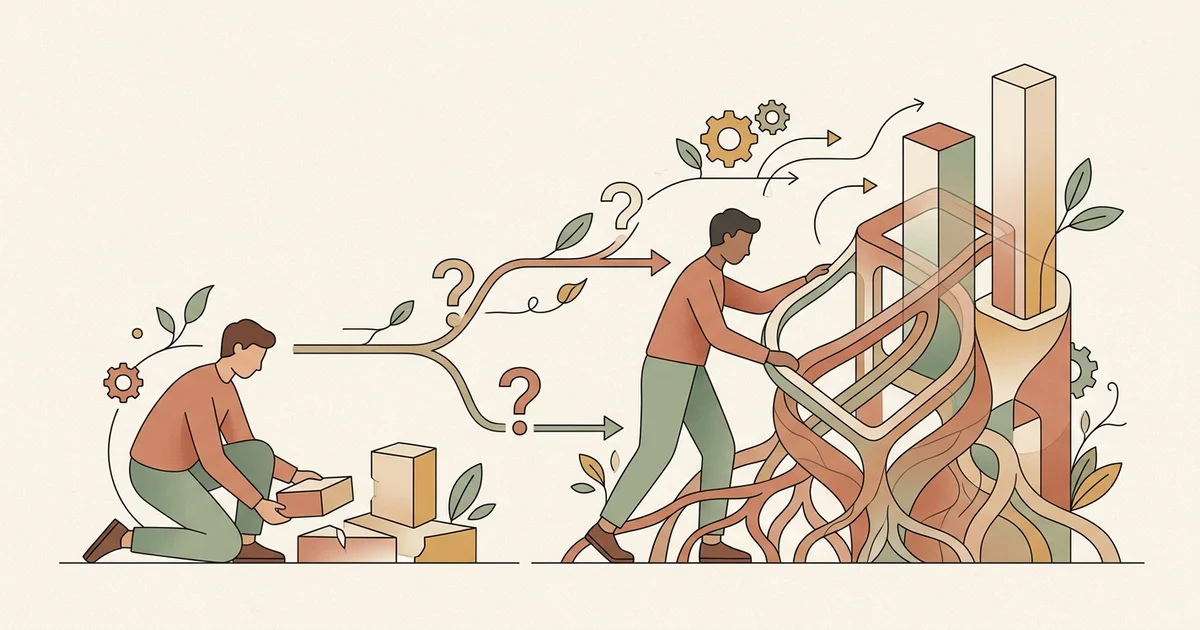
Elaboration is the process of connecting new information to existing knowledge in rich, meaningful ways. Instead of storing facts as isolated points, you weave them into a web of understanding. The question "Why is this true?" forces your brain to hunt for connections it would otherwise skip.
The evidence here is robust and goes back decades. Woloshyn, Willoughby, Wood, and Willson (1990) tested this directly. They had students read statements like "A pound of lead is heavier than a pound of feathers." Students who were simply asked to rate how obvious each statement seemed performed poorly on later tests. Students who were asked "Why is this true?" performed significantly better. even though both groups had the same reading time.
Why does this work?
When you ask why, you trigger a cascade of mental activity. Your brain doesn't just retrieve the fact. It searches for the explanation, the context, the underlying mechanism. That search process itself strengthens the memory. You're not just receiving information. You're constructing understanding.
Pressley and colleagues (1987) found something similar. They showed that students who generated explanations during learning recalled significantly more than students who simply studied the same material twice. The act of generating. not just receiving. explanations is where the learning lives.
Reder and Anderson (1980) offered another angle. They compared students who read textbook passages with students who read summaries of those passages. You might expect the fuller text to produce better learning. It didn't. Students who read summaries actually performed better, because summaries force elaboration. They present information compactly, which pushes your brain to fill in the gaps, to ask "what does this mean?"
The pattern is consistent across studies. Understanding doesn't come from taking in more information. It comes from working with the information you have.
Why Most Students Get It Wrong
Here's the trap. When you encounter something new, your brain's first instinct is to nod along. "That makes sense. Okay, moving on." This is called fluency illusion. the feeling of understanding that happens when information is presented clearly. You read it, it sounds right, you check it off.
But clarity is not the same as learning. You can read a chapter on cellular respiration and understand every sentence in the moment. That doesn't mean you can explain why ATP synthase rotates, or predict what happens when oxygen is unavailable, or connect it to why you feel burning in your muscles during exercise.
Surface knowledge looks like learning. Deep understanding lets you do things with what you know.
The difference isn't effort or time. It's the type of processing your brain performs. Passive review triggers shallow processing. your brain recognizes the words and moves on. Elaboration triggers deep processing. your brain integrates the new information with what it already knows, builds connections, and constructs meaning.
And here's the thing: deep processing feels harder. It takes more mental energy. You might even feel like you're understanding less, because you're not cruising through the material smoothly.
Trust that feeling. The discomfort means your brain is doing real work.
The Elaboration Strategy in Action
Let me show you what this looks like in practice.
Say you're learning about the placebo effect. A surface approach: read the definition, highlight "patients improve after receiving inactive treatment," move on.
An elaboration approach: pause after that sentence and ask why. Why would an inactive treatment make someone feel better? What does this tell us about the brain's relationship with expectation? How might this connect to how pain works, or how advertising influences behavior?
Now you're not just storing a fact. You're building a framework. The placebo effect starts to connect to cognitive psychology, neuroscience, medicine, even economics. When you encounter it again, you won't just remember the definition. You'll have a web of associations that makes the concept almost impossible to forget.
The same technique applies to history, literature, chemistry, anything. Read a statement of fact. Stop. Ask why it happened that way. Ask how it connects to causes you already understand. Ask what the consequences were. Ask what would be different if one detail had changed.
This is uncomfortable. It slows you down. Do it anyway.
How to Use This
Here's where most advice falls apart. It tells you what to do in theory and leaves you guessing at execution. Let's fix that.
1. Before you read, activate what you already know.
Spend two minutes writing down everything you think you know about a topic. Don't check sources. Don't worry about being wrong. This creates a framework for new information to connect to. When you encounter the actual material, you'll naturally start asking "how does this fit with what I wrote?"
2. While reading, pause every two to three paragraphs.
Ask: "Why is this true?" and "How does this connect to what I already know?" If you can't answer those questions, re-read the passage and try again. Don't just keep moving.
3. Explain concepts aloud to yourself.
After finishing a section, close the book and explain it as if you're teaching someone else. This is where gaps in your understanding become obvious. When you hit a gap, that's not failure. that's information. Go back and elaborate specifically on that weak point.
4. Turn facts into if-then relationships.
Every fact has a why buried underneath. "The heart has four chambers." Why? Because oxygenated and deoxygenated blood need to stay separate for efficient circulation. Why? Because mixing them would reduce how much oxygen reaches tissues. Now you understand the four chambers, not just know they exist.
5. Review with questions, not re-reading.
Don't re-read your notes or textbook. Instead, quiz yourself with "why" questions. "Why does X happen?" "Why does that matter?" If you can't answer, you've found something to study. That's the point.
The harder you make learning feel in the moment, the better you'll remember it later. This isn't intuition. It's one of the most replicated findings in cognitive psychology. Bjork calls them "desirable difficulties". obstacles that slow you down and force deeper processing, ultimately producing stronger, more durable knowledge.
Elaboration is one of those difficulties. Use it.
What's something you're currently studying where asking "why" might change how well you understand it?
Put the ideas into practice
Use Piply to organize materials and practise what you’re learning.
Try Piply