 iOS App
  Android App
 Study tips
Context Dependent Memory: Why Studying in Your Exam Room Helps You Remember
Piply Team
There's a reason cramming in your bedroom feels good and yet leaves you stranded during the actual exam. You memorized those notes horizontal, pillow-adjacent, and now you're supposed to recall them sitting upright in a hard plastic chair under fluorescent lights. Your brain is not broken. It's just confused about where it is.
Context-dependent memory is one of the most reliable findings in cognitive psychology, and it's been sitting there waiting for students to actually use it.
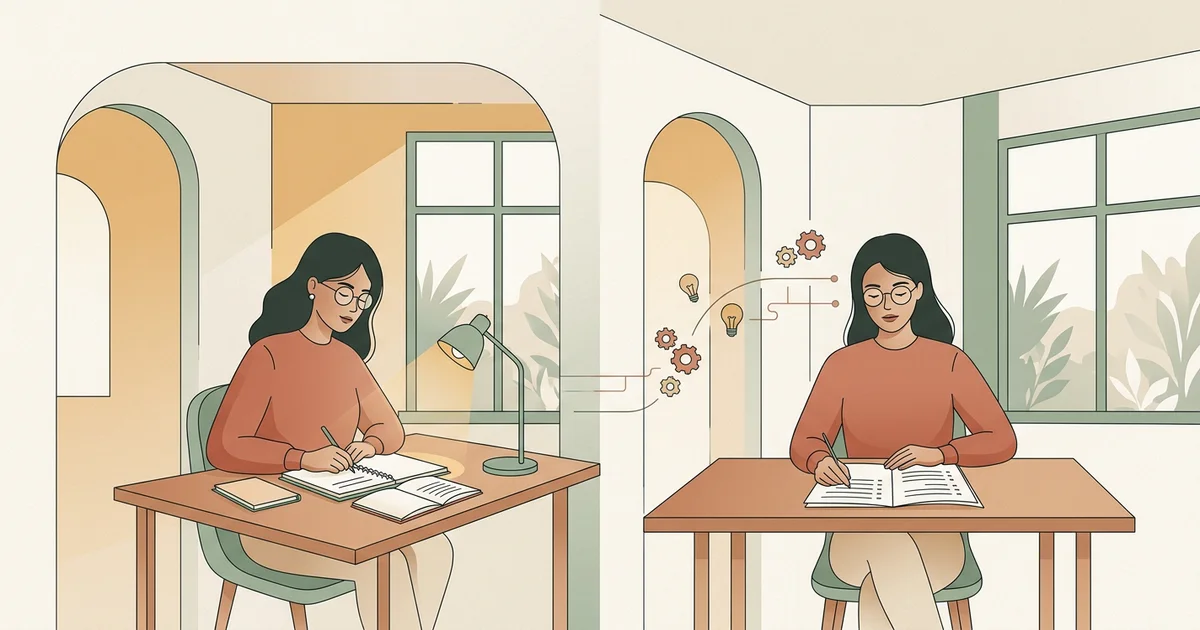
The idea is straightforward: your brain encodes memories alongside the environment around you. The sounds, the lighting, the furniture, even the smell of a room all become part of the memory trace. When you return to that same context later, those environmental cues act like handles, helping you pull the right information back out. When the context changes, those handles disappear. You haven't forgotten. you're just in the wrong room.
This isn't speculation. Godden and Baddeley (1975) had scuba divers memorize word lists either on the beach or underwater, then recall them in the same or different environment. The divers remembered significantly more words when they learned and recalled in the same location, whether that was dry land or fifteen feet deep. The implication hit researchers immediately: if underwater word recall works better with matching context, why wouldn't the same principle apply to studying and exams? The findings have held up for decades, and the effect shows up consistently across different types of material. not just word lists.
Grant Duncan at the University of Canterbury extended this into something more immediately relevant. He found that students who studied in their actual exam rooms performed better on tests than students who studied elsewhere, even when the material was identical. No tricks, no extra study time. Same content, different location. The room itself became part of the study strategy.
The mechanism behind this isn't mystical. When you encode information, your brain forms associations between the new material and the sensory and spatial details surrounding you. These associations create multiple pathways back to the memory. Think of it like leaving breadcrumbs. the more trails you have leading to the same place, the more likely you are to find it. When you study in the same room where you'll be tested, every environmental detail reinforces the same retrieval route. When you study somewhere else, you're building a path through a different forest and then trying to follow it in unfamiliar territory.
There's also the matter of cognitive busyness. Your exam room is probably not your favorite place. It might be sterile and uncomfortable. That discomfort actually works in your favor here. If you've only ever engaged with the material in that space, your brain associates the mental effort with the room naturally. When you walk in on exam day and feel that familiar institutional chill, your memory doesn't have to translate between contexts. the room and the knowledge are already speaking the same language.
Some researchers argue the effect is strongest when the match is physical and literal. same room, same seat if possible. Others suggest partial matching helps too, like studying in the same building even if not the exact room. The evidence leans toward exact matching being more powerful, but the practical takeaway is that even imperfect overlap beats none.
Here's what matters: this doesn't mean you should only ever study in your exam room. That would be its own trap. If you never practice retrieving information in different contexts, you lose the flexibility to adapt. A better frame is context-dependent memory as your secret weapon for consolidation, not your only study location.
How to Use This
Choose your primary study room intentionally. If you know where your exam will be held, that room should be your main study space for that subject in the weeks before the test. Request access, find an empty seat, and treat it like your classroom.
Match the physical setup. Sit at a desk rather than a couch. If the room has hard chairs, study in a hard chair. You're not trying to be uncomfortable. you're building consistent environmental cues. The goal is sensory overlap.
Study during the same time of day when possible. Lighting and ambient noise shift across the day, and your alertness level changes too. If your exam is at 9 a.m., do your serious review sessions in the morning. Time of day is part of the context package your brain records.
Don't abandon varied practice entirely. Mixing up where you study has real benefits for long-term retention and transfer. Use context-dependent matching as your final layer, not your only strategy. A good approach: study the material widely first, then do your final review sessions in the exam room itself.
Bring the room to you if you can't get in. If you genuinely can't access the exam room ahead of time, recreate key features. Use similar lighting if you can. Play ambient sound from the room if you've been there before. The goal is approximate matching, not perfection.
The reason this technique gets overlooked isn't that it's complicated. It's that it's inconvenient. Real exam rooms are often locked, booked, or uncomfortable. Doing things the easy way. curled up in bed with your laptop. costs nothing and feels good in the moment. But the exam room doesn't care how comfortable you were when you learned the material.
What the Research Actually Shows
Context-dependent memory is real, replicable, and meaningful. The evidence spans decades and methodologies. But it's not magic. It's not a replacement for putting in the hours. What it is, is a way to make the hours you put in work harder for you. a quiet optimization that sits underneath everything else you're already doing. You're not cheating the system. You're just meeting it on its own terms.
So next time you cram at your desk and walk into a cold lecture hall, ask yourself: what would change if you brought the study session to the exam room instead?
Put the ideas into practice
Use Piply to organize materials and practise what you’re learning.
Try Piply