
 iOS App
  Android App
 Study tips
Automaticity: Why Reading Fluency Predicts Calculus Success Long Before You Touch Algebra
Piply Team
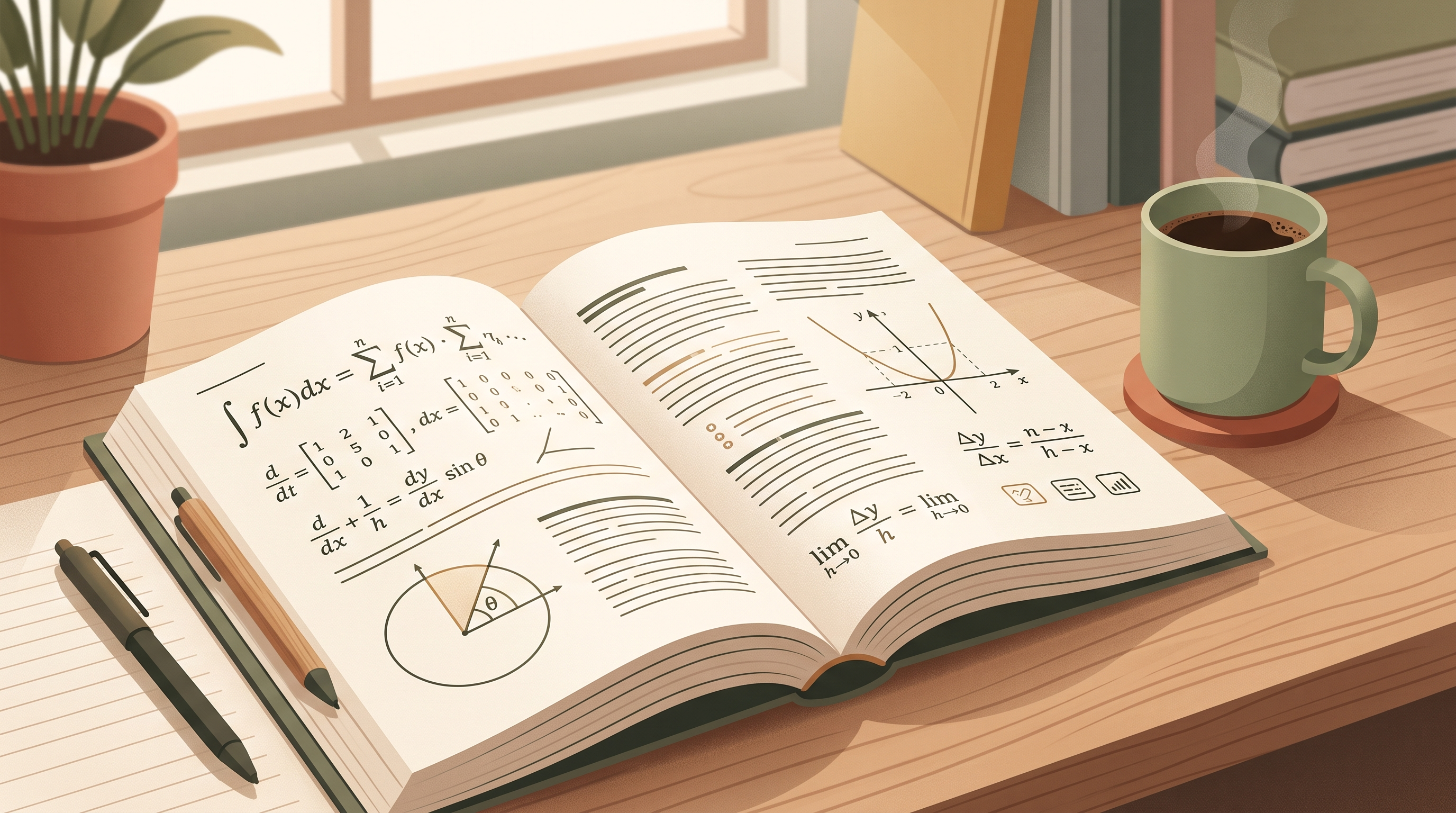
There's a version of this story that plays out in lecture halls every semester. A student who did fine in algebra, who understood the mechanics of equations, gets to calculus and suddenly hits a wall. They review the prerequisite material. They drill the basics. They do more problems than anyone else in the group chat. And still, something feels slow, effortful, disconnected.
The tutors usually suggest they go back and strengthen their algebra foundations. Sometimes that's right. But a growing body of evidence points at something less obvious, something most study guides never mention: the student's reading fluency.
Not reading comprehension. Not vocabulary. Reading fluency: the ability to process text without consciously decoding it.
What Automaticity Actually Means
The term comes from David LaBerge and S. Jay Samuels, who proposed in 1974 that skilled performance in any domain depends on making certain processes automatic. When a process is automatic, it runs with minimal demands on your attention. Your working memory is freed up for higher-level thinking.
Think of driving. When you first learn, every action takes deliberate thought: checking mirrors, judging distance, coordinating the pedals. After years of practice, you can drive while holding a conversation, planning dinner, or working through a problem in your head. The low-level skills became automatic and stopped consuming your mental bandwidth.
The same thing happens with reading. A beginner decodes each word letter by letter, sounding things out, working to identify even common words. Over time and with enough practice, word recognition becomes instant. A fluent reader doesn't sound out "the": they see it and understand it in one motion.
This is the shift researchers call automaticity in reading. It's not about intelligence. It's about practice and exposure reaching a threshold where the skill stops competing for cognitive resources (LaBerge & Samuels, 1974, Journal of Educational Psychology).
Why This Matters for Math Class
Here's where it gets uncomfortable for anyone who thinks math is purely about numbers.
Math textbooks are dense. A single page of a calculus or statistics text contains not just equations but sentences packed with qualifiers, conditions, logical connectors, and precise definitions. When you read "find all values of x for which the function is defined and continuous on the interval," you're doing two things simultaneously: processing language and processing math.
If your reading is not automatic, those two tasks compete for the same limited pool of working memory. The cognitive system that handles text decoding is also the system you need for tracking multi-step reasoning. You end up with a bottleneck before you even get to the interesting parts of a problem.
Perfetti's verbal efficiency theory (1985) describes this precisely: as reading becomes more fluent, verbal processing becomes faster and less effortful, leaving more capacity for comprehension and problem-solving. The faster your brain processes words, the more resources it has available for the actual math.
This is why studies in math education research consistently find that reading fluency in early grades predicts mathematical problem-solving performance years later, even after controlling for general cognitive ability. The mechanism isn't mysterious. It's working memory allocation. A student whose reading runs on autopilot can dedicate their full attention to the mathematical reasoning sitting on the page.
Schneider and Köller (2021) found that verbal fluency and processing speed mediated performance on complex math tasks in adolescents, supporting the view that language processing efficiency isn't separate from mathematical thinking. It enables it.
And it compounds. Students who read fluently early tend to read more. More reading practice means more fluency. More fluency means faster and easier homework completion. Faster completion means more time reviewing, practicing, and building deeper understanding. The students who were already ahead pull further ahead, and the gap looks like a math problem when it's really a reading problem.
The Silent Struggle in High School and College
The cruelest part is that students who are behind in reading fluency often don't realize that's what the problem is. They feel stupid in calculus. They think they missed something in algebra. They watch other students solve problems faster and assume those students just understand it better.
What they don't see is that the fast solver might be reading the problem twice as quickly, freeing up mental space to actually think about the solution approach rather than decoding what the question is asking.
This is especially visible in subjects like statistics, where problems are often presented in paragraph form with real-world scenarios. You have to extract the relevant variables, identify what you're being asked to find, and set up the right approach, all from text. Students with lower reading fluency are processing the language while also trying to do the math, which means they're effectively doing two hard things at once.
Studies by Fuchs and colleagues (2001) on reading and mathematics disabilities showed that the co-occurrence of reading difficulties and math difficulties is much higher than chance would predict, and that fluent decoding is a consistent predictor of math problem-solving success in upper elementary and beyond.
What You Can Actually Do About It
If you're in high school or college and you suspect reading fluency is part of why math feels harder than it should, here's the honest answer: reading more is the fix. Not reading math books. Read anything. Novels, long-form journalism, non-fiction. What matters is volume and consistency.
The fluency you build reading for pleasure transfers to academic text because it's the same underlying skill: fast, automatic word recognition. Fifteen minutes of pleasure reading a day is more effective than drilling vocabulary cards or re-reading textbooks.
Another practical step: when you encounter a word problem, read it twice before you start solving. The first read is for decoding. The second read is for understanding. Students who rush to the numbers often miss important qualifiers in the language. "Find the maximum" and "find the minimum" are different problems. Reading accurately saves you from solving the wrong one.
For anyone still in middle or early high school, this is even more actionable. The reading fluency you build in the next two years will be the foundation everything else sits on. Not just math. Chemistry, economics, psychology. Every subject assumes you can read quickly and accurately without thinking about it. If you can, the cognitive load shifts entirely to the actual content. If you can't, you're fighting your own brain while trying to learn.
The uncomfortable truth is that no app will fix this for you. No spacing algorithm applied to math flashcards will develop the reading automaticity that frees up your working memory. It comes from reading, and from reading a lot, and it compounds quietly over time until one day you realize that you're not struggling through paragraphs anymore. You're just reading.
That day usually comes right before the subjects get a lot harder.
How much of your study time do you spend re-reading the same sentences because the words didn't stick the first time? That's data worth paying attention to.
Put the ideas into practice
Use Piply to organize materials and practise what you’re learning.
Try Piply