 iOS App
  Android App
 Study tips
Why You Can't Focus: The Science of Dopamine and What Actually Helps
Ben Roe
"I sit down to study.
I open my laptop. I tell myself this time will be different.
Twenty minutes later I'm watching random YouTube videos and wondering why I can't just do what I need to do."
That Reddit post hits a nerve with thousands of students every day. You already know what you should be doing.
You've downloaded the productivity apps. You've made the promises. But when you actually sit down to focus, something invisible hijacks you.
The real reason you can't focus may be what your brain has been trained to expect.
The Lie Behind "Just Focus Harder"
Most study advice goes like this: remove distractions, use a timer, build better habits, try harder. It's not wrong, exactly. But it's incomplete. It treats the symptom (distraction) as if it were the cause. And the cause, the thing nobody talks about in plain language, is dopamine conditioning.
Here's what's actually happening in your brain.
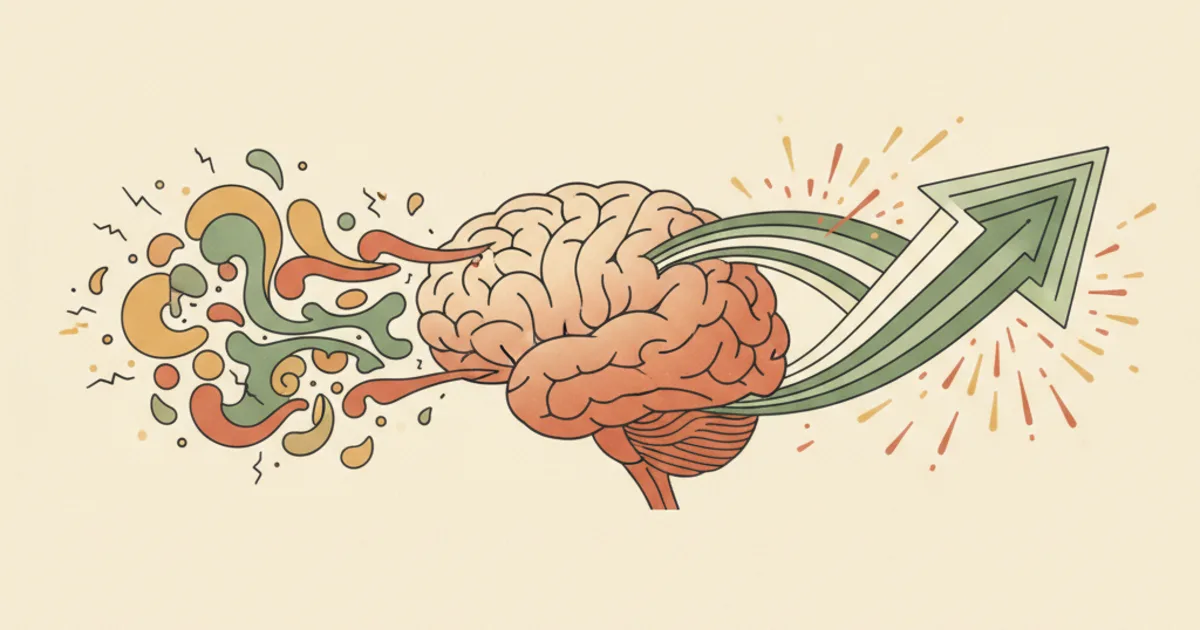
Your brain has a reward system built around a neurotransmitter called dopamine. When you get a notification, watch a video, or scroll through a feed, your brain releases a hit of dopamine.
But here's the critical part: dopamine isn't just about pleasure. It's about anticipation. It's about the seeking of reward, not the reward itself.
This is why social media is so devastating for focus. TikTok, Instagram, YouTube, these platforms are specifically engineered to trigger unpredictable dopamine hits. You don't know when the next interesting video will appear, so you keep scrolling, keep seeking.
Your brain learns to expect that kind of instant, effortless stimulation.
Then you sit down to study. And it feels like torture. Not because studying is inherently boring, but because it requires delayed reward. You study now, and the payoff comes later, in the form of a grade, a certification, a future version of yourself who understands the material. That's not instant. That's not easy. And your dopamine-hungry brain resists it violently.
Neuroscience supports this. Research shows that chronic overstimulation of reward systems, through social media, gaming, endless content, can blunt your natural dopamine responses to effortful tasks like studying. The more conditioned you're to easy stimulation, the harder it is to feel motivated by things that require sustained mental effort. That's biological adaptation.
Dr. Sophie Rockwell, a cognitive neuroscientist who studies attention, puts it simply: "Your brain doesn't want to focus on hard things when it has learned that easy things are available."
What High Performers Understand That You're Missing
Here's the counterintuitive truth that most productivity articles skip entirely: the ability to focus under difficulty is a skill, and like all skills, it can be trained, but only if you stop interpreting the discomfort as a sign to quit.
Cal Newport, the computer science professor who wrote Deep Work, describes high performers as people who have simply "normalized friction." They expect to feel resistance when they sit down to focus. They interpret that resistance as a sign they're doing real work, not as a sign they should stop.
Average students chase stimulation. Serious students build tolerance.
That shift, from "I can't focus" (framed as a failure) to "focusing is uncomfortable and that's normal and expected" (framed as part of the process), changes everything. Because once you stop fighting the feeling and start working with it, you stop wasting energy on self-recrimination. And that energy goes back into the actual work.
The Actual Science of What Helps
Understanding the neuroscience is important. But you need practical tools, things grounded in research that actually work in a student's real life. Here's what the science says:
1. Environment Design Is More Powerful Than Willpower
Willpower is finite. Your environment is always there. The most effective focus strategy isn't to try harder, it's to make distraction physically impossible.
This means: phone in another room, more than on silent.
Browser closed, or site blockers activated. Study space that your brain has associated with work.
The goal is to remove the path of least resistance toward distraction and replace it with a path toward studying.
Cal Newport's research backs this up: "The ability to perform deep work is becoming increasingly rare at exactly the same time it's becoming increasingly valuable in our economy." The students who develop this ability aren't superhuman, they've just designed environments where it's easier to focus than to not.
2. Dopamine Stacking, Pair Study With Small Rewards
Remember: dopamine responds to anticipation and reward. The solution isn't to eliminate dopamine from studying, it's to attach immediate, small rewards to the studying itself.
Some students use a coffee or tea as a reward after each study session. Others listen to a specific type of music only while studying, so their brain learns to associate that music with focus. The key is: the reward should be small, immediate, and consistently paired with studying. Over time, your brain starts to anticipate the reward when you sit down, and that makes starting easier.
3. Use the Pomodoro Method, But Not the Way You Think
The Pomodoro Technique (25 minutes of focused work, 5-minute break) works, but not for the reasons most people think. It doesn't work because 25 minutes is some magic number. It works because it creates a small, achievable dopamine-worthy unit.
When you look at "study for 3 hours," your brain sees an enormous, demanding task with delayed payoff. When you look at "focus for 25 minutes," that's a small, attainable goal that you can actually see yourself completing. The break afterwards is your dopamine hit, it's built in.
Then you start again.
This is one reason Piply's Study Sessions feature uses a built-in timer: it breaks your study time into units small enough to be psychologically manageable, which is exactly what your dopamine-conditioned brain needs to actually engage.
4. Build a Streak, Make Showing Up Its Own Reward
One of the most powerful findings in behavioral science is that humans are more motivated by the fear of losing something than by the desire to gain something. If you have a 15-day study streak, the idea of breaking it creates real psychological cost. That's use, not weakness.
This is why streak-based systems work. When you track your study sessions and watch your streak grow, you're more than recording data, you're creating a system where the act of showing up itself becomes rewarding. The streak is the immediate feedback loop your brain craves.
5. Sleep Is Not Optional, It's Neurological Maintenance
You can't focus on 5 hours of sleep. This isn't about being "tough enough." Your prefrontal cortex, the brain region responsible for attention, decision-making, and impulse control, is physically impaired by sleep deprivation. A 2019 study from the University of Washington found that poor sleep reduces the brain's ability to filter out distractions and maintain sustained attention during cognitive tasks.
If you're running on 5 hours and wondering why you can't focus, start with sleep before hunting for a better playlist.
The System Matters More Than the Individual Sessions
Here's what all of this adds up to: focus is a skill shaped by the systems around you. The student who uses Piply's Study Sessions, tracks their streak, and sits in a designed environment is fighting the focus battle on different ground than the student trying to "just focus harder" with a phone on the desk.
The research points one way: your brain has been rewired by years of instant-gratification technology. That's not reversible overnight. But it's trainable, with the right systems, the right environment, and the willingness to see your struggle as a biology problem, not a character problem.
You don't need more discipline. You need a better system. That's what Piply is built for, to give you the structural support that lets your brain do what it already knows how to do, once the distractions are removed and the rewards are real.
Put the ideas into practice
Use Piply to organize materials and practise what you’re learning.
Try Piply