 iOS App
  Android App
 Study tips
The Testing Effect and Confidence: Why Practice Tests Reduce Exam Anxiety
Piply Team
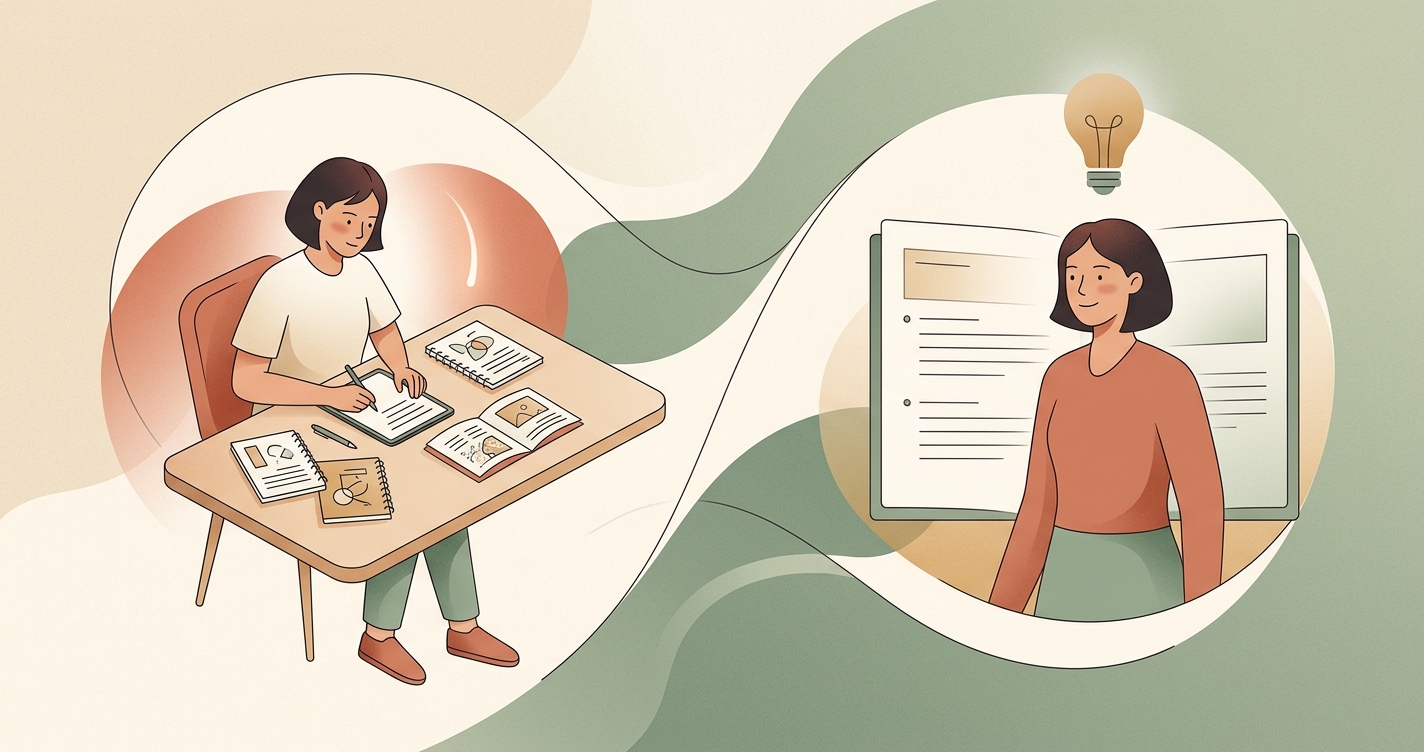
Your palms are sweating. Your heart rate climbs. You're convinced you've forgotten everything you studied, even though you spent hours reviewing your notes. Sound familiar?
Most students blame their anxiety on not knowing the material well enough. But research suggests the real problem is something else entirely. You might be studying wrong.
Here's what I mean.
When you reread your notes for the fifth time, you feel a warm sense of familiarity. The words look right. The concepts seem clear. Your brain whispers: "You've got this."
But familiarity is a liar.
What you're actually experiencing is a fluency illusion. Your brain recognizes the words, so it assumes you understand them. You won't discover the gap until you're sitting in the exam room, staring at a question you can't answer.
The solution isn't more rereading. It's retrieval practice.
The Testing Effect: Your Brain Remembers What It Works For
In 2006, psychologists Henry Roediger and Jeffrey Karpicke published a study that should have changed how we teach studying. They divided students into two groups. One group studied a text and reread it three times. The other group studied the text once, then practiced retrieving the information by recalling it without looking.
When tested one week later, the retrieval practice group scored 23% higher than the rereaders.
Not 23% better. 23% higher. On the same material, with the same study time.
The mechanism is surprisingly physical. Every time you successfully recall something, your brain strengthens the neural pathways associated with that memory. It's like carving a path through a forest. The first attempt barely leaves a mark. By the fifth attempt, there's a clear trail.
Rereading, by contrast, is like standing at the edge of the forest, looking at a map someone else drew. You see the path exists. That doesn't mean you can walk it.
Karpicke and Blunt replicated and extended this finding in 2011. They found that students who used retrieval practice learned nearly twice as much as those who used concept mapping, a popular active study technique. The simple act of generating answers, even when wrong, created deeper learning than passive review.
So why aren't more students doing this?
Because it feels harder. And because it feels bad.
Why Retrieval Practice Feels Terrible (And Why That's Good)
Here's the uncomfortable truth: practice testing feels like failure.
When you pull out a blank sheet of paper and try to write everything you know, you will struggle. You'll forget things. You'll write partial answers. You'll second-guess yourself constantly.
This is not a sign that studying isn't working. This is studying working exactly as intended.
The struggle is the point. When you fail to retrieve something, your brain tags that information as important. It says: "Remember this. You need this." The next time you review, your attention sharpens. The neural connection strengthens.
Mueller and Oppenheimer found in 2014 that students who took notes by hand performed better on conceptual questions than those who typed. The reason? Handwriting forces you to process information. You can't write fast enough to transcribe everything, so you must decide what's important. That processing creates the same kind of struggle that retrieval practice does.
The discomfort is the mechanism.
But here's what most students miss: that same struggle is also reducing your anxiety.
How Practice Tests Build Confidence (The Real Way)
Think about the last time you felt truly confident before an exam. Not the false confidence of familiarity, but the real thing. The kind where you walked in knowing you could handle whatever came up.
That confidence came from one source: having done it before.
Every practice test you take is a dress rehearsal. You're not just memorizing information. You're building the emotional and procedural memory of taking tests. You're training your nervous system to stay calm under pressure.
Research on test anxiety shows it's often rooted in uncertainty. Students don't just fear the content of exams. They fear the experience itself. The unfamiliarity. The high stakes. The feeling of being trapped in a room with a ticking clock.
Practice tests reduce all three.
When you've taken twelve practice exams before the real one, the experience feels familiar. You've already survived similar pressure. The stakes feel lower because you've already seen this situation and come out the other side.
Ramirez and colleagues demonstrated this in 2019. Students who practiced retrieving information not only learned better, they reported less anxiety when tested later. The act of retrieval practice built what researchers call "learned predictability." Your brain learns that the testing situation is survivable. It learns that you can handle it.
This is why cramming is so anxiety-inducing. You're walking into an unfamiliar situation with high stakes and no practice. Of course you're terrified.
How to Use This
Here's where most study advice falls apart. You're told to "practice retrieval" and then left to figure out the details yourself. Let's make this concrete.
Start with your materials. Take the key concepts from your notes and turn them into questions. Don't just copy what you wrote. Rephrase it. Force yourself to explain it in your own words. This transformation is where the real learning happens.
Use blank paper. No peeking. Set a timer for the amount of time you'd have in a real exam. Write everything you can. When time's up, check your answers. Anything you missed, mark it and move on. The act of trying to remember something, even when you fail, strengthens the memory more than looking it up immediately.
Space your practice. Don't do all your practice tests the night before. Distribute them across your study period. If you have two weeks, take one practice test every three days. Each session builds on the last, and spacing itself enhances long-term retention.
Simulate the conditions. Find a quiet room. Put away your phone. Use the same materials you'd have in an exam (or as close as possible). The closer your practice environment matches the real one, the more your brain builds context-specific confidence.
Review what you got wrong, then forget it. After each practice test, spend ten minutes on your errors. Understand why you missed them. Then close the book. Don't dwell. The goal isn't perfection in practice. It's building the ability to recover from mistakes.
Track your progress. Keep a simple log: date, subject, score, how you felt. Over time, you'll see improvement that might be invisible day-to-day. This record becomes evidence for your brain when anxiety tells you you're not ready.
The Real Shift
The students who perform best in high-pressure situations aren't the ones who never feel anxious. They're the ones who've practiced so much that anxiety has nowhere to land.
Your brain isn't fighting the exam. It's fighting the unknown. Practice tests make the unknown known.
So the next time you sit down to study, ask yourself: am I studying to feel familiar with the material, or am I studying to be able to retrieve it under pressure? Those sound similar. They're not.
What does your current study routine look like? Are you a rereader or a retriever?
Put the ideas into practice
Use Piply to organize materials and practise what you’re learning.
Try Piply