 iOS App
  Android App
 Study tips
How to Stay Motivated When Studying (And Why 'Just Do It' Is the Worst Advice)
Andy Anderson
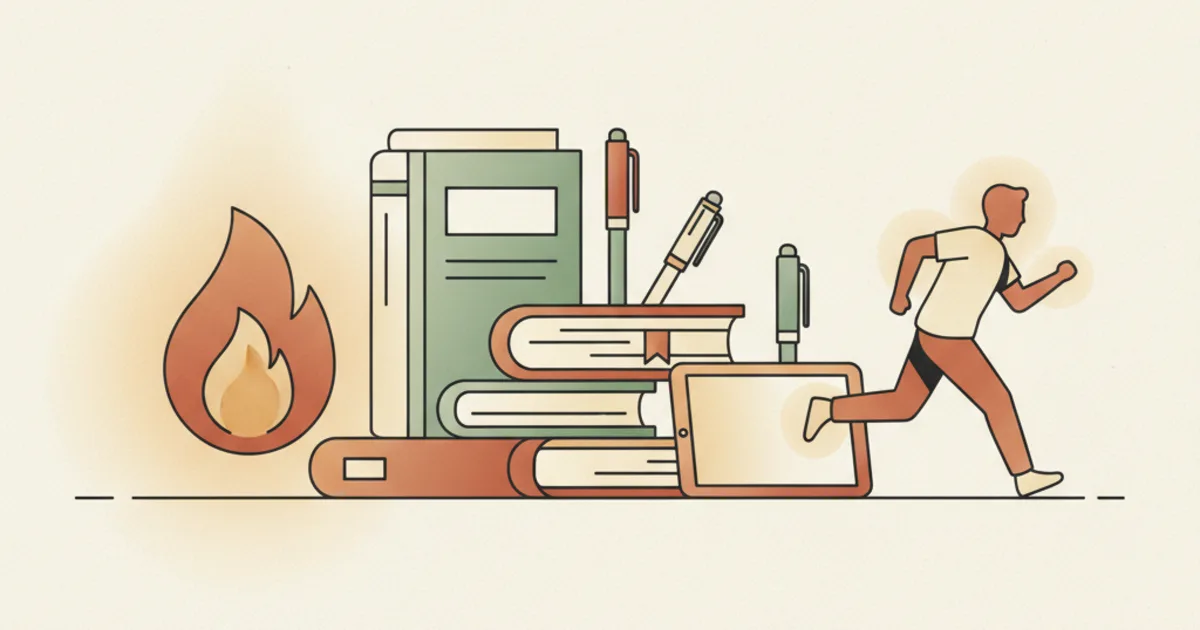
You're sitting at your desk.
The lecture slides are open. Your coffee is getting cold.
You've been staring at the same page for 20 minutes and gotten nowhere. The guilt is familiar by now. You know you should be studying. You want to study. And yet, the pull to do literally anything else is stronger than anything you can muster by sheer force of will.
If this sounds familiar, you aren't broken. And "just do it" isn't going to fix it.
The better question is why the feeling keeps disappearing and what to do when it does. Answering that requires looking at what motivation science actually says, and ignoring the advice that sounds good on a poster but falls apart in practice.
Why "Just Be Disciplined" Fails as a Strategy
The standard response to low motivation is discipline.
Dig deeper. Push harder.
Show up anyway. This advice isn't wrong exactly, but it treats the symptom (low motivation) as the problem when it's actually a signal.
Motivation isn't a personality trait you either have or lack. It's a psychological state that fluctuates based on conditions.
When those conditions are off, no amount of willpower will sustainably compensate. That isn't laziness, it's biology. Your brain is responding rationally to an environment and a mindset that aren't supporting the work.
The issue is that most study motivation advice doesn't engage with any of this. It gives you systems (which are useful) without explaining why the emotional experience of studying keeps getting in the way. Students read list after list of tips, implement two or three, feel briefly better, and then crash when the feeling returns.
The gap is understanding.
The Three Reasons Motivation Collapses
Research in educational psychology points to three broad categories of cause when student motivation drops off.
1. Disconnected purpose.
You open your organic chemistry textbook at 11 PM and the thought that surfaces is: "When will I ever use this?" That question isn't excuse-making. It's your brain asking a perfectly rational question about relevance. If you can't connect what you're studying to something that matters to you, the brain allocates resources elsewhere, toward things that do feel meaningful.
You can rebuild the connection deliberately. A medical student who tells herself "I'm learning this because it's the foundation of how I will understand patients" isn't lying to herself. She's actively constructing the relevance her brain is asking for. The purpose is real; it just needs to be made explicit.
2. Competence erosion.
There's a specific flavor of study exhaustion that comes not from tiredness but from confusion. When material feels consistently over your head, your brain registers repeated small failures.
Each time you can't solve a problem or understand a concept, the answer your brain learns is: this isn't for you. That's a slow, quiet motivational drain.
Lower the floor of the task until you're operating at the edge of your competence, doing work that challenges you but doesn't routinely defeat you. That's where flow happens.
That's where motivation can survive.
3. Unmet basic needs.
Self-Determination Theory, developed by Deci and Ryan, identifies three psychological needs that drive sustained motivation: autonomy (you feel in control of your choices), competence (you feel capable), and relatedness (you feel connected to others). When even one of these is consistently unmet in your study life, motivation erodes regardless of how good your schedule looks.
If your study routine feels like something imposed on you rather than chosen by you, or if you're isolating for days without meaningful contact with peers, those are structural problems no timer or habit tracker will fix.
The Momentum Trap: Why Starting Is the Hardest Part
Here's what neuroscience has established: the brain has a built-in resistance to starting new tasks. psychologists call this "cognitive inertia." The bigger the behavioral shift required, the more activation energy needed to overcome it. Opening a textbook after two hours of Netflix requires more neural activation than continuing to watch.
This is why motivation doesn't precede action, it follows from it. David Greenfield, a clinical psychologist and attention researcher, described this precisely: action precedes motivation. You don't feel ready and then act. You act, and the feeling of readiness emerges from the action itself.
This is the insight behind every "just start" strategy, and it's correct. But most advice stops there. It doesn't tell you how to start when the gap between "not studying" and "studying" feels insurmountable.
The answer is to shrink the gap until it's laughably small. Not "study for two hours."
Open the file. Read one sentence. That's it. The goal isn't to accomplish anything in that moment. The goal is to make the behavioral starting line so close that resistance can't realistically block you. Once you open the file, momentum tends to carry you further than the initial micro-commitment.
What Actually Works: Six Evidence-Based Approaches
Micro-goals over massive ones.
A study by physicist Alan Cisstrom found that setting specific, small targets dramatically increased sustained effort. The logic is straightforward: when a goal feels achievable, your brain commits to it. When it feels enormous, it avoids it.
"Study for three hours" is a vague, high-resistance target. "Review two pages of notes" is specific and achievable.
The latter gives your brain a concrete win it can recognize and celebrate. Each win builds toward the next.
Separating studying from feeling.
Most students believe they need to feel motivated before they can study. The research suggests the reverse. A 2012 study published in the Journal of Consumer Research found that people who defined themselves as "people who act first and feel motivated afterward" significantly outperformed those who waited for motivation to arrive.
The shift is subtle but profound: stop waiting for the feeling. Study anyway. The motivation, when it comes, will be a byproduct, not a prerequisite.
Environment before effort.
James Clear describes this in Atomic Habits: make the behaviors you want obvious and the behaviors you want to avoid invisible. For most students, the environment is working against them.
Phone on the desk. Netflix in the taskbar. A messy room with fifty visual distractions. Fighting all of this requires willpower on top of the studying itself.
The practical version: remove your phone from the room entirely during study sessions. Not on silent, in another room. Close the laptop lid if you don't need it.
Have your water, notes, and anything else you need within arm's reach before you sit down. The goal is to make studying the path of least resistance.
Tracking visible progress.
Teresa Amabile and Steven Kramer's "Progress Principle" research, a multi-year study of workers across hundreds of companies, found that the single greatest motivator was making visible progress on meaningful work. The same applies to students.
Seeing your streak grow, watching your flashcard count increase, or checking off completed sections gives your brain tangible evidence that effort leads to results.
Without that evidence, you're working on faith. With it, you're working on proof.
The behavioral difference is substantial.
Social accountability, quietly used.
You don't need a study group if that isn't your style. But knowing that someone else is aware of your goals increases follow-through in measurable ways. A 2019 study in the Journal of Educational Psychology found that students who shared weekly goals with a peer were 76% more likely to achieve them than students who kept goals private.
This can be as simple as telling one friend what you're working toward this week, or joining an online study community where you can check in.
Self-compassion on low days.
Dr.
Kristin Neff's research on self-compassion consistently shows that students who treat themselves with kindness after a setback, rather than with harsh self-criticism, recover faster and maintain motivation more consistently. The guilt spiral isn't a productivity tool.
It's a motivation drain.
When you miss a session, the response isn't to punish yourself. It's to acknowledge the miss, recognize that low days are part of the process, and restart with a smaller target than usual.
How Piply Helps Where Tips Fall Short
Most motivation advice is content. You read it, you feel briefly inspired, you try one or two things, and then life gets in the way and it fades. The problem isn't intelligence or effort. The problem is that implementing six different strategies requires active mental energy, the same mental energy that's already depleted when motivation is low.
Piply is designed to automate the infrastructure of motivation so that you don't have to manage it manually.
- Smart scheduling removes the decision "when should I study?" by attaching sessions to your existing routine anchors.
- Built-in Pomodoro timing respects your cognitive limits, ensuring you work in bursts that match your brain's actual capacity rather than burning out.
- Streaks and XP give you visible proof of consistency. When you have a 15-day streak, the psychological cost of breaking it becomes a push on the low-motivation days.
- Progress dashboards show you measurable evidence of effort. Completed sessions, mastered concepts, and weekly volume, your brain sees the data and updates its belief about whether the work is working.
The goal is to make the conditions that sustain studying reliable enough that motivation becomes background noise instead of a daily crisis.
The Honest Summary
Staying motivated as a student is hard.
Not because you're doing something wrong, but because the conditions of modern studying, long sessions, abstract goals, isolation, and high cognitive demand, are genuinely hostile to sustained motivation. The advice to "just push through" doesn't fix those conditions.
It only asks you to fight them with willpower, which is a limited resource.
What actually works is structural: clarity of purpose, achievable micro-goals, an environment designed for focus, visible progress tracking, social accountability, and self-compassion on the days when none of it goes to plan. Build those conditions, and motivation stops being a lightning bolt you wait for. It becomes something that emerges naturally from the system you built.
Tools to Stay Motivated While Studying
Piply helps you build a study system that sustains motivation automatically:
- Study timetable generator, build day-by-day plans so you always know what to study next
- Pomodoro timer, work in focused bursts that match your brain's actual limits
- Free active recall, practice retrieval so you see measurable progress every session
Put the ideas into practice
Use Piply to organize materials and practise what you’re learning.
Try Piply