 iOS App
  Android App
 Study tips
Do AI Flashcards and Quizzes Actually Improve Memory?
Ben Roe
Students are right to be suspicious of any tool that promises to "make studying effortless." Learning isn't effortless.
Still, there's one place where AI can genuinely help: reducing the admin around good study methods.
That matters because many students do know what works. They know flashcards can help. They know quizzes help. They know active recall beats passive rereading. What gets in the way is the setup cost. Turning a dense lecture PDF into useful questions takes time, and students often burn that time on formatting instead of retrieval.
Used carefully, AI can solve that part.
Why flashcards and quizzes work in the first place
Flashcards and quizzes are useful because they support retrieval practice. You're trying to recall the answer before seeing it, which is one of the most dependable findings in memory research.
Roediger and Karpicke's work on the testing effect helped make this clear: students who practice retrieval tend to remember more later than students who spend the same time restudying. Add spaced review and the effect becomes even stronger.
So the goal isn't "have flashcards." The goal is "retrieve the material often enough, with enough effort, that the memory holds."
Where AI helps
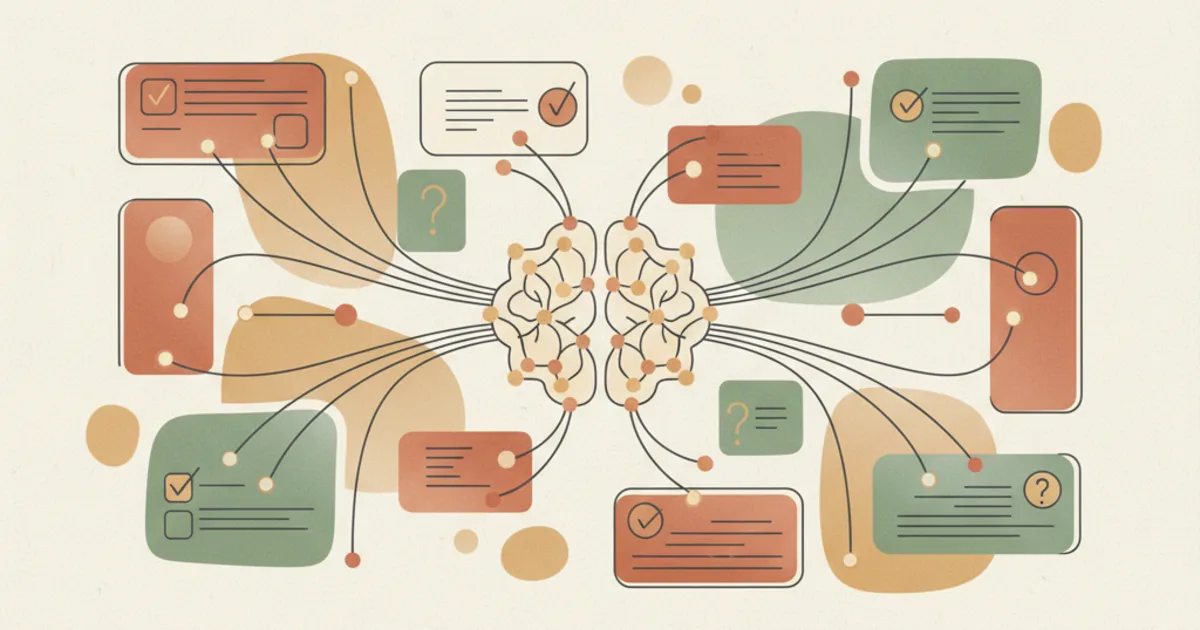
AI is most useful when it speeds up the first draft of a study set.
For example, it can:
- pull likely key terms from notes or slides
- turn headings into short-answer questions
- generate practice quizzes from a chapter or PDF
- vary question wording so the review is less repetitive
That can save students real time. If the alternative is spending ninety minutes building a deck and then having no energy left to use it, a faster setup is a meaningful improvement.
Where AI fails students
This is the part a lot of marketing skips.
Generated flashcards are only good if the questions are clear, accurate, and small enough to answer cleanly. AI often gets this wrong.
It can make cards that are too vague, too broad, or quietly inaccurate. It can also overproduce trivial facts and underproduce the concepts you actually need for the exam.
Common problems include:
- cards with too much information packed into one answer
- shallow definition-only questions for subjects that need application
- incorrect wording from bad PDF extraction or weak source material
- students reviewing the answer too quickly and slipping back into passive recognition
If you skip the editing step, you can end up memorising noise efficiently.
The better workflow
AI works best as the first pass, not the final pass.
Here is a smarter sequence:
- Upload the source material.
- Generate a draft deck or quiz.
- Remove weak, obvious, or inaccurate questions.
- Rewrite broad cards into smaller, answerable ones.
- Use the deck for real retrieval, not quick flipping.
- Revisit the material on later days instead of one long cram session.
This keeps the speed advantage without pretending the machine can do the whole learning process for you.
Quizzes matter for a different reason
Flashcards are great for facts, vocabulary, definitions, formulas, and short conceptual checks. Quizzes add something else: context.
They force you to discriminate between similar ideas, apply concepts in different wording, and see what breaks when a question changes shape. That's closer to how many real assessments work.
AI-generated quizzes can therefore be useful not because they feel smart, but because they give you more chances to retrieve and adapt.
So do they boost retention?
Yes, when three conditions are true:
- the generated material is accurate enough to trust after review
- you actually attempt retrieval before seeing the answer
- you come back to the material over time
No, if the deck becomes another piece of digital clutter you never review or a pile of bad cards you memorise mechanically.
Where Piply fits
The useful role for AI is shortening the distance between "I've notes" and "I'm doing retrieval practice." That's where Piply is strongest. It helps students go from source material to quiz or flashcard draft quickly, then spend their energy on the part that matters: testing, correcting, and revisiting.
If that's the bottleneck in your workflow, Piply's flashcard and quiz tools are a better use of AI than another generic summary generator.
Further Reading
- Roediger, H. L., & Karpicke, J. D. (2006). Test-enhanced learning.
- Dunlosky, J. et al. (2013). Improving students' learning with effective learning techniques.
- Cepeda, N. J. et al. (2006). Distributed practice in verbal recall tasks.
Put the ideas into practice
Use Piply to organize materials and practise what you’re learning.
Try Piply