 iOS App
  Android App
 Study tips
The 2-Step Memory Trick: Why Encoding AND Retrieving Matter More Than Just Reading
Andy Anderson
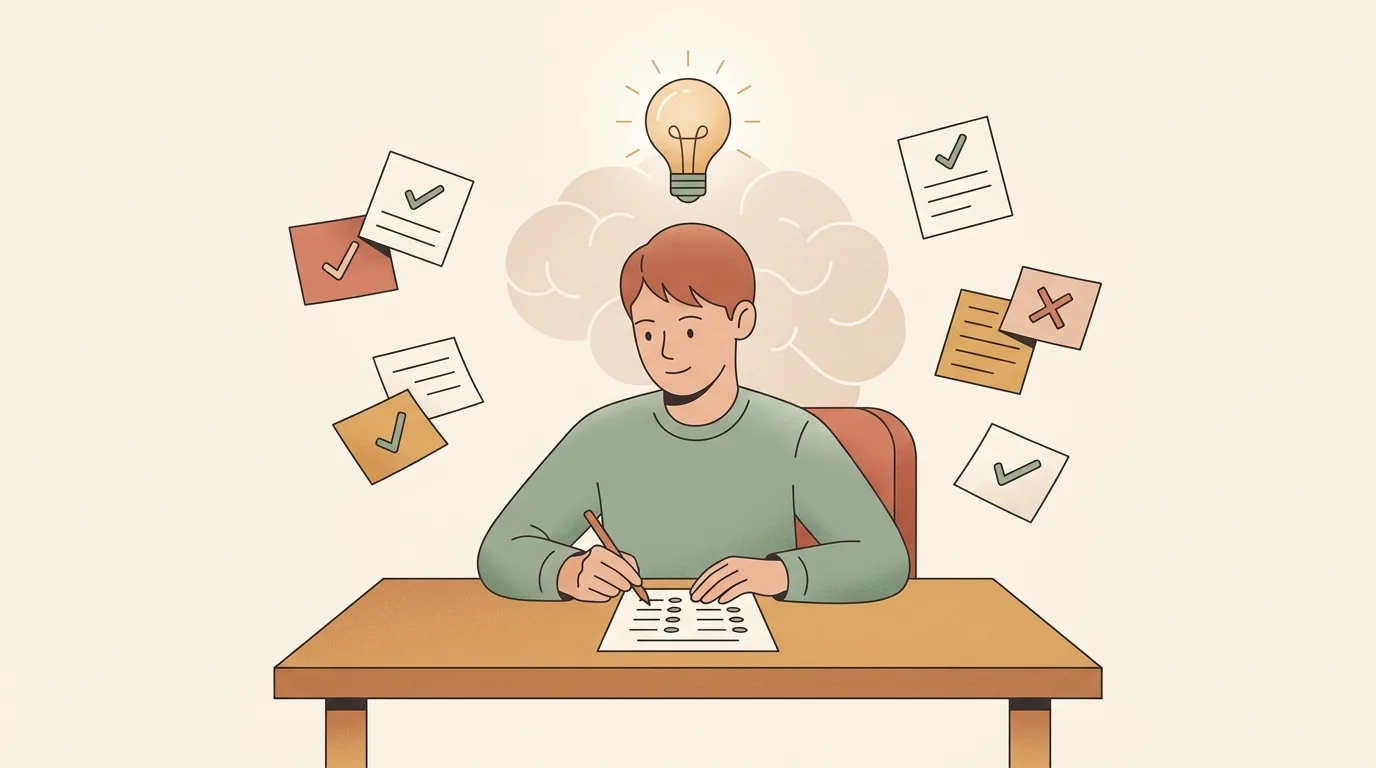
We've all been there. You spend hours poring over textbooks, meticulously highlighting every important detail, only to draw a blank when faced with an exam question. Or perhaps you feel like you understand a concept perfectly in the classroom, but when you try to explain it to someone else, the words just don't come. This isn't a sign of a bad memory; it's a sign that you might be focusing on only one half of the learning equation.
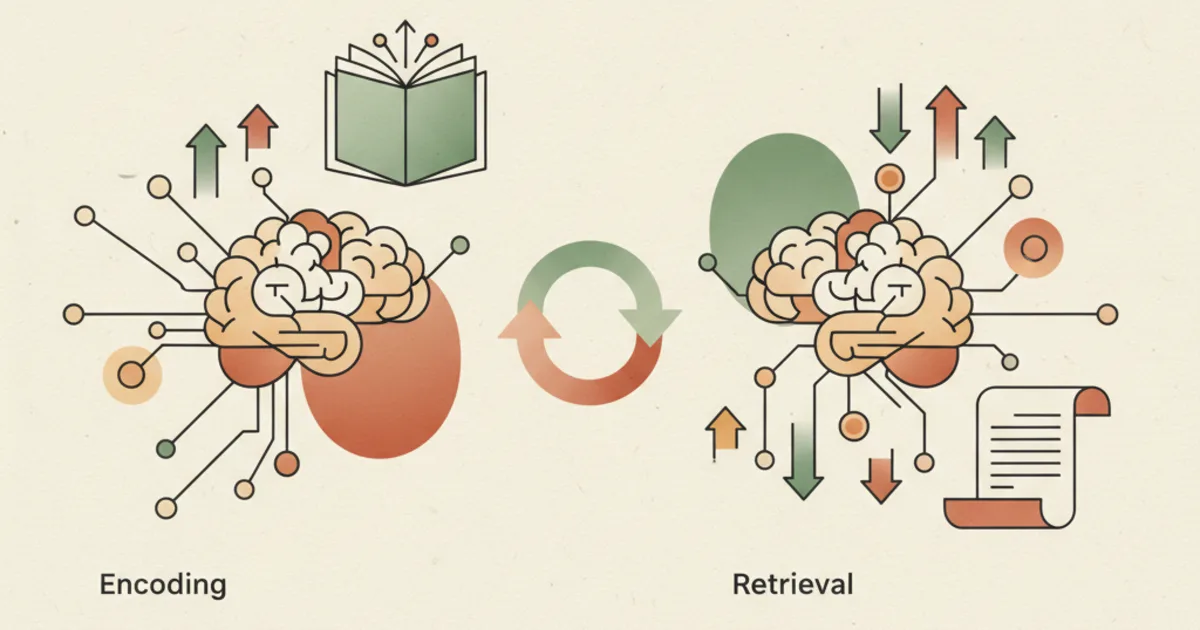
Learning isn't just about passively absorbing information. It's an active, two-way street, governed by two fundamental processes in your brain: encoding and retrieval. Think of your memory like a library. Encoding is how you take a new book, give it a proper title and subject tags, and carefully place it on the correct shelf. Retrieval is how you then effectively find that book when you need it, quickly and without fuss. Most students spend a disproportionate amount of time on the "encoding" part of the process – reading, rereading, and highlighting – and far too little on the crucial "retrieval" phase. This imbalance is a primary reason why so many clever, hardworking students struggle to recall what they've learned when it matters most.
Understanding and actively engaging with both encoding and retrieval is the secret to building robust, accessible knowledge. It's the difference between temporary understanding and lasting mastery. These two phases shape how well information sticks, how reliably it comes back, and whether study time turns into usable knowledge.
Encoding: Making Information Stick
Encoding is the initial process of transforming sensory information (what you see, hear, read) into a form that can be stored in your brain's memory system. It's not just about getting information into your brain; it's about getting it in meaningfully. The quality of your encoding directly impacts how well you'll be able to retrieve that information later.
Imagine you're trying to remember a new person's name. Simply hearing it once isn't enough. You might repeat it, try to associate it with someone you already know, or even visualize it spelled out. All these actions are forms of encoding designed to make the name stick.
There are different levels of encoding, and this concept was famously explored by Craik and Lockhart in their Levels of Processing framework (Craik & Lockhart, 1972, Journal of Verbal Learning and Verbal Behavior). They proposed that the deeper and more elaborately you process information during encoding, the more likely it is to be remembered. Shallow processing, like merely recognizing the shape of words on a page, leads to weaker, short-lived memories. Deep processing, however, involves understanding the meaning, relating it to existing knowledge, and making connections. This creates a richer, more interconnected memory trace.
Why deep encoding matters: When you encode information deeply, you're essentially building multiple neural pathways to that piece of information. The more pathways you create, the more routes your brain has to find it later. Instead of just one thin thread, you're building a strong, intricate web.
For example, simply reading a definition for a new term, say "photosynthesis," is shallow encoding. You recognize the words, but you haven't necessarily grasped their full meaning or implications. Deep encoding would involve:
- Defining it in your own words: This forces you to process the meaning.
- Relating it to what you already know: "Photosynthesis is like how plants 'eat' sunlight, similar to how we eat food for energy."
- Giving examples: "Trees use photosynthesis, and so do algae."
- Drawing a diagram: Visualizing the process engages different parts of your brain.
- Explaining its purpose or significance: "Without photosynthesis, there would be no oxygen or food for most life on Earth."
Each of these actions strengthens the initial memory trace, making it more robust and accessible.
Retrieval: Finding What You Need, When You Need It
Encoding is only half the battle. Retrieval is the process of accessing and bringing stored information back into conscious awareness. This is where many students fall short. They assume that if they've encoded something well, retrieval will happen automatically. This is a dangerous assumption.
Retrieval is not a passive act of pulling a file; it's an active reconstruction of memory. Every time you retrieve information, you're not just accessing it; you're also strengthening the pathways to that memory. This is the core principle behind the powerful "testing effect" or "retrieval practice."
Research consistently shows that practicing retrieval, even if you make mistakes, significantly enhances long-term retention compared to merely rereading material. Roediger and Karpicke's seminal work (Roediger & Karpicke, 2006, Psychological Science) demonstrated this convincingly. In one study, students who spent 75% of their time practicing retrieval (testing themselves) and 25% reading performed significantly better on a final exam than students who spent 75% of their time reading and 25% practicing retrieval. Even more surprisingly, the group who practiced retrieval recalled more information a week later than the group who had spent more time studying the material initially.
Why retrieval practice is so powerful:
- Strengthens Memory Traces: Each successful retrieval attempt strengthens the neural pathways associated with that memory. It makes it easier to find and access that information the next time. It's like walking a path through a forest; the more you walk it, the clearer and easier it becomes to traverse.
- Identifies Knowledge Gaps: When you try to retrieve information and fail, you immediately identify what you don't know. This allows you to target your further study efforts precisely, rather than rereading everything.
- Enhances Encoding: The act of trying to retrieve information, even if unsuccessful, primes your brain for better subsequent encoding. When you then review the correct answer, your brain is more 'ready' to integrate that information effectively.
- Improves Transfer: Retrieval practice doesn't just help you remember facts; it helps you transfer that knowledge to new situations and problems, a critical skill for deeper learning and problem-solving.
Many students avoid retrieval practice because it feels hard. It exposes what you don't know, which can be uncomfortable. But this "desirable difficulty" is precisely what makes it so effective (Bjork & Bjork, 1994, Memory & Cognition). The struggle indicates that your brain is working hard, and that's when significant learning happens.
How to Use This: Practical Takeaways for Students
The mechanics turn into useful study habits when each session includes both deeper processing and active recall.
To Deepen Encoding:
- Elaborate and Connect: Don't just passively read. As you encounter new information, ask yourself:
- What does this mean in my own words?
- How does this relate to what I already know?
- Can I think of an example for this concept?
- What are the implications of this information?
- Can I visualize this process or concept?
- How is this similar to/different from other concepts?
- Why is this important? Make active notes that reflect these connections, rather than just copying text.
- Teach Someone Else (or a Rubber Duck): The act of explaining a concept forces you to organize your thoughts, identify gaps in your understanding, and articulate the information clearly. This is a powerful form of deep encoding. If no human is available, explain it aloud to yourself, your pet, or even an inanimate object.
- Use Mnemonics and Analogies: While sometimes seen as superficial, well-constructed mnemonics (like acronyms or memory palaces) can provide strong hooks for encoding complex information. Analogies are particularly useful for connecting new abstract concepts to something concrete you already understand.
- Vary Your Study Environment: While some routines are good, occasionally changing your study location slightly can create multiple contextual cues, helping with later retrieval. This is known as "context-dependent memory."
- Interleave Your Studies: Instead of studying one topic for hours, mix different subjects or topics within a subject. This forces your brain to constantly make new comparisons and connections, leading to deeper encoding (Rohrer, 2012, Educational Psychology Review).
To Boost Retrieval Practice:
- Self-Testing is Your Superpower: This is the absolute cornerstone of effective retrieval practice.
- Flashcards: Not just for definitions. Use them for concepts, processes, formulas, and problem-solving steps. Active recall means looking at one side and trying to generate the answer before flipping.
- Practice Questions: Work through end-of-chapter questions, old exam papers, or problems from supplemental texts. Don't just read the answers; actively try to solve them first.
- Summarize Without Notes: After reading a section, close your book and notes. Try to write down everything you can remember about that section. Then, check your notes to identify gaps.
- Concept Mapping from Memory: Start with a central concept and try to build a concept map purely from memory, adding details and connections.
- Spaced Repetition: Instead of cramming, review information at increasing intervals over time. Tools like Anki or Quizlet incorporate spaced repetition algorithms, showing you flashcards just as you're about to forget them, making retrieval slightly difficult but highly effective for long-term retention.
- Explain Concepts to Others Actively: As mentioned in encoding, teaching is also a powerful form of retrieval practice. When you explain, you're pulling information from your memory and organizing it for another person.
- Use "Brain Dumps": Before starting a study session on a particular topic, take 5-10 minutes to write down everything you can recall about that topic from previous sessions, without looking at your notes. This immediately activates prior knowledge and highlights areas needing review.
- Embrace the Struggle: When retrieval feels difficult, resist the urge to immediately look up the answer. Give your brain a few extra seconds to search, struggle, and make connections. That extra mental effort makes the eventual successful retrieval (or finding the correct answer) far more potent.
Conclusion
Learning isn't magic. It's a trainable skill built on the foundational processes of encoding and retrieval. Too many students mistakenly equate passive exposure to information with learning. True learning involves actively engaging with material, transforming it into meaningful memories (encoding), and then repeatedly challenging your brain to recall it (retrieval).
By consciously integrating deep encoding strategies and consistent retrieval practice into your study routine, you'll move beyond ephemeral understanding to build a durable, accessible bank of knowledge. This isn't just about passing exams; it's about developing a profound and lasting understanding that will serve you long after your academic career. So, next time you sit down to study, don't just read; process and practice recalling. Your memory will thank you.
What study technique are you struggling with? Tell me in the comments.
Put the ideas into practice
Use Piply to organize materials and practise what you’re learning.
Try Piply