 iOS App
  Android App
 Study tips
The Binge Learning Illusion: Why 10 Hours in One Day Is Less Effective Than 1 Hour Daily
Piply Team
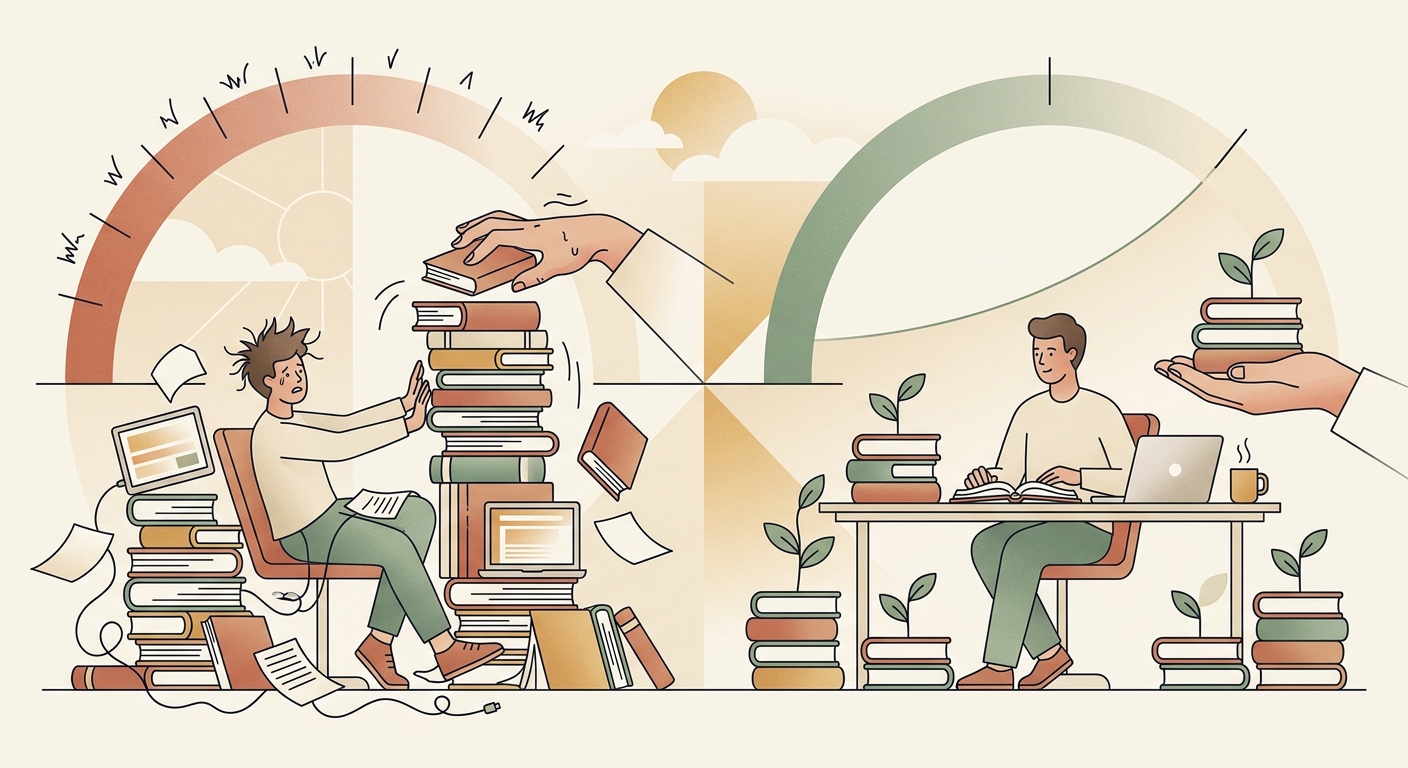
You spent ten hours on Saturday. The coffee went cold. Your highlighter ran dry. You felt like you were absolutely crushing it.
By Wednesday, you remembered almost none of it.
This isn't a character flaw. It's how memory works. And once you understand the mechanism behind it, you'll never want to cram again.
The Problem With Feeling Smart
Your brain has two separate systems at play when you learn something. There's the short-term version, where information feels immediate and available. Then there's the long-term version, where it actually integrates into memory you can access weeks later.
Cramming hijacks the first system. When you reread a chapter five times in one sitting, the text starts to feel familiar. Your brain mistakes that familiarity for knowledge. Researchers call this "fluency illusion." You feel like you're learning, but you're really just getting used to the words being there.
Ebbinghaus documented this over a century ago with his forgetting curve. Freshly learned information drops steeply within the first 24 hours without reinforcement. A single session, no matter how intense, doesn't give your brain the repeated contact it needs to move something from short-term to long-term storage.
The spacing effect, studied extensively by Cepeda and colleagues in their 2006 meta-analysis, shows that distributing study across multiple sessions produces dramatically better retention than the same total time crammed into one session. Their analysis of 323 experiments confirmed this holds across different types of material, age groups, and study conditions.
Here's what that means practically. One hour a day for seven days will outperform ten hours on Saturday. Not by a little. By a margin significant enough that the research community stopped debating whether spacing works and started studying how to apply it.
Why Spacing Actually Works
There's a process in memory research called "retrieval practice." When you bring something back to mind, you're not just accessing it. You're reconsolidating it. Each time you retrieve a memory, your brain destabilizes it slightly, then rewrites it with new connections. This reconstruction process is where real learning happens.
Spacing amplifies this. When you return to material after a day or two, you've partially forgotten it. That forgetting forces deeper retrieval. You're not just recognizing the text. You're rebuilding it from scratch. Roediger and Karpicke demonstrated this in their 2006 study, showing that repeated retrieval practice produced substantially better long-term retention than repeated study, even when students felt like they were learning less.
This is the mechanism behind what Bjork calls "desirable difficulties." Making learning harder in specific ways, like spacing it out or interleaving topics, triggers the processes that produce durable knowledge. The irony is that students consistently rate these techniques as less effective than easy, familiar methods. Your subjective sense of learning is a poor guide to actual retention.
Think about it like this. A muscle grows not during exercise, but during recovery. Your memory strengthens not during the study session, but during the gap that follows. The retrieval attempt itself is the workout. The rest is when the adaptation happens.
The Interleaving Bonus
One more layer. When you study one topic exclusively for a long stretch, you're using what researchers call "blocked practice." Everything stays in context. Your brain has less work to do because the cues are always the same.
Interleaved practice mixes topics or problem types within a single session. This feels messier, more uncomfortable. Students hate it in the moment. But Kornell and Bjork's 2009 research showed that interleaving produces better transfer, meaning you can apply what you learned to new situations rather than just recognizing familiar ones.
A music student who practices scales in blocks will perform scales well. A student who interleaves scales with sight-reading and theory drills will perform music better. The blocked practice feels productive. The interleaved practice feels frustrating. Your brain is building something different in each case.
This connects to cramming because marathon sessions almost always become blocked practice. You stay in one topic until you're sick of it, then move on. By the end of ten hours, you're reading without processing. The familiarity has taken over and the actual learning has stopped.
How to Use This
You can start applying this today. It doesn't require new tools or systems. It requires a different relationship with your study time.
Break your sessions into smaller chunks. If you have ten hours of material to cover, split it across a week instead of a weekend. Two hours a day for five days gives you five retrieval events instead of one. Each one reinforces the previous.
End sessions with a quick recall test. Before you close the book, close your eyes and try to write or say everything you just covered. Don't check your notes first. The struggle is the point. Note what you couldn't retrieve. That becomes your starting point next time.
Keep a running list of weak spots. When you can't retrieve something, write it down. Return to that list in your next session before moving on. This is retrieval practice targeted at your actual gaps.
Accept the discomfort of interleaving. If you're studying multiple subjects, mix them up within a session instead of finishing one entirely before starting another. If it feels harder, that's because it is. That difficulty is working for you.
Front-load effort, not hours. Your first encounter with new material should be your most active. Read less, retrieve more. Don't save the hard work for review. Put it in first contact.
The Tradeoff Nobody Talks About
There's a real cost to spacing. It feels slower. The progress is quieter. You won't have the dramatic Saturday accomplishment to point to. You won't feel like you're doing as much.
But you're building something that lasts. The knowledge you gain through spaced retrieval integrates differently than what you cram. It connects to more concepts. It survives longer. When you need it, it's actually there.
The students who do best in the long run are rarely the ones who look most impressive during study sessions. They're the ones who built a process that works on their brain's terms, not on the feeling of familiarity that makes cramming so seductive.
So what's one thing you could move from a weekend marathon to a short daily session this week?
Put the ideas into practice
Use Piply to organize materials and practise what you’re learning.
Try Piply