
 iOS App
  Android App
 Study tips
Why Your Biology Is Working Against Your Grades: Understanding Chronotypes
Ben Roe
The Morning Class Problem
Picture this. It's 7:45am.
Your lecture starts in 15 minutes. You made it to campus, found a seat, opened your notebook. The professor starts speaking and your brain feels like it's wading through concrete.
You studied the material last night and understood it fine. At this hour, though, your brain is barely online.
Meanwhile, your classmate Sarah is taking notes fluently. She was out last night by 10pm and woke up feeling refreshed. She had coffee, she is alert, she is absorbing everything.
You and Sarah might have different chronotypes, and that difference can show up in grades.
What a Chronotype Actually Is
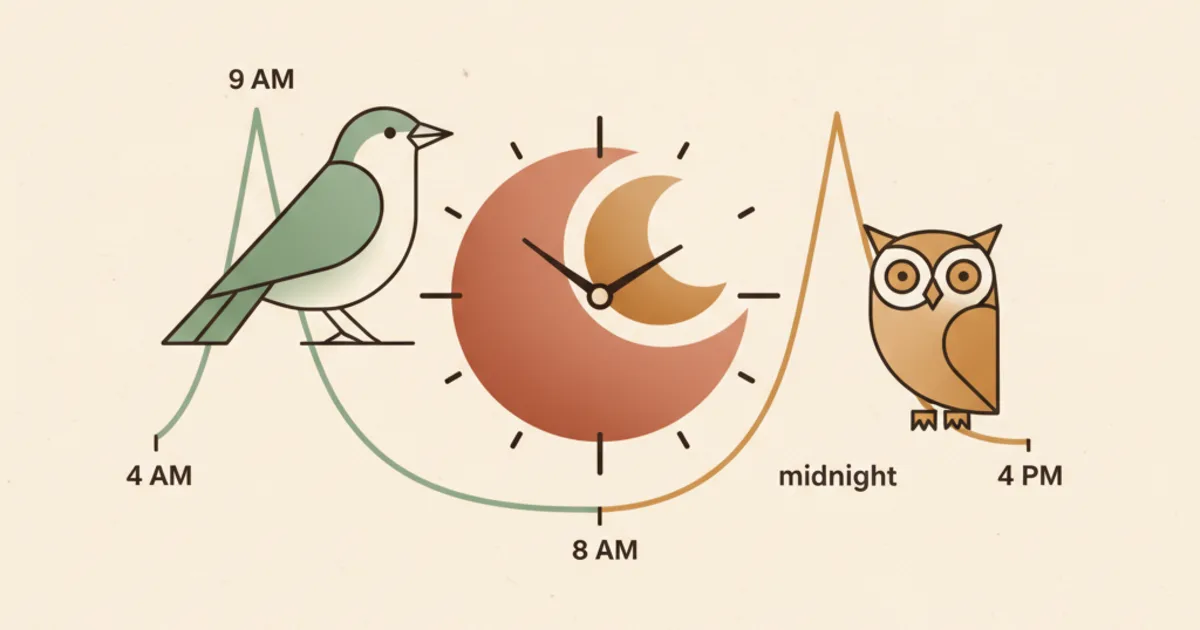
Chronotype refers to your biologically determined preference for sleep and wake times. It's governed by your circadian rhythm, the roughly 24-hour internal clock that regulates hormone release, body temperature, alertness, and cognitive performance across the day. While everyone operates on the same 24-hour cycle, the timing of peak alertness varies from person to person.
Research from Frontiers in Psychology published in December 2025 studied 224 medical students and found that only about 15 percent of them were morning types. Sixty-one percent were intermediate, and roughly 24 percent were evening types.
Evening types reach peak cognitive performance later in the day, often well into the afternoon or evening. Morning types peak early. This isn't a habit or a preference. It's biology.
The suprachiasmatic nucleus in the hypothalamus acts as your master clock, and its timing varies genetically. Some people are wired to be sharpest in the morning and drowsy by evening. Others run the opposite schedule.
Teenagers and young adults are particularly skewed toward evening preference, with peak lateness typically arriving in the late teens and early twenties.
Why This Matters for Grades
A large-scale study published in npj Science of Learning found that later chronotypes had significantly higher odds of grade retention, but only in schools with early start times. When school schedules were later, the performance gap between chronotypes shrank substantially. This is one of the most direct pieces of evidence that school scheduling isn't neutral for all students.
Another finding from that same study showed that evening types were more likely to be absent from morning classes.
Attendance problems compounded over a semester become grade problems. The absence wasn't caused by lack of motivation.
It was caused by a structural mismatch between when these students' brains were actually capable of functioning and when the institution demanded they be present.
A study published in Chronobiology International looked specifically at whether morning types had an academic advantage over evening types when class and exam times were factored in. The results were nuanced but consistent.
Morning types generally performed better in morning-heavy schedules, and evening types performed better when assessments were scheduled later. The timing of evaluation mattered as much as the material being tested.
The practical implication is direct. If you're an evening type forced into a morning-heavy schedule, you're likely performing below your actual ability level because your cognitive peak is being spent elsewhere.
What Evening Types Are Actually Dealing With
Evening chronotype is more than a preference for staying up late. It comes with a measurable cognitive cost in the morning that goes beyond ordinary grogginess. Research shows that reaction time, working memory, and attention all peak and trough at different times depending on chronotype.
This means a student with an evening chronotype taking a 9am exam in a high-focus subject may process information more slowly and with less accuracy than they would at 2pm. The performance gap between a morning and evening type on the same 8am exam can be significant.
None of this means evening types are at a permanent disadvantage. It means the disadvantage is structural and can be managed with the right approach.
How to Work With Your Biology Instead of Against It
You can't reprogram your circadian rhythm through willpower, but you can make strategic choices that reduce the damage of mismatch.
First, protect your peak hours ruthlessly. If you're most alert between 2pm and 8pm, don't waste those hours on passive review or scrolling. Use them for the hardest material, the subjects that require the most reasoning, and any exam prep that involves complex problem solving. Schedule your most demanding study work during your actual peak, not when you think you should be studying.
Second, manage your evening routine to support consistency.
Even if you go to bed late, try to keep your wake time fixed. Irregular sleep schedules shift your biological clock in ways that make the mismatch worse over time.
Shiftworkers who change their sleep times constantly report worse cognitive performance than those with irregular schedules, and the same principle applies to students.
Third, advocate for scheduling flexibility where you have it. If you have any control over when you take exams or which section of a class to join, choose times that align with your peak.
This isn't gaming the system. It's matching the structure to your actual capacity.
Fourth, don't use caffeine as a substitute for proper sleep timing. Caffeine can push your evening chronotype further into the night by disrupting adenosine clearance, which makes the morning deficit worse the next day. It's a short-term fix that compounds the problem.
Fifth, use brief strategic naps if you have a morning class you can't avoid. A 20-minute nap between 1pm and 3pm can boost alertness for several hours afterward without disrupting nighttime sleep, according to sleep research. A nap before a morning exam is more useful than cramming the night before for most evening types.
Does This Mean You Should Skip Morning Classes
No.
But it means you should be honest with yourself about what morning classes cost you and plan accordingly. Skipping class is usually not the answer.
But pretending that you can perform at your best at 8am when your biology says otherwise, and then blaming yourself when you don't, isn't the answer either.
The goal is to reduce the friction between your biology and your habits. Some of that friction is unavoidable. Much of it isn't.
What to keep
Chronotype is a variable. Students who understand their own rhythms and structure their study time accordingly have an advantage over equally talented students who ignore timing completely.
Work with the clock you have.
Study sessions in Piply are available whenever your peak hours arrive. No forced schedule, no algorithmic nudges to study at the wrong time for your biology. Just a clean space to do the work when your brain is actually ready for it.
Put the ideas into practice
Use Piply to organize materials and practise what you’re learning.
Try Piply