Piply Logo
Piply
study-tips

The Room You Study In Is Hurting Your Grades More Than You Think

The Room You Study In Is Hurting Your Grades More Than You Think

The Variable Nobody Controls

You probably think about what to study. You might think about when to study. You probably don't think much about the room you study in.

That's understandable. The room feels like a backdrop. It's just there.

But a growing body of research suggests that the physical environment where you study is one of the most powerful variables in the equation, and almost nobody talks about it.

Researchers have been studying how temperature, lighting, and noise affect learning for years. The results are consistent and striking enough that they should be part of every student's study strategy. Instead, they're buried in academic journals nobody reads.

This post is about the room. Boring, yes. Also weirdly important.

Temperature: The 20 Degree Rule

The most well-controlled research on study environments focuses on temperature. The findings are straightforward and a little unsettling.

A 2025 experimental study published in Frontiers in Built Environment tracked 53 undergraduate students over two weeks in controlled classroom conditions. The researchers varied the temperature between 20 degrees Celsius and 27 degrees Celsius and measured everything: thermal satisfaction, motivation, and exam performance. Students in the cooler condition, around 20 to 22 degrees Celsius, performed significantly better on assessments than students in the warmer condition.

The relationship between thermal comfort and academic performance was statistically significant. The researchers concluded that maintaining cooler classroom temperatures is important for academic outcomes.

This aligns with earlier research from Harvard, where economists Joshua Goodman, Michael Hurwitz, Jisung Park, and Jonathan Smith analyzed academic performance data from over 10 million PSAT takers across the United States. Their study, published through the Harvard Kennedy School, found that cumulative heat exposure during the school year directly inhibits cognitive skill development. Each 1 degree Fahrenheit increase in average school year temperature reduced the amount students learned that year by approximately 1 percent. The effect was concentrated during the school year itself, not weekends or summers. Air conditioning almost entirely offset the damage. Without it, heat was doing measurable harm to learning.

The practical takeaway is plain: if you can control the room, keep it cool. Somewhere between 18 and 21 degrees Celsius is where the research points. If you're stuck in a hot room, a fan and good ventilation can help more than most students expect.

Light: What Windows Actually Do

Natural light is one of the most documented boosters of mood and cognitive performance. Students who study in rooms with natural light tend to report better mood, lower stress, and improved attention compared to students in artificially lit spaces with no windows.

The research on light exposure and academic performance is consistent. A room with windows lets in daylight, which regulates circadian rhythms and supports the brain's natural alertness cycles. When your circadian rhythm is aligned, you feel more alert during the day and more ready to sleep at night.

Disrupted or irregular light exposure, especially late at night under artificial lights, pulls your alertness cycle out of alignment. Over time, that shows up as poorer sleep quality, lower daytime alertness, and reduced cognitive performance during study sessions.

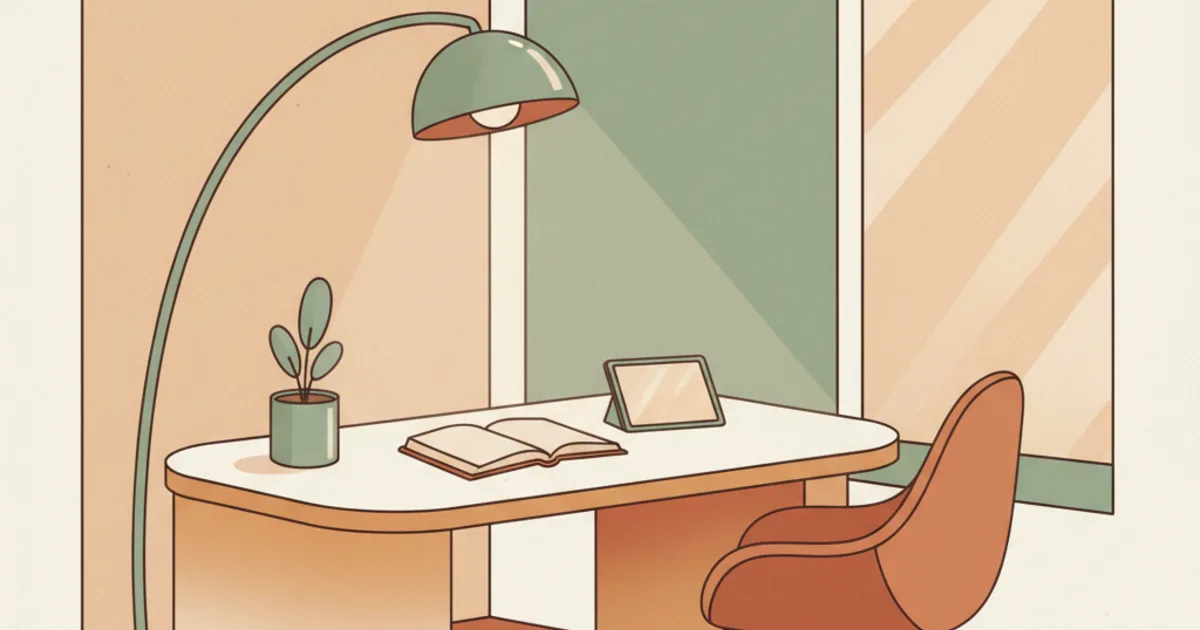
The most practical advice here is simple. Study near a window when you can. Open the curtains during the day. If your study space has no natural light, try to spend time outside during daylight hours to keep your circadian rhythm regulated.

Noise: The Difference Between Focused and Fragmented

Noise is complicated because the research doesn't point in one clean direction. Some noise can actually help with creative or divergent thinking tasks. But for the kind of focused, linear studying that most students need to do, noise is almost always working against you.

Open-plan study environments have been studied extensively. A 2017 review in the journal Ergonomics found that noise in open-plan settings significantly impaired performance on tasks requiring sustained attention. Students in noisy open-plan study spaces made more errors and reported higher levels of mental fatigue compared to students in quieter individual spaces.

The mechanism isn't mysterious. Noise competes for your cognitive bandwidth. Even sounds you aren't consciously aware of require processing resources.

Background conversations are particularly disruptive because they carry language content, which your brain tries to process even when you aren't paying attention. If someone nearby is speaking a language you understand, your brain is partially processing that speech whether you want it to or not.

White noise or instrumental background music can sometimes help by masking more unpredictable sounds. But this depends heavily on the individual and the task. For most students doing reading or problem sets, a quiet space is the goal.

If you can't get a quiet room, noise-canceling headphones are one of the most effective study investments you can make. They don't require changing your environment. They just remove the competition for your attention.

The Layered Problem

The hard part is that most bad study rooms are bad in more than one way.

The room is too warm. There's no window. The background noise is unpredictable. These factors do more than add together. They compound.

A student studying in a hot room with noise and poor lighting isn't dealing with three cute little annoyances. They're carrying one large drag on cognitive performance that they may not even recognize. They feel tired.

They feel less motivated. They don't connect these feelings to the room. They think they're lazy or need more caffeine.

This is why the environmental factors are so commonly missed. They don't announce themselves as problems. They show up as vague feelings of tiredness, difficulty concentrating, and the sense that studying is harder than it should be.

What You Can Actually Control

Most students have more control over their study environment than they assume. You may not be able to choose your classroom temperature, but you can choose where you study afterward.

Start with temperature. If you're feeling sluggish during study sessions and the room is warm, try cooling it down. Open a window, turn on a fan, or move to a cooler space. The effects are immediate. You may feel noticeably more alert within minutes.

Prioritize natural light. If your current study space lacks windows, try studying near one. If that isn't possible, make a point of getting outside during daylight hours. A thirty minute walk between study sessions does more for your alertness than a third cup of coffee.

Seek quiet or create it. A library is a study space specifically designed to minimize noise. A coffee shop isn't. If you need focused study time, choose accordingly. If quiet options are limited, noise-canceling headphones are worth the investment.

Keep your study space for studying. Mixing leisure and study in the same space trains your brain to be less focused in that space. If your bed is also where you scroll your phone, your brain associates the bed with leisure rather than focus. Keep study spaces as study spaces.

The Principle Behind All of This

There's a broader point under the tactics. Strong students are often systematic about the room in the same way they're systematic about the schedule.

They understand that cognitive performance comes from effort and conditions. Effort gets all the attention. Conditions quietly decide how far the effort goes.

You don't need a perfect study room. You need a room that's not fighting you.

Sometimes the highest-return change isn't a new technique or a new app.

It's moving to a different room.

Start there before buying another notebook.

Piply helps you build focused study sessions once you've picked the room. The room still matters.

Ready to try Piply?

Turn this article into your reality. Start studying faster today.

Try Piply for Free