 iOS App
  Android App
 Study tips
How to Focus When Studying: Why Your Brain Won't Stop Wandering
Ben Roe
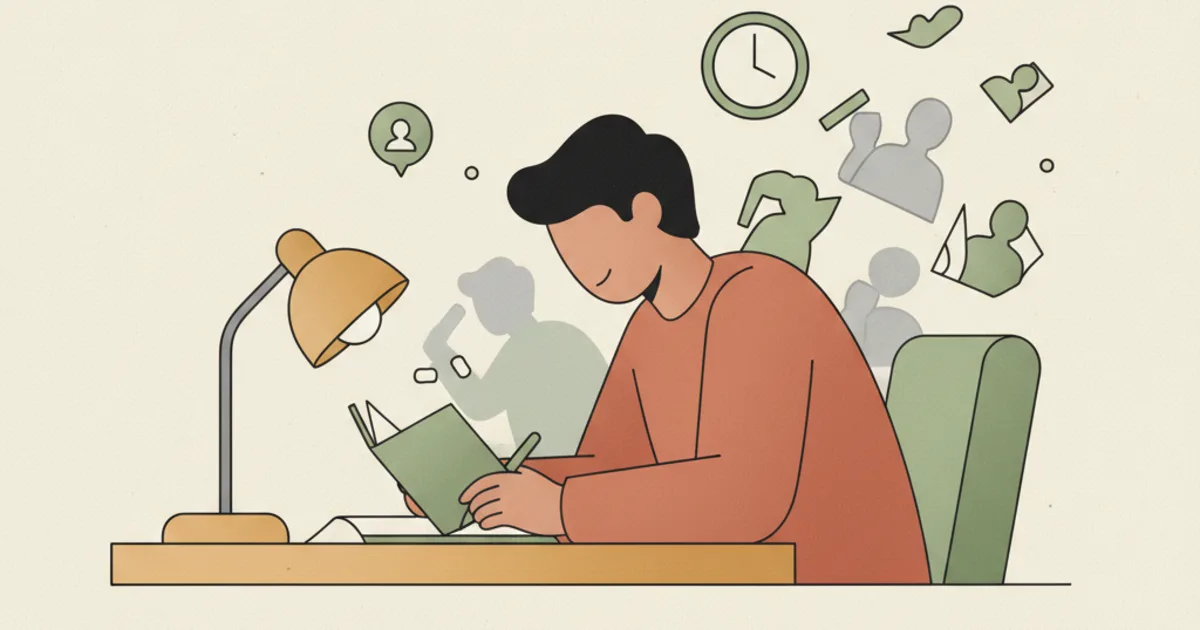
You open your textbook.
You've been planning this study session since yesterday. You read the first paragraph.
Something about a deadline next week surfaces in your mind. You think about what to text back. You read the second paragraph again because you didn't actually process the first one. Ten minutes have passed. You look at your notes and they look back at you like a foreign language. You close the book. You feel guilty.
There's a neurology problem hiding inside what students usually call motivation.
And it's far more common than the productivity content online lets on.
What Is Actually Happening Inside Your Brain
Every time you try to focus on a single task, two large networks in your brain are in competition. The first is the Task Positive Network, which activates during directed attention, problem-solving, and sustained mental effort. The second is the Default Mode Network, which activates during mind-wandering, self-referential thought, and memory consolidation. When you aren't doing anything in particular, the Default Mode Network is your brain's default state.
Research by Sophie Leroy, a management professor at the University of Washington, documented a phenomenon she called attention residue.
When you switch from one task to another, your attention doesn't follow immediately. Part of your cognitive capacity stays stuck on the previous task, even if you've consciously decided to move on.
This creates a split attentional state where part of your brain is here and part is still there, producing exactly the experience students describe: you're looking at the material but not processing it.
The practical consequence is that reading a paragraph while mentally rehearsing a conversation you had this morning isn't "mildly distracted." It's your brain running two separate processes simultaneously, both of them half-working. Nothing gets the full benefit of your attention, including the studying.
Most study advice online addresses the wrong side of this problem. It tells you to eliminate distractions, set intentions, or build better habits. Those aren't wrong, but they don't address the neurological mechanism that's making sustained focus feel impossible in the first place.
The Three Failure Points That Appear in Every Student Story
1. The Brain Resists Starting Because the Task Feels Too Big
The Zeigarnik effect describes how the brain keeps unfinished tasks in active memory.
This is useful in small doses. But when you sit down to study a subject you've been avoiding, the accumulated weight of all the unfinished sessions, unread chapters, and unworked problem sets creates a form of cognitive resistance that feels like dread.
Students describe this as "opening the book gives me anxiety" or "I know I should be studying but I physically can't make myself start." That response can be your brain reacting to a stack of unresolved open loops.
2. Sustained Focus Produces No Immediate Reward Signal
The dopamine system doesn't reward you for sitting still and reading. It rewards you for completing goals and receiving feedback. When you study passively, your brain registers effort but no progress signal.
Every few minutes it checks: is there a reward coming? No. Is there a reward coming? No. The brain starts scanning for other sources of feedback, which is why the pull toward your phone isn't a character flaw. Your brain is doing exactly what it evolved to do, which is seek immediate feedback.
This is why active recall changes the experience of studying. When you generate an answer from memory, the brain registers a micro-completion event. That small reward signal is enough to keep the Default Mode Network suppressed and the focus state active longer than passive reading will ever manage.
3. There Is No Structure for the Middle of the Session
Students receive advice for the beginning of study sessions and the end.
What about the middle, when you've been at it for twenty minutes and the material isn't sticking? Most advice doesn't give you a tool for this moment.
It tells you to push through or take a break. But "push through" produces diminishing returns because your cognitive resources are depleting, and "take a break" often turns into a thirty-minute scroll because no structure is enforcing the boundary.
What the Top Google Results Miss
Search "how to focus when studying" and you'll find articles that say: put your phone in another room, sleep more, eat better, use a planner, try the Pomodoro Technique. All of that's reasonable and mostly correct. But it's all upstream advice.
It addresses the conditions that support focus rather than the mechanism that produces it.
The student who is getting eight hours of sleep, has deleted Instagram, and still can't make it through a thirty-minute study session without their mind running in five directions isn't going to be helped by another article telling them to drink water and set an intention. Something more specific is happening, and the research on attention residue, Default Mode Network interference, and active retrieval gives us a more precise picture of what that's.
The Science-Backed Strategy for Getting and Staying Focused
Make the Entry Cost Extremely Small
Your brain resists starting when the perceived cost is high. The fix is to set a goal so specific and so small that the entry cost feels negligible.
Not "study for biology" but "read page 47 and write one question about it without looking at the book." One question. That's the entire goal. When you complete it, the Zeigarnik effect works in your favor: the brain registers a partial completion and wants to finish the pattern. You use that momentum for the second question.
Build Retrieval Into Every Study Block
Close the material and write what you can recall. Do this at least once per twenty-five minute block. Roediger and Karpicke's research on the testing effect showed that retrieval practice produces substantially better long-term retention than passive review. But it also does something for focus that passive review can't: it generates a micro-reward signal that keeps the Default Mode Network suppressed while you're in the session. The material starts to feel like progress instead of effort with no feedback.
Have a Specific Transition Ritual for Breaks
The break is where most Pomodoro-based study sessions fall apart.
Your brain leaves the material, finds something more immediately rewarding, and doesn't come back cleanly. The break needs a specific ritual: stand up, close the materials, set a five-minute timer, and do one physical action.
Not "relax" in the abstract. Stand up and get water. Or stretch. Or stand at the window. The ritual gives the brain a specific transition signal instead of leaving it to default to whatever is most immediately rewarding.
Track What You Covered, Not Just How Long You Studied
One of the reasons focus degrades over a study session and across the week is that nothing in the system tells you that you're advancing. A session log that records what you actually covered, how many recall rounds you completed, and how the material felt gives your brain a progress feed. The absence of this is what makes studying for five days straight start to feel pointless even when you've been productive.
Progress needs to be visible.
How Piply Approaches This
Piply is built around a study session model that uses a timer-based structure but with one critical difference: the work inside the session is designed to produce the reward signals your brain needs to stay engaged.
When you start a session, you're doing more than blocking time. You're working with recall-based study tasks that generate micro-completions as you move through the material. The session tracker records what you covered, which means you have a visible record of progress after each block instead of only knowing that time has passed.
The break system in Piply is structured to solve the specific problem of momentum loss. Rather than five minutes of unstructured downtime that your brain fills with your phone, the break is a defined window with a clean handoff back to the next study block.
The streak system tracks that you came back the next day. That isn't gamification for its own sake. Consistency is the mechanism by which the brain builds the neural pathways for focus as a skill rather than focus as a constant negotiation with your own brain.
Piply makes showing up the default rather than an act of willpower.
The gap between "knowing you should focus" and actually sustaining focus across a session and a week is mostly a structure problem. The research tells us what focus actually requires at the neurological level. Piply was built to make those requirements the default setup instead of leaving them as individual habits to engineer from scratch.
Put the ideas into practice
Use Piply to organize materials and practise what you’re learning.
Try Piply