 iOS App
  Android App
 Study tips
How to Build a Study Schedule That Actually Works (Not Just One You Feel Guilty About Breaking)
Andy Anderson
Picture this: it's Sunday night.
You have two exams and a paper due by Friday. You open a blank spreadsheet, block out "9 AM - Bio," "11 AM - History," "2 PM - Review," and feel an immediate surge of productivity.
You've scheduled.
For about twelve minutes, you're set.
By Tuesday, the spreadsheet is a ghost town and you're doom-scrolling at 11 PM wondering where it all went wrong.
Sound familiar? You're not lazy. The study schedule itself is broken.
Here's why the standard advice, "block your time and stick to it", fails most students, and what the science says actually works instead.
Why Most Study Schedules Collapse
The real snag is that most students build schedules around content coverage rather than memory retention.
Think about it. When you plan "study Bio 9-11 AM," you're thinking like a librarian: the goal is to get through the material.
But the goal should be: "have the material locked in my brain for the exam." Those are completely different plans.
This matters because of one of the most replicated findings in all of cognitive science: the spacing effect. Hermann Ebbinghaus discovered it in 1885. A century later, Roediger and Karpicke (2011) confirmed it again.
Distributed study, short sessions spread across days, produces dramatically better long-term retention than cramming everything into one marathon session.
But almost no student schedule reflects this. Instead, it's "I'll cover everything before the exam." That's not a study plan. That's a panic plan.
The Framework That Actually Works
Forget time-blocking as a productivity ritual. Instead, build a schedule around three questions:
1. What do you actually need to know? Before you touch your calendar, open your syllabus, last year's exam (if you can find it), and any study guides. Make a list of every topic that could show up. Be honest about what you actually understand vs. what you feel like you understand. That feeling is the enemy.
2. When will you review, more than "study"? There's a difference between reading notes and active retrieval. Your schedule should include specific review sessions, more than "study time." A review session means: close the book, write down everything you know about Topic X, check what you missed, repeat.
Cornell's own Learning Strategies Center puts it plainly: "Study at a regular time and in a regular place." The regularity is the point. Your brain learns the context. When you show up to the same desk at the same time to do the same thing, the routine itself becomes a retrieval cue.
3. Are you spacing it? Once you've "learned" something, you need to see it again at strategic intervals: 1 day later, 3 days later, 1 week later. This is the spaced repetition principle, and it's the single most underused study technique on any campus. Most students read something once, maybe twice, and call it done. That's why they feel like they understood it and then blank on exam day.
A Realistic Week-Long Framework
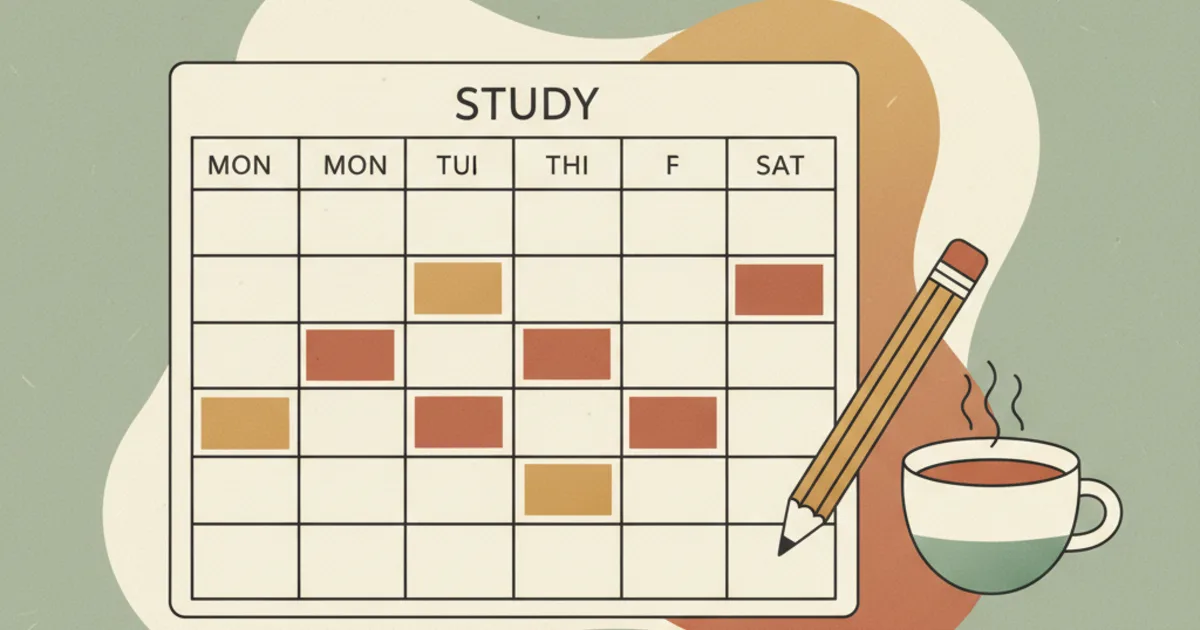
Here's what this looks like when you actually apply it. Say you have an exam on Friday. Here's your week:
Monday: Chunk your material into 4-5 topics. Spend the session on active processing, rewrite notes in your own words, create flashcards or practice questions for each chunk. Don't re-read. Transform.
Tuesday: Review Topic 1 and 2 using active recall. Can you answer questions on them without looking? If not, that's data. Flag what you don't know and return to it.
Wednesday: Review Topics 3 and 4 + a quick 10-minute pass on Topics 1-2. Switch between subjects, interleaving actually improves retention, according to a 2024 meta-analysis in Educational Psychology Review.
Thursday: Full practice test or "blank page" test on everything. Force retrieval on all topics. Whatever you can't produce, that's what you focus on in your remaining review time. Sleep at least 7 hours.
Friday: Exam day. But your Thursday session was basically a mock exam, so the material is still fresh.
This is close to what the Learning Strategies Center at Cornell recommends. The "Five-Day Study Plan" breaks material into chunks and alternates preparation with review across days, exactly the pattern the spacing effect predicts.
Why Students Don't Do This
If this is all well-known, why does it still fail?
Three reasons:
First, it feels slower. Cramming feels like you're doing more. Spaced review at regular intervals feels like you're "only studying a little bit." But that feeling is backwards. Cramming produces fast forgetting. Distributed review produces durable knowledge.
Second, it requires starting early. Spacing only works if you've time to spread. Students who start the week of the exam literally can't use this method. The students who build weekly schedules, more than pre-exam schedules, are the ones who always have time.
Third, accountability. This is where most schedules break down. Not because students don't know what to do, but because there's no one and nothing enforcing the sessions. You write "review Bio flashcards 6-7 PM" on a notepad, and then... nothing happens if you skip it. The spreadsheet has no opinion.
Where Piply Fits In
This is exactly the problem Piply's Study Sessions feature was built to solve.
A study schedule only works if you actually sit down and do the work. Study Sessions builds your weekly review schedule automatically, factoring in spaced repetition so that you're always reviewing material at the right interval, more than when you feel like it. You get a timer, a structured session, and a streak system that makes showing up feel rewarding even when you don't want to.
That's the gap the productivity YouTubers don't fill. They tell you to "make a schedule." Piply makes sure you actually keep it.
Start Smaller Than You Think
If you're reading this because you have an exam in a week and feel behind, start today with one 45-minute session on the hardest topic. Not a full schedule. One session.
The schedule can come later. The habit of showing up is what matters. Build that first, and the calendar will handle itself.
Piply makes the showing up part automatic. Structure your sessions, track your review intervals, and build the habit before your next exams hit.
Put the ideas into practice
Use Piply to organize materials and practise what you’re learning.
Try Piply